
Can You Climb K2 Without Oxygen? Expert Insights From Summiteers
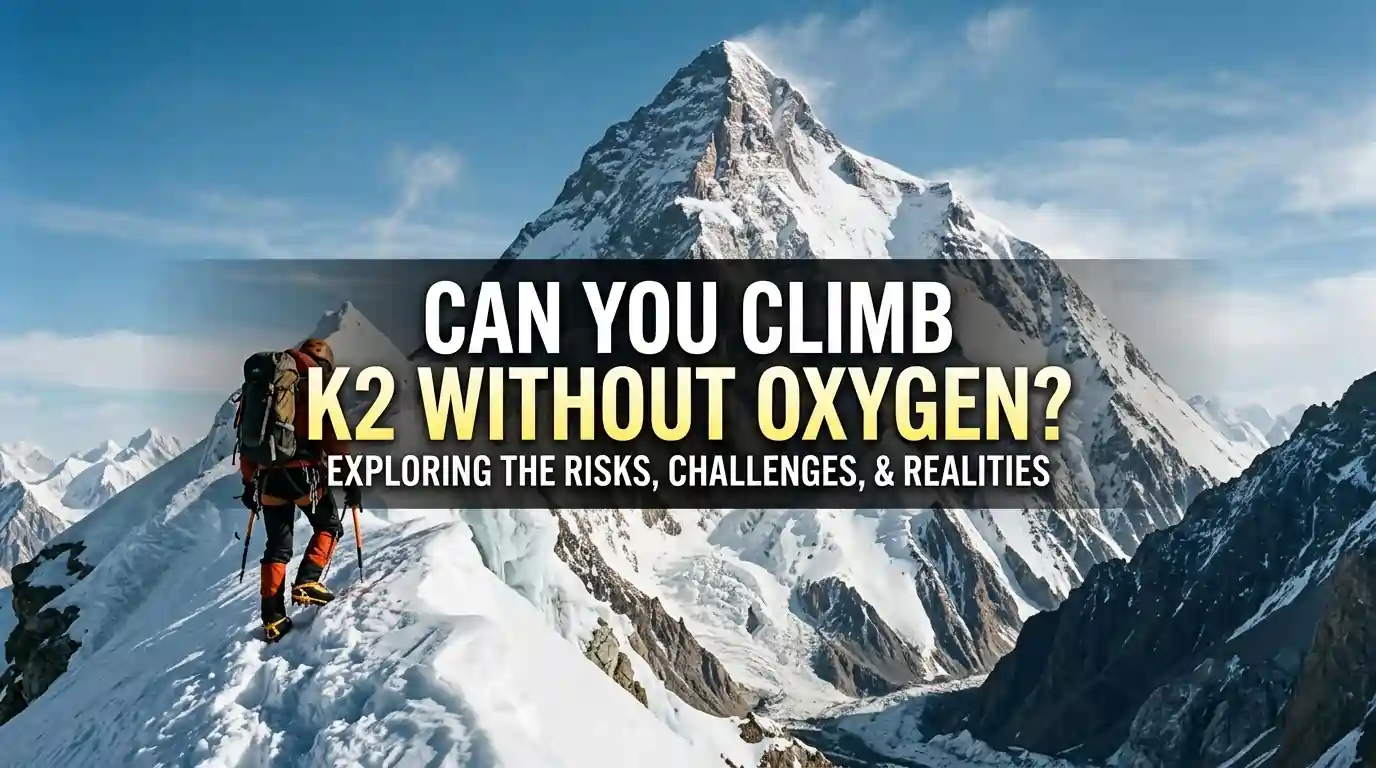
Standing at 8,611 meters above sea level, K2’s summit pushes human survival to its absolute limit. The air is so thin that your lungs take in only one-third of the oxygen available at sea level, forcing most climbers to rely on bottled oxygen just to stay alive. Yet a rare group of elite mountaineers have defied these odds, reaching the top breathing nothing but the thin Himalayan air around them.
In this blog about K2 Expedition, can you climb K2 without oxygen, we explore one of mountaineering’s most dangerous and exclusive achievements. You’ll discover why fewer than 50 people have succeeded since 1979, what makes oxygen-free K2 climbing so deadly, who has accomplished this extraordinary feat, and the years of experience required before anyone should even consider attempting it.
Can You Climb K2 Without Supplemental Oxygen?
Yes, climbing K2 without supplemental oxygen is possible, but only a handful of elite mountaineers have ever done it. The list of successful oxygen-free K2 summiters spans over four decades and remains remarkably short, which tells you everything about how difficult this achievement really is.
Supplemental oxygen refers to bottled oxygen carried in cylinders and delivered through a mask system. On K2 mountain, most guided expeditions provide 3-4 cylinders per climber for the summit push. Without this support, climbers face dramatically increased risks of hypoxia (oxygen deprivation), frostbite, and cognitive impairment that can lead to fatal decision-making errors.
The vast majority of K2 climbers use bottled oxygen, and for good reason. Above 8,000 meters, oxygen levels drop to roughly one-third of what you’d breathe at sea level, and the human body simply cannot adapt to these conditions.
Why K2 Without Oxygen Is So Dangerous?
Climbing K2 without supplemental oxygen is dangerous because your body cannot function properly above 8,000 meters, where oxygen levels drop to one-third of sea level. The extreme altitude causes severe cognitive impairment, dramatically slower movement through hazardous sections like the Bottleneck, increased frostbite risk in temperatures below -40°C, and virtually no rescue options if something goes wrong. Your body begins deteriorating immediately in the death zone, consuming its own muscle tissue while your decision-making abilities become dangerously compromised. These combined factors make oxygen-free K2 climbing one of mountaineering’s deadliest challenges.
1. The Death Zone Above 8,000 Meters
Above 8,000 meters, atmospheric pressure drops so low that your body cannot acclimatize, it can only deteriorate. Mountaineers call this threshold the “death zone” because your cells receive insufficient oxygen regardless of how long you spend at altitude.
Without supplemental oxygen, climbers experience severe cognitive impairment: memory loss, confusion, inability to make simple decisions, and a distorted sense of time. The body begins consuming its own muscle tissue for energy, and even basic tasks like clipping a carabiner become extraordinarily difficult.
2. The K2 Bottleneck
The Bottleneck is K2’s most notorious feature, a steep, narrow couloir at approximately 8,200 meters that sits directly beneath massive hanging seracs. Seracs are unstable ice cliffs that can collapse without warning, and climbers typically spend 2-4 hours navigating this section.
Without supplemental oxygen, climbers move significantly slower through the Bottleneck. What might take 2 hours with oxygen can stretch to 4 or more without it, doubling exposure time in one of the most dangerous sections of any 8,000-meter peak.
3. Extreme Cold and Unpredictable Weather
K2’s summit temperatures regularly drop below -40°C, with wind chill pushing effective temperatures even lower. Without supplemental oxygen, the body’s ability to generate heat decreases dramatically, making frostbite almost inevitable during extended summit pushes.
Weather windows on K2 are notoriously short and unpredictable compared to Everest. A climber moving slowly without oxygen may find themselves caught in deteriorating conditions with no margin for error.
4. Limited Rescue and Emergency Options
At K2’s upper elevations, helicopter rescue is impossible due to extreme altitude and technical terrain. If something goes wrong above Camp 4, climbers are entirely dependent on their own abilities and those of their teammates.
Without supplemental oxygen, the cognitive decline that accompanies hypoxia makes self-rescue decisions increasingly unreliable. Climbers may not recognize they’re in trouble until it’s too late to descend safely.
How K2 Without Oxygen Compares to Everest?
While Everest stands taller at 8,849 meters, experienced mountaineers consistently rank K2 as harder to climb than its taller neighbor. K2’s steeper technical terrain, unpredictable weather patterns, and minimal infrastructure create challenges that exceed Everest’s greater elevation. The mountain’s notorious reputation as the “Savage Mountain” reflects these compounded difficulties that make it objectively more demanding than its taller neighbor.
| Factor | K2 | Everest |
| Summit elevation | 8,611m | 8,849m |
| Technical difficulty | Steeper, more technical terrain | Less technical, established fixed lines |
| Weather predictability | Short, unpredictable windows | Longer, more predictable windows |
| Infrastructure and support | Minimal | Well-established camps and routes |
K2’s steeper terrain demands more technical climbing skill, and the mountain offers fewer rest opportunities during summit pushes. The shorter weather windows mean climbers have less margin for the slower pace that oxygen-free climbing requires.
While Everest has seen dozens of oxygen-free summits since Reinhold Messner and Peter Habeler’s pioneering 1978 ascent, K2’s oxygen-free summit list remains remarkably short.
Who Was the First Person to Summit K2 Without Oxygen?
Reinhold Messner became the first person to summit K2 without oxygen in 1979, just one year after proving oxygen-free climbing was possible on Everest. His achievement challenged the long-held belief that humans couldn’t survive at extreme altitude without bottled support. Since then, fewer than 50 climbers have repeated this extraordinary feat, making it one of mountaineering’s rarest accomplishments. The list includes legendary alpinists like Jerzy Kukuczka, Wanda Rutkiewicz, and most recently Nirmal Purja, who achieved the first winter K2 summit without oxygen in 2021.
1. Reinhold Messner and the 1979 Oxygen-Free Summit
Reinhold Messner, widely considered the greatest mountaineer in history, reached K2’s summit without supplemental oxygen in 1979. This came just one year after he had proven oxygen-free climbing was possible on Everest, challenging the long-held belief that humans couldn’t survive at extreme altitude without bottled support.
2. Nirmal Purja and the Historic Winter Ascent
In January 2021, Nirmal “Nims” Purja made history as part of the first team to summit K2 in winter, and he did it without supplemental oxygen. The Nepali climber, a former British Special Forces soldier, had already gained fame for his “Project Possible” campaign.
Purja’s winter K2 achievement stands apart because winter conditions on the mountain are exponentially more severe. Temperatures can drop below -60°C with wind chill, and the already-short weather windows shrink to mere hours.
3. Other Notable Oxygen-Free K2 Summiters
The list of climbers who’ve reached K2’s summit without supplemental oxygen includes:
- Liv Sansoz: French alpinist who summited without oxygen in 2022, then paraglided from high on the mountain
- Jerzy Kukuczka: Polish mountaineer who completed an oxygen-free ascent via a new route in 1986
- Wanda Rutkiewicz: First woman to summit K2 in 1986, achieved without supplemental oxygen
The brevity of this list, spanning over four decades, illustrates just how exceptional oxygen-free K2 climbing remains.
How to Train for Climbing K2 Without Oxygen?
Training for an oxygen-free K2 attempt requires 10-15 years of progressive high-altitude experience, starting with lower peaks and gradually building to multiple 8,000-meter summits. This is not a goal for intermediate mountaineers. It represents the culmination of a lifetime dedicated to extreme altitude climbing. You need to develop exceptional cardiovascular capacity, master technical climbing skills, and gain extensive experience managing your body’s response to oxygen deprivation before even considering such an attempt.
1. Building Extreme Cardiovascular Endurance
Oxygen-free climbing at extreme altitude demands cardiovascular efficiency that goes far beyond standard K2 training protocols. Elite alpinists targeting oxygen-free 8,000-meter summits typically train with VO2 max protocols, extended duration aerobic sessions lasting 4-6 hours, and altitude simulation through hypoxic tents.
The goal isn’t just fitness, it’s teaching your body to function efficiently with dramatically reduced oxygen availability.
2. Altitude Acclimatization Strategies
Proper acclimatization for an oxygen-free K2 attempt typically involves spending extended periods above 7,000 meters in the weeks before the summit push. The “climb high, sleep low” principle applies, but at a much more aggressive scale than standard guided expeditions.
Some climbers spend 60-90 days on the mountain before attempting the summit, making multiple acclimatization rotations to progressively higher camps. This extended acclimatization allows the body to maximize red blood cell production, though true acclimatization above 8,000 meters remains physiologically impossible.
3. Mental Preparation for Oxygen-Deprived Conditions
Perhaps the most underappreciated aspect of oxygen-free climbing is psychological preparation. At extreme altitude without supplemental oxygen, climbers experience cognitive impairment that affects judgment, memory, and emotional regulation.
Experienced oxygen-free climbers establish predetermined turnaround times and conditions before leaving high camp, knowing they may not be capable of making rational decisions later.
Conditions Required for a Successful Oxygen-Free K2 Summit
An oxygen-free K2 summit demands more than just physical preparation. You need environmental conditions that align perfectly with human survival limits at extreme altitude. Weather windows, temperature thresholds, and your body’s acclimatization status must all converge at the right moment. Without this precise alignment of conditions, even the most experienced climbers cannot safely attempt the summit without supplemental oxygen.
1. Ideal Weather Windows
K2’s weather windows are notoriously short, sometimes just 12-24 hours of climbable conditions before storms return. For oxygen-free attempts, these windows become even more critical because slower climbing speeds mean longer exposure.
Climbers targeting oxygen-free summits often wait at high camps for extended periods, watching forecasts and waiting for the rare convergence of low winds, moderate temperatures, and stable conditions.
2. Temperature Thresholds for Oxygen-Free Climbing
Experienced oxygen-free climbers often establish personal temperature limits below which they won’t attempt the summit. Summit day temperatures on K2 typically range from -25°C to -40°C, meaning acceptable windows are rare.
Wind chill can push effective temperatures 20-30 degrees lower, further narrowing the margin for safe climbing.
3. Physical Readiness Indicators
Before committing to an oxygen-free summit attempt, climbers look for specific signs that their body has acclimatized as fully as possible:
- Resting heart rate at altitude: Stabilized at a manageable level, not persistently elevated
- Sleep quality: Ability to sleep reasonably well at high camps
- Appetite and digestion: Body functioning normally, able to eat and process food
- Mental clarity: No persistent confusion, headaches, or cognitive fog
Experience and Skills Required Before Attempting K2 Without Oxygen
Attempting K2 without supplemental oxygen isn’t a goal for intermediate or even advanced mountaineers, it’s reserved exclusively for elite alpinists who’ve spent decades building experience on the world’s highest peaks. This achievement represents the culmination of a lifetime dedicated to extreme altitude climbing, requiring not just exceptional physical conditioning and preparation but also the judgment and technical mastery that only years of 8,000-meter expeditions can develop.
The prerequisite experience includes:
- Multiple 8,000-meter summits: Prior experience on at least several 8,000-meter peaks, typically with supplemental oxygen initially
- Technical ice and mixed climbing: Advanced proficiency on steep, exposed terrain in all conditions
- Previous oxygen-free high-altitude experience: Successful summits of lower 8,000-meter peaks without oxygen
- Self-rescue capabilities: Ability to navigate and descend in an impaired cognitive state
For climbers building toward high-altitude objectives, Nepal’s trekking peaks and 6,000-meter summits provide essential foundational experience. Peaks like Island Peak (6,189m) offer technical climbing challenges at altitude while developing the judgment that more serious objectives demand.
Safety Protocols for Oxygen-Free High-Altitude Climbing
Elite climbers attempting oxygen-free K2 ascents rely on rigorous safety protocols that can mean the difference between survival and death. These protocols include constant monitoring of vital signs, predetermined turnaround times established before cognitive impairment sets in, and emergency descent procedures that don’t depend on rational decision-making at extreme altitude. Without these systematic safeguards, even the most experienced mountaineers face dramatically increased risks in the death zone.
1. Monitoring Vital Signs at Extreme Altitude
Modern climbers use pulse oximeters to track blood oxygen saturation throughout their ascent. While readings become less reliable at extreme altitude, they provide valuable data about how the body is responding.
Experienced partners watch each other for signs of deterioration that the affected climber might not recognize in themselves.
2. Recognizing Early Signs of Hypoxia
Warning signs that indicate dangerous oxygen deprivation include:
- Confusion and poor judgment: Difficulty making simple decisions or following established plans
- Slurred speech: Communication becomes impaired or nonsensical
- Loss of coordination: Stumbling, inability to clip carabiners, fumbling with equipment
- Visual disturbances: Tunnel vision, blurred vision, or seeing things that aren’t there
2. Emergency Descent and Evacuation Procedures
The only reliable treatment for severe altitude illness is immediate descent. Oxygen-free climbers establish predetermined turnaround times and conditions before leaving high camp, creating decision frameworks that don’t rely on impaired judgment.
Most K2 fatalities occur during descent, when climbers are exhausted, oxygen-deprived, and facing technical terrain in deteriorating conditions.
Start Your High-Altitude Climbing Journey in Nepal
For climbers inspired by the achievements of elite alpinists on K2, the path forward begins with building foundational experience on progressively challenging objectives. Nepal’s peaks offer an ideal training ground, and working with the best expedition and trekking company in Nepal helps you progress safely, from trekking peaks like Island Peak (6,189m) to more serious objectives that develop technical skills and altitude tolerance.
The journey to extreme altitude is measured in years, not months. Each expedition builds judgment, technical proficiency, and understanding of how your body responds to thin air.
Explore Our Adventures to find guided expeditions that prepare you for high-altitude challenges.
FAQs About Climbing K2 Without Oxygen
How many climbers have successfully summited K2 without supplemental oxygen?
Estimates suggest fewer than 50 climbers have achieved this feat since Reinhold Messner’s pioneering 1979 ascent. This represents a tiny fraction of total K2 summits, making oxygen-free success one of mountaineering’s rarest accomplishments.
How long can a climber survive in the K2 death zone without supplemental oxygen?
The human body deteriorates rapidly above 8,000 meters without supplemental oxygen. Extended time in the death zone, typically more than 24-48 hours, dramatically increases the risk of death or permanent injury.
Do high-altitude Sherpas use supplemental oxygen when climbing K2?
While Sherpas are exceptionally well-acclimatized due to genetic adaptations and lifetime exposure to altitude, most still use supplemental oxygen on K2 summit pushes. This maintains their strength, speed, and cognitive function, essential for their own safety and their ability to assist clients.
Can an intermediate mountaineer attempt K2 without supplemental oxygen?
No. Oxygen-free K2 attempts are exclusively the domain of elite alpinists with extensive 8,000-meter experience. Intermediate climbers benefit most from building foundational high-altitude skills on lower peaks first.
Has K2 ever been summited in winter without supplemental oxygen?
Yes. In January 2021, a Nepali team achieved the first winter summit of K2, with Nirmal “Nims” Purja notably reaching the top without using supplemental oxygen.

Ready for your next Himalayan adventure?
Plan Your Next Big Adventure with Us
Explore Our AdventuresJoin our expert-guided journeys across Nepal and beyond, from classic trails to epic summits.