
Is K2 Expedition Harder Than Everest Expedition? A Complete Guide
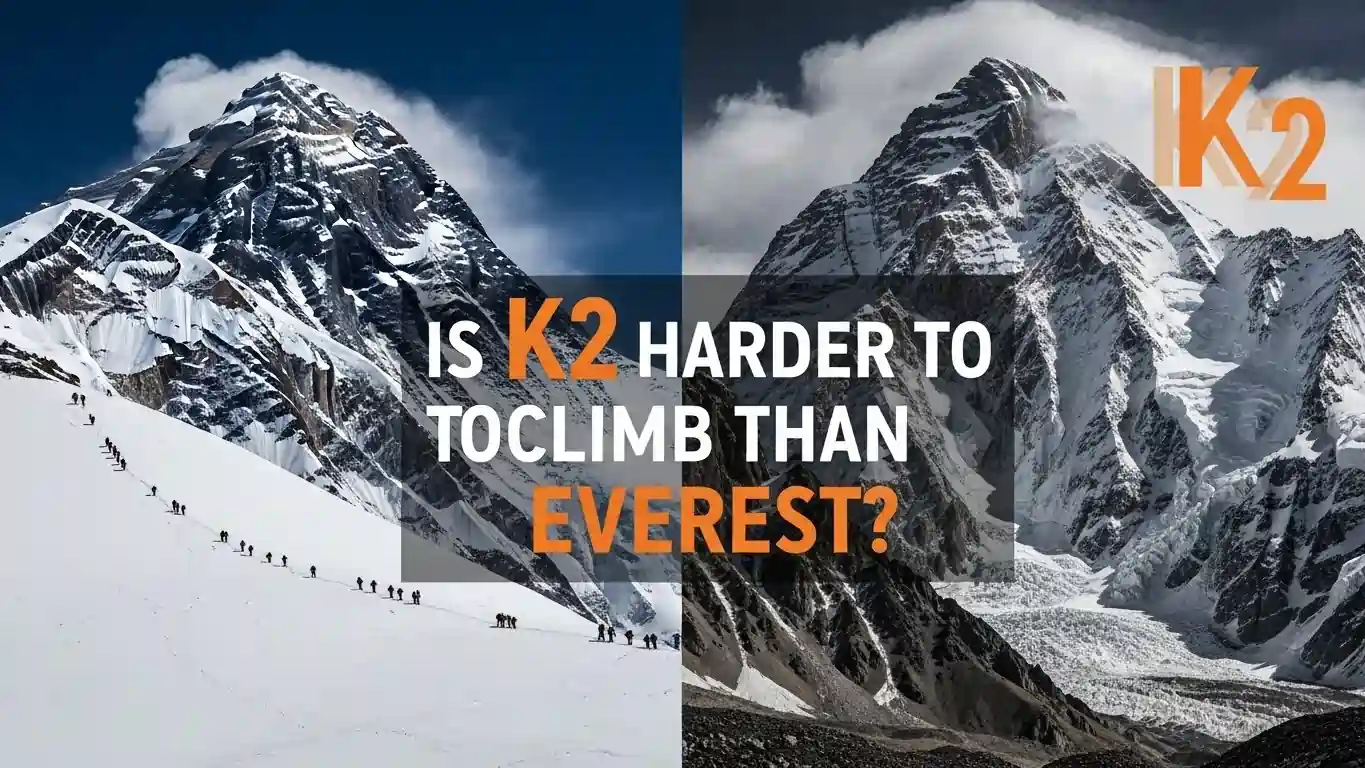
Ever wondered why climbers call K2 the “Savage Mountain” and consider it more dangerous than Everest? Many adventure seekers struggle to decide which peak to attempt first due to differences in technical difficulty, weather, and risk.
In this blog, is K2 harder to climb than Everest is explored in detail. We compare climbing routes, altitude challenges, weather conditions, expedition duration, fatalities, and necessary preparation. This guide also explains which peak suits different experience levels and what makes K2 notoriously challenging compared to Everest, helping climbers make an informed decision before attempting these iconic Himalayan mountains.
What Makes a Mountain Difficult to Climb?
What makes a mountain difficult to climb is a combination of altitude, terrain, weather, and logistical challenges rather than height alone. While many people dream of summiting the best mountains to climb in the world, these peaks demand immense physical endurance, technical skills, and mental resilience. Steep gradients, crevasses, and unstable surfaces increase risk, while unpredictable weather can turn even manageable trails into life-threatening situations. Long expeditions on these famous summits require careful planning for food, oxygen, and shelter.
Other factors include acclimatization needs, remoteness, and rescue availability. Even experienced climbers face challenges when weather shifts, ice breaks, or winds intensify. Mountains like K2 and Everest test both physical capability and decision-making under extreme conditions.
Why difficulty depends on more than height?
Mountain height alone does not determine climbing difficulty. Technical terrain, steep slopes, rock and ice conditions, and exposure to extreme weather significantly impact challenge level. Logistics, accessibility, and risk of avalanches or crevasses further influence how hard a peak feels. Even slightly lower mountains can demand more skill than taller but easier peaks.
Overview of Mount Everest
Mount Everest, the world’s tallest peak at 8,848.86 meters, sits on the Nepal-Tibet border. It attracts climbers from across the globe due to its fame and achievable logistics compared to other high peaks. The mountain offers two main routes for ascents: the South Col route from Nepal and the North Col route from Tibet, both with well-established trails and camps. An Everest expedition benefits from decades of climbing experience, infrastructure, and support systems that make summiting more accessible than technically harder peaks like K2.
Height, location, and climbing routes of Everest
Where is Everest? Everest rises to 8,848.86 meters (29,032 feet) and lies in the Himalayas, forming a natural border between Nepal and Tibet. The South Col route starts from Everest Base Camp in Nepal, passing through Khumbu Icefall, Camp I, II, III, and IV to the summit. The North Col route in Tibet features a longer approach, technical ridges, and harsher winds. Both routes require acclimatization, careful planning, and navigation of dangerous terrain.
Everest climbing conditions and infrastructure
Everest expeditions use fixed ropes, ladders, and established camps to aid climbers. Supplemental oxygen is commonly used above 7,500 meters to combat extreme altitude. Commercial expeditions provide guides, Sherpa support, and logistical management, including meals, tents, and permits. While infrastructure eases climbing, risks like avalanches, crevasses, and unpredictable weather remain, requiring experience and vigilance for safe ascents.
Overview of K2
K2, the second-highest mountain in the world at 8,611 meters, lies in the Karakoram range along the Pakistan-China border. Unlike Everest, K2 is far more remote and technically demanding, attracting only highly experienced climbers. Its steep, icy slopes, unpredictable weather, and lack of extensive commercial infrastructure make a k2 expedition extremely challenging. K2 has several climbing routes, with the Abruzzi Spur being the most popular, while alternative routes pose higher technical difficulty and greater risk.
Height, location, and climbing routes of K2
Where is K2 mountain? K2 rises to 8,611 meters (28,251 feet) in the rugged Karakoram range, straddling the border between Pakistan and China. The Abruzzi Spur route is the most commonly attempted, featuring steep snow and ice sections, rock bands, and high-altitude camps. Alternative routes, like the North Ridge or Cesen Route, are rarely attempted due to extreme technical difficulty and exposure. Unlike Everest, there is minimal fixed infrastructure, making route finding and climbing more challenging.
K2 climbing conditions and terrain challenges
K2’s slopes consist of steep ice, mixed rock, and snow, requiring advanced technical skills. Climbers face extreme exposure, frequent avalanches, and harsh weather conditions that can change within hours. The mountain offers a very limited margin for error; even minor mistakes can be fatal. Unlike Everest, K2 has fewer established camps and limited Sherpa or commercial support, making each expedition highly demanding and risky.
Is K2 Harder to Climb Than Everest?
Yes, K2 is harder to climb than Everest due to its extreme technical difficulty, unpredictable weather, and remote location. Unlike Everest, K2 has steeper slopes, fewer fixed ropes, and minimal commercial support. Climbers face higher risk, greater exposure, and a narrow margin for error, making each ascent more challenging and dangerous.
Direct comparison of technical difficulty
K2 requires advanced ice and rock climbing skills, including steep mixed terrain and knife-edge ridges. Everest, while high, has more fixed ropes, ladders, and established camps. Technical obstacles on K2 are continuous, whereas Everest allows sections of moderate trekking, making K2 more physically and mentally demanding. Additionally, K2’s climbing conditions demand precise route finding, leaving little room for improvisation.
Success rates and fatality ratios
K2 has a success rate of around 25–30%, significantly lower than Everest’s 50–60% for guided expeditions. Fatality ratio for K2 is roughly 25%, compared to Everest’s 1–2% for commercial climbs. This highlights K2’s reputation as a peak where only highly skilled and prepared climbers succeed. Harsh weather and limited rescue options further increase mortality risks on K2.
Risk level and error tolerance
K2’s extreme terrain and rapid weather changes allow very little room for mistakes. Minor slips or misjudgments can be fatal. Everest provides more safety nets through Sherpa support, fixed ropes, and oxygen. On K2, climbers must rely heavily on experience, precise planning, and constant vigilance to survive. Even seasoned mountaineers report that a single misstep can turn a climb into a life-threatening situation.
K2 vs Everest: Technical Difficulty Comparison
Many prospective climbers ask, is Everest expedition scary compared to its more rugged neighbor? While K2 is widely regarded as more technically demanding due to its steep slopes, mixed rock and ice sections, and minimal fixed support, Everest presents its own unique psychological and physical terrors. Climbers face continuous challenges requiring advanced mountaineering skills on K2, whereas Everest, though higher in altitude, has more established routes, fixed ropes, and ladders. Comparing the two peaks highlights how technical difficulty, rather than altitude alone, often determines the overall climbing challenge.
Steepness, rock, and ice climbing demands
K2 features long, exposed rock and ice ridges that require expert climbing techniques. Steep sections such as the Bottleneck demand precise footwork and rope management. Everest’s South Col and North Col routes involve steep ice and snow but include fixed ladders and ropes, easing navigation. Overall, K2 requires constant technical engagement, while Everest allows short breaks on less demanding sections.
Objective dangers on both mountains
Both mountains present serious objective hazards, including avalanches, falling seracs, and unstable ice. K2 has more exposed fall zones with narrower ridges, increasing risk. Everest faces high-risk areas like the Khumbu Icefall and Hillary Step, but extensive route preparation mitigates some dangers. Climbers on K2 have limited rescue options, meaning hazards can be far more unforgiving, making risk management critical at every stage.
Weather and Climbing Windows
Weather plays a decisive role in climbing both Everest and K2, often determining success or failure. Everest benefits from more predictable conditions with defined climbing windows in spring and autumn, while K2 faces harsher, less predictable weather. Sudden storms, high winds, and extreme cold make K2 expeditions shorter and riskier. Understanding seasonal patterns and summit windows is critical for planning safe ascents on both peaks.
Weather patterns on Mount Everest
Everest experiences two main climbing seasons: spring (April-May) and autumn (September-October). Jet streams at high altitude create predictable low-wind windows, allowing climbers to attempt the summit safely. Temperatures are extreme but manageable with proper gear and supplemental oxygen. Overall, Everest’s weather is more stable than K2, giving climbers a higher probability of clear skies and summit success.
Extreme weather risks on K2
K2 is notorious for sudden, violent storms that can strike without warning. High winds, heavy snowfall, and avalanches are common, creating a very narrow climbing window. Unlike Everest, K2 offers no extended calm period for summit attempts, requiring climbers to act quickly. These unpredictable conditions contribute to its high fatality rate and technical difficulty, demanding advanced experience and constant vigilance.
Altitude vs Technical Skill: Which Matters More?
Both altitude and technical skill are critical in high-altitude mountaineering, but their importance varies between Everest and K2. Everest’s extreme height challenges physical endurance and oxygen management, while K2 demands advanced climbing techniques even at slightly lower altitudes. Choosing which factor matters more depends on the climber’s experience: Everest tests stamina and acclimatization, whereas K2 tests technical ability and decision-making under high-risk conditions.
Oxygen dependency on Everest
Climbers on Everest often rely on supplemental oxygen above 7,500 meters to cope with thin air and extreme altitude. Oxygen use reduces fatigue, lowers risk of altitude sickness, and improves summit success rates. While some experienced mountaineers attempt Everest without oxygen, most guided expeditions make it a standard safety measure. Proper oxygen planning can be the difference between a safe summit and life-threatening exhaustion.
Technical precision required on K2
K2 requires precise technical skills for ice, rock, and mixed climbing, even at lower altitudes compared to Everest. Climbers navigate steep ridges, knife-edge sections, and unstable snow, where errors can be fatal. Unlike Everest, K2 offers minimal fixed ropes or ladders, demanding constant skill and judgment throughout the climb. Each pitch on K2 can present new technical challenges, making sustained focus critical.
Physical endurance vs climbing skill
Everest emphasizes physical endurance, acclimatization, and mental resilience for long ascents over multiple camps. K2 emphasizes climbing skill, balance, and risk management on continuous technical terrain. Success on Everest can be aided by support infrastructure, while K2 rewards experience, skill, and precise decision-making at every stage. Climbers often find K2 requires higher stamina under sustained technical pressure compared to Everest’s longer but less technical route.
Fatality Rates and Safety Records
Fatality rates and safety records highlight why K2 is considered far more dangerous than Everest. While Everest sees thousands of climbers each year, its infrastructure, support teams, and predictable weather reduce risk. K2’s remote location, extreme technical terrain, and sudden storms contribute to a significantly higher death rate. Understanding these statistics helps climbers evaluate risk and prepare adequately before attempting either peak.
Death rate on Mount Everest
Deaths on Everest have remained a major concern for the climbing community, though the mountain currently maintains a relatively low death rate of around 1–2% for commercial expeditions. Most fatalities result from altitude sickness, avalanches, falls, or exhaustion during summit pushes. Crowded sections, particularly in the Khumbu Icefall or near the Hillary Step, can also increase risk. Safety measures such as fixed ropes, oxygen, and Sherpa guidance mitigate many dangers, making Everest more accessible for climbers. Additionally, the availability of rescue helicopters and medical support further lowers mortality compared to remote peaks like K2.
Death rate on K2
K2 has a historical death-to-summit ratio of approximately 25%, much higher than Everest. The mountain’s steep faces, narrow ridges, and frequent avalanches leave little margin for error. Sudden weather changes and technical challenges contribute to its nickname, the “Savage Mountain.” Rescue operations are difficult due to K2’s remoteness, making every expedition highly perilous and requiring expert skills and experience. Furthermore, delayed help and limited communication increase the consequences of mistakes, adding to the mountain’s deadly reputation.
Logistics, Support, and Rescue Possibilities
Logistics, support, and rescue capabilities play a crucial role in the relative safety of Everest versus K2. Everest benefits from extensive infrastructure, established base camps, and professional expedition support, allowing faster evacuation and better emergency care. K2’s remoteness and technical terrain limit rescue possibilities, requiring climbers to be highly self-reliant and prepared for extended periods without external help. Understanding these differences is key to assessing risk before attempting either peak.
Rescue and evacuation on Everest
Everest has relatively accessible helicopter evacuation options from Base Camp and intermediate camps for medical emergencies. Organized rescue systems include coordinated Sherpa teams, high-altitude guides, and communication networks to respond quickly to accidents. Many commercial expeditions provide medical staff and oxygen for rapid intervention. Even at higher camps, rescue operations are feasible, though weather can delay response. The presence of these systems significantly reduces fatality risk compared to more isolated peaks.
Limited rescue options on K2
K2’s extreme remoteness and steep, technical terrain make rescue operations extremely difficult. Helicopters cannot easily access higher camps, and weather often prevents immediate assistance. Climbers must rely heavily on self-sufficiency, careful planning, and team coordination for emergencies. Limited communication and sparse infrastructure mean delayed evacuation can be life-threatening. Every expedition requires climbers to manage high-altitude injuries, equipment failure, and sudden storms with minimal external support.
Which Mountain Is More Dangerous Overall?
K2 is more dangerous overall because of its extreme technical difficulty, unpredictable weather, and limited rescue options. While Everest presents altitude-related challenges and crowding risks, K2 combines steep, exposed terrain with sudden storms and minimal support. Fatality rates, narrow climbing windows, and continuous technical obstacles make K2 far riskier for even experienced mountaineers. Careful preparation, advanced skills, and risk awareness are essential for anyone attempting K2.
Objective danger vs human factors
Objective dangers on K2 include avalanches, rockfall, ice seracs, and narrow ridges with little margin for error. Everest’s dangers are partly mitigated by fixed ropes, ladders, and established routes. Human factors, such as crowding, decision-making under fatigue, and overconfidence, influence risk on both peaks. On K2, objective hazards dominate due to its raw, exposed terrain and lack of infrastructure, making human errors far more consequential.
Risk tolerance comparison
Everest allows climbers some flexibility with oxygen use, Sherpa support, and gradual acclimatization. K2 demands extreme technical skill and mental resilience, tolerating minimal mistakes. Climbers must weigh personal experience, endurance, and ability to handle continuous risk before attempting K2. Risk tolerance for K2 is significantly lower, and mistakes can have immediate life-threatening consequences.
Why danger perception differs
Many perceive Everest as more dangerous due to its height and crowds, but statistics show otherwise. K2’s remote location, technical challenges, and higher death-to-summit ratio make it objectively riskier. Everest fatalities often result from altitude or overcrowding, while K2 fatalities arise from technical failure, exposure, and sudden weather, contributing to its reputation as the “Savage Mountain.”
Which Company Is Best for Both K2 and Everest Expedition?
Marvel Treks is the best company for both K2 and Everest expeditions because of its extensive experience, expert guides, and proven safety record. They provide comprehensive logistics, high-altitude Sherpa support, and personalized expedition planning. Their teams are skilled in handling technical routes, extreme weather, and emergency situations, ensuring climbers have the highest chances of a safe and successful ascent.
Key criteria for choosing an expedition company
A reliable expedition company should offer experienced guides, well-organized logistics, and strong support networks. Proper planning of routes, high-altitude camps, and communication systems are crucial. Marvel Treks meets these criteria, providing professional equipment, pre-expedition training, and on-site support to maximize safety and efficiency.
Experience with 8000-meter peaks
Experience with high-altitude peaks ensures that the team can manage challenges like severe weather, crevasses, and technical climbing sections. Marvel Treks has led multiple successful K2 and Everest expeditions, demonstrating expertise in route finding, acclimatization planning, and summit strategies. Their knowledge reduces risks for climbers while enhancing success rates.
Safety record, guides, Sherpa, and logistics support
Safety is paramount for extreme mountains like Everest and K2. Marvel Treks provides certified guides, experienced Sherpas, and reliable logistical support, including oxygen, tents, and food supplies. Their proven safety record reflects careful risk assessment, emergency planning, and efficient coordination, making them a trusted choice for high-altitude expeditions.
Related Blog: https://marveltreks.com/how-to-choose-best-company-for-everest-expedition/
Final Verdict: Is K2 Harder Than Everest?
Based on difficulty, risk, and historical data, K2 is undeniably harder to climb than Everest. Its extreme technical challenges, steep ridges, and exposed ice and rock faces demand constant skill and focus. Unpredictable weather, narrow climbing windows, and limited rescue options further increase risk, making K2 far less forgiving than Everest. Fatality rates and the mountain’s reputation as the “Savage Mountain” reinforce this conclusion for even highly experienced mountaineers.
Everest, while higher in altitude, benefits from established routes, fixed ropes, Sherpa support, and predictable summit windows. Climbers can rely on oxygen, organized logistics, and rescue possibilities, making it more accessible for commercial expeditions. Choosing between the two mountains should depend on experience, technical skill, risk tolerance, and personal goals, but for sheer difficulty and danger, K2 remains the ultimate test of high-altitude mountaineering.
FAQS
Is K2 harder to climb than Everest?
Yes, K2 is harder due to steep terrain, technical sections, unpredictable weather, and limited rescue options.
What makes K2 more dangerous than Everest?
K2 combines technical difficulty, sudden storms, narrow ridges, and high fatality rates, making it riskier than Everest.
Can beginners attempt K2 or Everest?
Beginners should avoid K2; Everest can be attempted with guides, proper training, and acclimatization experience.
Which mountain has higher fatality rates?
K2 has a death-to-summit ratio of around 25%, much higher than Everest’s 1–2% for commercial climbers.
Does Everest require supplemental oxygen?
Yes, most climbers use oxygen above 7,500 meters to reduce fatigue, prevent altitude sickness, and increase summit success.
Are rescue operations easier on Everest than K2?
Yes, Everest offers helicopter evacuation, Sherpa support, and medical assistance; K2 requires self-reliance due to remoteness.
Which mountain requires more technical climbing skills?
K2 demands advanced ice, rock, and mixed climbing skills continuously, while Everest has less technical standard routes.
Can weather windows affect summit success?
Yes, Everest has predictable spring and autumn windows, whereas K2 has short, uncertain windows, increasing expedition difficulty and risk.

Ready for your next Himalayan adventure?
Plan Your Next Big Adventure with Us
Explore Our AdventuresJoin our expert-guided journeys across Nepal and beyond, from classic trails to epic summits.