
HACE vs HAPE: Understanding High Altitude Cerebral and Pulmonary Edema
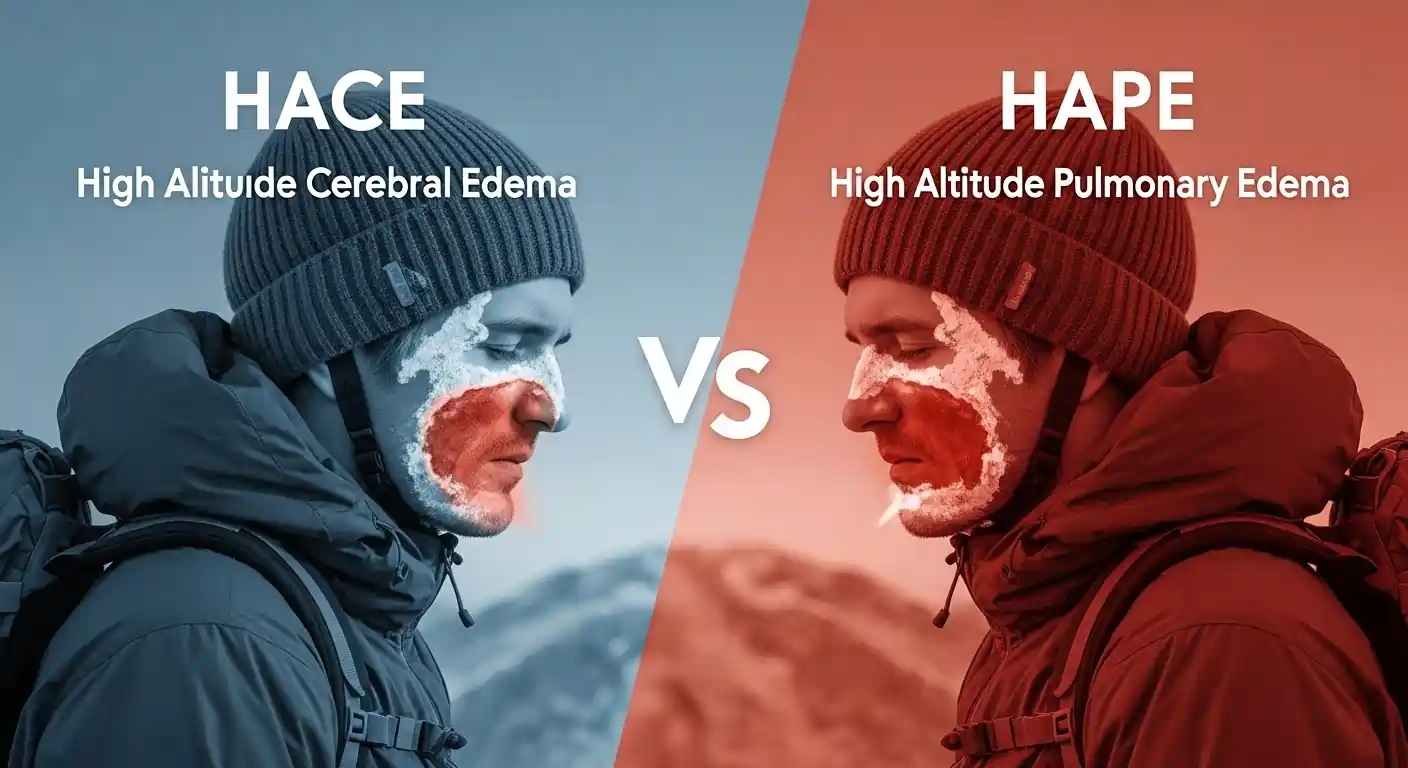
You’re at 4,500 meters on the Everest Base Camp trail when your trekking partner starts stumbling and can’t walk a straight line. Or maybe you wake up gasping for breath in your teahouse room, unable to get enough air even while lying still. These are the moments when knowing the difference between HACE and HAPE, and recognizing which one you’re facing, becomes the most important knowledge you’ll ever use.
In this blog about HACE vs HAPE, we’ll break down the critical differences between these two life-threatening altitude conditions that every Himalayan trekker needs to understand. HACE (High Altitude Cerebral Edema) is swelling in the brain caused by fluid leakage at altitude, while HAPE (High Altitude Pulmonary Edema) is fluid accumulation in the lungs. Both are medical emergencies that can develop rapidly above 2,500 meters and turn fatal within hours without proper response. You’ll learn how to recognize the distinct symptoms of each condition, what treatment options exist in remote mountain settings, and the prevention strategies that keep most trekkers safe on routes like Everest Base Camp and the Annapurna Circuit.
What Is the Difference Between HACE and HAPE
HACE (High Altitude Cerebral Edema) and HAPE (High Altitude Pulmonary Edema) are both life-threatening conditions caused by fluid buildup when your body fails to adapt to low oxygen at altitude. The key difference comes down to location: HACE involves swelling in your brain, while HAPE involves fluid in your lungs. Both typically occur above 2,500–4,000 meters and can develop within 1–5 days of ascending too quickly.
| Feature | HACE | HAPE |
| Full medical term | High Altitude Cerebral Edema | High Altitude Pulmonary Edema |
| Location in body | Brain | Lungs |
| Primary cause | Fluid leaking into brain tissue | Fluid filling lung air sacs |
| Main symptoms | Confusion, ataxia, severe headache | Breathlessness at rest, cough, fatigue |
| Typical onset | 1–3 days after rapid ascent | 2–5 days after rapid ascent |
You might be wondering which one is more dangerous. The honest answer? Both are medical emergencies that can turn fatal within hours if ignored. HACE tends to progress faster and impairs your judgment directly, while HAPE is more common but equally serious.
What Is HACE (High Altitude Cerebral Edema)
HACE is swelling in your brain caused by fluid leaking through the blood-brain barrier when your body can’t adapt to low oxygen levels at altitude. This dangerous accumulation of fluid inside your skull creates pressure on brain tissue, which explains why HACE causes such dramatic changes in mental function and coordination. The condition typically develops as a progression from untreated Acute Mountain Sickness (AMS) when you continue ascending despite warning signs.
In most cases, HACE develops as a progression from untreated Acute Mountain Sickness (AMS). AMS includes the headaches, nausea, and fatigue that many trekkers experience above 3,000 meters. When you ignore early warning signs and keep climbing, mild fluid shifts can escalate into full cerebral edema within hours.
What Is HAPE (High Altitude Pulmonary Edema)
HAPE (High Altitude Pulmonary Edema) is fluid accumulation in your lungs caused by high pressure in pulmonary arteries at altitude. When you ascend too quickly, this pressure forces fluid out of blood vessels and into the air sacs of your lungs, blocking oxygen from reaching your bloodstream. The result is a dangerous cycle: low oxygen causes more pressure, which causes more fluid leakage, further reducing your ability to breathe.
Here’s what makes HAPE tricky: it can strike without any prior warning signs. You might feel perfectly fine one evening and wake up struggling to breathe the next morning. Unlike HACE, HAPE doesn’t always follow the typical AMS progression, which catches many trekkers off guard.
Symptoms of HACE at High Altitude
HACE symptoms escalate quickly, often within hours, making early recognition critical. The hallmark signs include severe headache unresponsive to medication, confusion, loss of coordination (ataxia), and altered mental status. You might also notice vision changes, drowsiness, or difficulty with simple tasks, all indicating dangerous brain swelling that demands immediate descent.
Severe headache that does not respond to medication
The headache associated with HACE is relentless. It doesn’t improve with ibuprofen, paracetamol, or rest. While mild headaches are common at altitude, a headache that intensifies despite treatment is a red flag that separates HACE from ordinary AMS.
Confusion and altered mental status
You might struggle to answer simple questions, forget where you are, or have difficulty making basic decisions. Companions often notice personality changes—irritability, apathy, or bizarre behavior, before the affected person realizes anything is wrong.
Loss of coordination and ataxia
Ataxia refers to loss of coordination and is one of the most reliable indicators of HACE. Guides often use the “heel-to-toe walk test”: if you can’t walk in a straight line placing one foot directly in front of the other, your brain function is compromised.
Vision changes and hallucinations
Blurred vision, seeing spots or halos, and visual hallucinations all indicate worsening cerebral edema. When swelling affects the visual processing areas of your brain, you’ll notice changes in what you see.
Drowsiness progressing to unconsciousness
Excessive sleepiness that goes beyond normal fatigue is a late-stage warning sign. If someone with HACE is allowed to “sleep it off,” they may slip into a coma. Waiting until morning can be fatal.
Symptoms of HAPE
HAPE symptoms often develop at night or during rest, catching many trekkers off guard when they expect to feel worse during exertion. The condition can progress rapidly from mild breathlessness to life-threatening fluid accumulation in your lungs within hours. Early recognition of symptoms like persistent cough, breathlessness at rest, and extreme fatigue gives you the critical window needed to descend before HAPE becomes a medical emergency.
Persistent dry cough becoming productive
The cough typically starts dry and irritating, then progresses to a wet cough as fluid accumulates in your lungs. The progression can happen over hours rather than days.
Shortness of breath at rest
This symptom distinguishes HAPE from normal altitude breathlessness. Everyone breathes harder during exertion at high altitude, but gasping while sitting still or lying down suggests fluid is filling your lungs.
Gurgling or rattling breath sounds
A distinctive crackling or bubbling sound when breathing—sometimes audible to nearby companions—indicates significant fluid in the lungs. Medical professionals call this sound “rales.”
Extreme fatigue and weakness
Sudden inability to keep pace with your group, even on flat terrain, suggests your blood oxygen is dropping. The fatigue feels different from normal tiredness—it’s a profound weakness that doesn’t improve with rest.
Blue or gray lips and fingernails
Cyanosis, the bluish discoloration of lips, fingertips, and nail beds, indicates critically low blood oxygen. By the time you see cyanosis, the situation is urgent.
Pink or frothy sputum
Coughing up pink, foamy mucus is a late-stage symptom indicating fluid has severely compromised your lungs. At this point, you’re facing a medical emergency.
How Your Body Responds to High Altitude?
When you ascend above 2,500 meters, reduced atmospheric pressure means each breath delivers less oxygen to your bloodstream, a condition called hypoxia. Your body responds by breathing faster, increasing heart rate, and producing more red blood cells over time.
However, adaptation takes days to develop fully. When you ascend faster than your body can adjust, fluid can leak into tissues where it doesn’t belong. In some people, fluid accumulates in the lungs (HAPE); in others, it affects the brain (HACE). Why some individuals are more susceptible than others isn’t fully understood, though genetics and previous altitude history play a role.
Treatment of Altitude Sickness for HACE and HAPE
The single most important treatment for both HACE and HAPE is the same: descend immediately. No medication or oxygen therapy can replace the life-saving effect of losing elevation. While supplemental oxygen and drugs like dexamethasone (for HACE) or nifedipine (for HAPE) can stabilize your condition temporarily, they’re emergency measures that buy you time to get down, not treatments that allow you to stay high or continue ascending. Think of medications as a bridge to descent, not a cure.
Immediate descent to lower elevation
Descending even 300–1,000 meters often produces dramatic improvement in symptoms. The goal is to keep moving downward until symptoms resolve, not to stop at a predetermined elevation.
Supplemental oxygen administration
Oxygen helps stabilize the patient during descent or while awaiting evacuation. Flow rates of 2–4 liters per minute can significantly improve blood oxygen levels and reduce strain on lungs and brain.
Portable hyperbaric chamber use
A Gamow bag or similar portable altitude chamber simulates descent by increasing air pressure around the patient. On remote trails where immediate descent isn’t possible, a hyperbaric chamber serves as a temporary measure while evacuation is organized.
Medications for HACE
Dexamethasone, a powerful corticosteroid, reduces brain swelling and can dramatically improve symptoms within hours. However, it’s a bridge to descent, not a treatment that allows you to continue ascending.
Medications for HAPE
Nifedipine reduces pulmonary artery pressure, slowing fluid leakage into lung tissue. Like dexamethasone for HACE, nifedipine buys time for descent rather than resolving the underlying problem.
When You Should Descend With HACE or HAPE
The decision to turn around and descend can feel like failure at the moment, but it’s actually the most important judgment call you’ll make on any high-altitude trek. Recognizing when symptoms have crossed from manageable discomfort into dangerous territory, and acting on that recognition immediately, separates successful mountain travelers from tragic statistics. Your summit will still be there next year, but ignoring warning signs of HACE or HAPE can have permanent consequences. The climbers and trekkers who return home safely are the ones who know when to prioritize survival over achievement.
Warning signs requiring immediate descent
- Ataxia or confusion: Any loss of coordination or mental clarity means descend now
- Breathlessness at rest: Struggling to breathe while sitting still indicates serious trouble
- Symptoms worsening despite rest: If a night’s sleep doesn’t improve how you feel, don’t wait for another night
- Cyanosis: Blue lips or fingernails indicate dangerously low oxygen
- Pink or frothy sputum: This late-stage HAPE symptom is a medical emergency
How far to descend for each condition
The rule is simple: descend until symptoms improve. For some people, that’s 300 meters; for others, it might be 1,000 meters or more. Let your body tell you when you’ve gone far enough rather than setting a target elevation.
What to do when descent is not possible
When weather, terrain, or darkness prevents immediate descent, use every available resource: supplemental oxygen, hyperbaric bag, and medications. Meanwhile, coordinate helicopter evacuation if the situation is critical. In Nepal’s major trekking regions, rescue helicopters can often reach remote locations within hours of a distress call.
How to Prevent HACE and HAPE on Himalayan Treks
You can prevent HACE and HAPE on Himalayan treks by following proper acclimatization schedules, ascending gradually above 3,000 meters, and building rest days into your itinerary at key elevations. The strategies below are straightforward and proven effective: climb high during the day but sleep at lower elevations to stimulate adaptation, stay well-hydrated with 3-4 liters of water daily while avoiding alcohol, consider preventive medications like Diamox after consulting your doctor, and monitor yourself and your trekking partners each morning for early warning signs. These prevention measures require patience and discipline, but they’re far more effective than treating altitude sickness after it develops.
1. Follow proper acclimatization schedules
Above 3,000 meters, the standard guideline is to increase your sleeping elevation by no more than 300–500 meters per day. Rest days at key elevations, like Namche Bazaar (3,440m) on the Everest Base Camp route or Manang (3,540m) on the Annapurna Circuit, give your body time to adapt.
2. Climb high and sleep low
This mountaineering principle means hiking to a higher elevation during the day, then descending to sleep. The exposure to higher altitude stimulates adaptation, while sleeping lower gives your body recovery time.
3. Stay hydrated and avoid alcohol
Dehydration thickens your blood and impairs acclimatization. Aim for 3–4 liters of water daily at altitude. Alcohol depresses breathing and disrupts sleep, both of which worsen altitude sickness risk.
4. Consider preventive medications like Diamox
Acetazolamide (Diamox) speeds acclimatization by increasing your breathing rate. Discussing acetazolamide with your doctor before your trek is worthwhile, especially if you have a history of altitude problems.
5. Monitor yourself and trekking partners daily
Check in with yourself and your companions each morning. The Lake Louise Acute Mountain Sickness Score provides a standardized way to track symptoms. Watch for changes in appetite, energy, coordination, and mental clarity.
6. Choose routes with built-in rest days
Well-designed itineraries include acclimatization stops at strategic elevations. A 12-day Everest Base Camp itinerary with rest days at Namche and Dingboche is far safer than a rushed 10-day schedule covering the same distance.
Emergency Field Management for HACE and HAPE
When you’re days from the nearest hospital on a remote Himalayan trail, your ability to recognize and respond to altitude emergencies can mean the difference between life and death. The isolation of high-altitude trekking means you can’t rely on immediate medical evacuation, weather, terrain, and distance all create delays that turn minutes into hours. Understanding field management protocols before you need them gives you the confidence and knowledge to act decisively when every decision counts.
Recognizing an emergency at remote altitude
The transition from “feeling unwell” to “medical emergency” can happen quickly. Key indicators include symptoms that worsen despite rest, any sign of ataxia or confusion, and breathlessness that doesn’t improve when you stop moving.
Prioritizing descent over summit goals
Experienced guides make decent calls without hesitation because they understand a fundamental truth: no summit is worth a life. If you’re trekking with a professional operator, trust their judgment when they say it’s time to go down.
Using emergency oxygen and hyperbaric bags
On guided treks with professional operators, emergency oxygen and portable hyperbaric chambers are typically available for high-altitude routes. Both tools can stabilize a patient while descent is organized.
Coordinating helicopter evacuation in Nepal
In the Khumbu, Annapurna, and Langtang regions, helicopter rescue is well-established. Response times vary based on weather and location, but evacuations from Everest Base Camp or Annapurna Circuit villages typically happen within hours of a distress call. Travel insurance that explicitly covers high-altitude helicopter evacuation is essential.
Why Guided Treks Reduce Your Risk of HACE and HAPE
Trekking with experienced local guides significantly reduces your altitude sickness risk for several practical reasons. Professional guides recognize early symptoms, often before you do, because they’ve seen hundreds of trekkers at altitude and know what to watch for.
Structured itineraries from reputable operators build in proper acclimatization time rather than rushing to meet arbitrary deadlines. Guides carry pulse oximeters for daily monitoring, have access to emergency oxygen and medications, and maintain communication networks for rapid evacuation if needed. Knowing how to choose a trekking company that prioritizes these safety standards is an essential part of your pre-trek planning.
Perhaps most importantly, a good guide provides objective judgment when your own thinking may be impaired by altitude. When HACE affects your brain, you’re often the last person to recognize something is wrong.
Explore Our Adventures to see how Marvel Treks builds safety protocols into every Himalayan journey.
FAQs
Can you get HACE and HAPE at the same time?
Yes, both conditions can occur simultaneously since they share the same underlying cause of inadequate acclimatization. Having one condition actually increases your risk of developing the other, which is why any serious altitude symptom warrants immediate descent.
How quickly can HACE or HAPE become fatal without treatment?
Both conditions can progress from early symptoms to life-threatening within hours, not days. The rapid progression is why the universal advice is to descend at the first sign of serious symptoms rather than waiting to “see how you feel in the morning.”
Does physical fitness prevent HACE or HAPE?
No, even elite athletes can develop altitude illness because fitness doesn’t determine how quickly your body acclimatizes to reduced oxygen. In fact, very fit individuals sometimes face higher risk because they’re tempted to push through symptoms that would stop less conditioned trekkers.
Can you return to high altitude after recovering from HACE or HAPE?
Yes, but waiting until fully recovered, re-ascending more slowly than before, and considering prophylactic medications under medical guidance are all important considerations. Having experienced HACE or HAPE once does increase your risk of recurrence on future climbs.
At what altitude do HACE and HAPE typically occur?
Both conditions generally occur above 2,500 meters, with risk increasing significantly above 3,500 meters. However, susceptible individuals can develop symptoms at lower elevations, particularly during rapid ascents.
Which condition is more common on Everest Base Camp Trek?
HAPE occurs more frequently than HACE among trekkers, though both remain relatively rare when proper acclimatization schedules are followed. On well-designed itineraries with rest days at Namche Bazaar and Dingboche, serious altitude illness affects a small percentage of trekkers.

Ready for your next Himalayan adventure?
Plan Your Next Big Adventure with Us
Explore Our AdventuresJoin our expert-guided journeys across Nepal and beyond, from classic trails to epic summits.