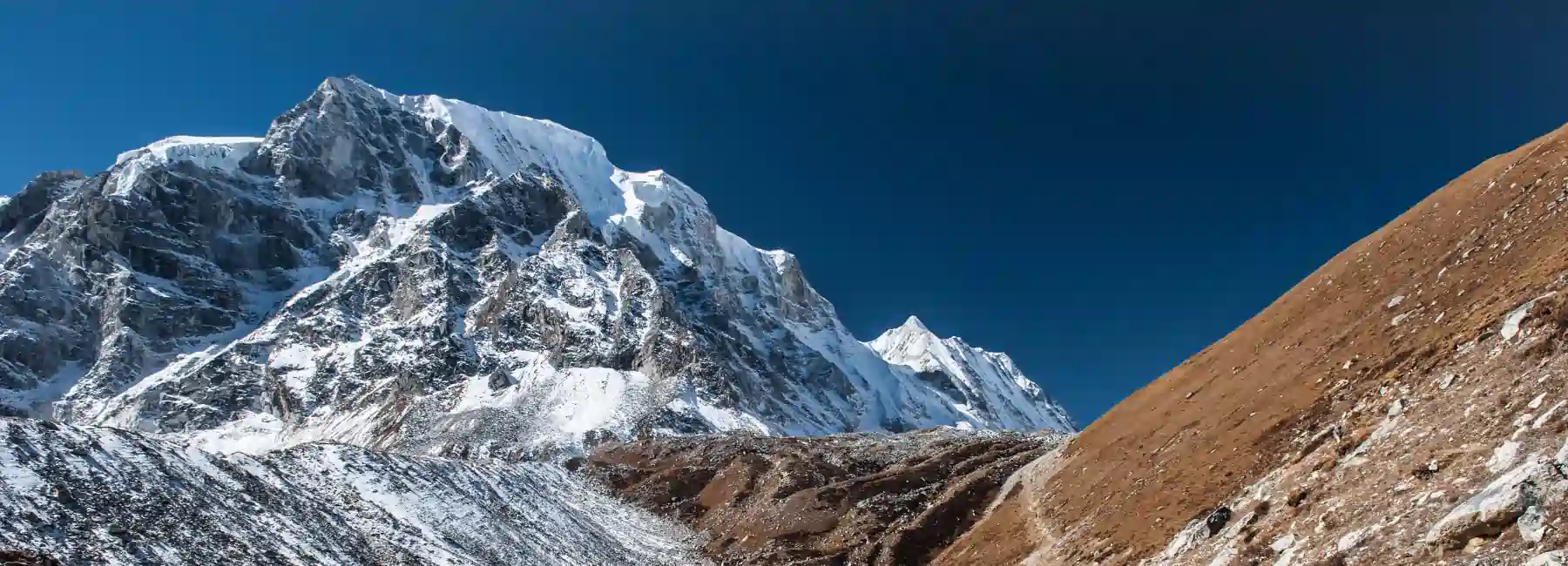
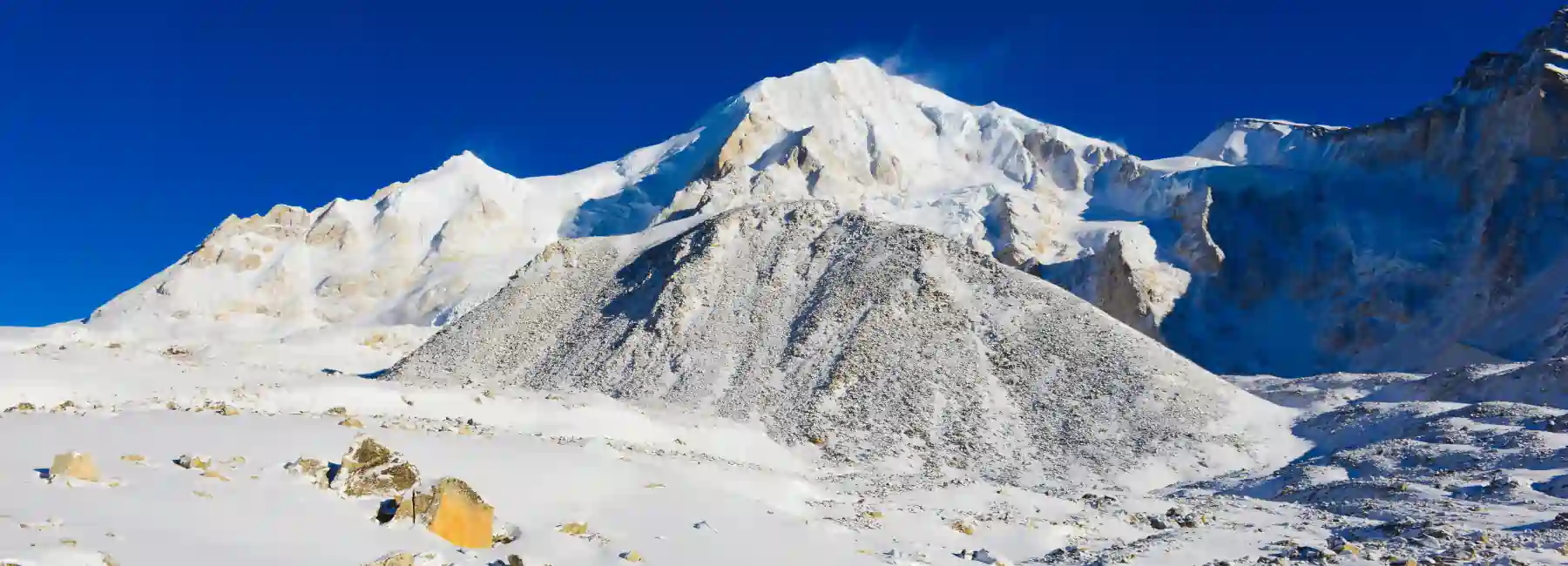
Manaslu Expedition – 31 Days

Nepal
Manaslu Himal
1-12 Pax
8,163m
Extreme
Teahouse/Lodge, Tented camp
5-8 hrs
Autumn, Spring
Highlights of Manaslu Expedition – 31 Days
Manaslu is a mountain in the Himalayas of Nepal, and climbing it is a challenging and technical endeavor that requires a high level of physical fitness and mountaineering skills. Some highlights of a Manaslu expedition might include:
- High-altitude climbing:
- Manaslu stands at an elevation of 8,163 meters (26,781 feet), making it one of the highest peaks in the world.
- Scenic views:
- The summit of Manaslu offers breathtaking panoramic views of the surrounding landscape, including the other peaks in the Manaslu range.
- Cultural experiences:
- The expedition will take you through various villages and communities in the Manaslu region, giving you the opportunity to learn about the local culture and way of life.
- Sense of accomplishment:
- Successfully climbing Manaslu is a major achievement and a once-in-a-lifetime experience that will stay with you forever.
- Teamwork and camaraderie:
- A Manaslu expedition requires teamwork and cooperation, and you will have the opportunity to build strong bonds with your fellow climbers and sherpas
Manaslu Expedition – 31 Days Overview
Manaslu, the Mountain of the Spirit, rises to 8,163 metres (26,781 ft) above Nepal’s Gorkha District, making it the world’s eighth-highest peak and the highest mountain in the Mansiri Himal range. First summited on May 9, 1956 by Toshio Imanishi and Gyalzen Norbu Sherpa as part of a Japanese expedition led by Maki Yuko, Manaslu has since become one of the most popular 8,000-metre objectives in the Himalaya for one compelling reason: it is widely considered the ideal first 8,000-metre peak.
Considered by many climbers when choosing the Best Expedition Company in Nepal, its standard route on the Northeast Face follows a logical, fixed-rope line from Base Camp at 4,800 m to the summit snowfield, the approach is road-accessible from Kathmandu, and its overall summit success rate of 55–65% is higher than almost every other eight-thousander. Marvel Treks runs guided Manaslu expeditions in the optimal autumn season (September–November) with veteran Sherpa guides, a structured acclimatization programme, four oxygen cylinders per climber, and full permit management from the Nepal Mountaineering Association (NMA) briefing through to your summit certificate.
Key Facts Table (Replace existing spec box)
| Fact | Detail |
| Mountain | Manaslu (also: Kutang) |
| Elevation | 8,163 m / 26,781 ft |
| World Rank | 8th highest mountain in the world |
| Location | Gorkha District, Gandaki Province, Nepal |
| Range | Mansiri Himal (Manaslu Himal), Nepalese Himalaya |
| Standard Route | Northeast Face (Normal Route) |
| Base Camp Altitude | 4,750–4,800 m / 15,584–15,748 ft |
| High Camps | Camp I (5,700 m) → Camp II (6,400 m) → Camp III (6,800 m) → Camp IV (7,450 m) |
| Expedition Duration | 31 days (Marvel Treks package) / 45–55 days full expedition |
| Best Season | Autumn (September–November) — post-monsoon, clearest skies |
| Secondary Season | Spring (April–May) — fewer teams, less infrastructure |
| Difficulty | Extreme — sustained high-altitude glacier and snow climbing |
| Group Size | 1–12 climbers |
| Permit Authority | Nepal Mountaineering Association (NMA) + Dept of Tourism |
| First Ascent | Toshio Imanishi & Gyalzen Norbu Sherpa, May 9, 1956 |
| First Winter Ascent | Maciej Berbeka & Ryszard Gajewski (Poland), January 12, 1984 |
| Total Summits (2024) | Approximately 3,317 successful ascents |
| Total Fatalities (2024) | Approximately 90 recorded deaths |
| Overall Fatality Rate | 2.7% (significantly safer than K2 at 9.5% or Annapurna at 29%) |
| Summit Success Rate | 55–65% (among the highest of all 8,000-metre peaks) |
| Price from | USD $6,500 service package (see full cost breakdown below) |
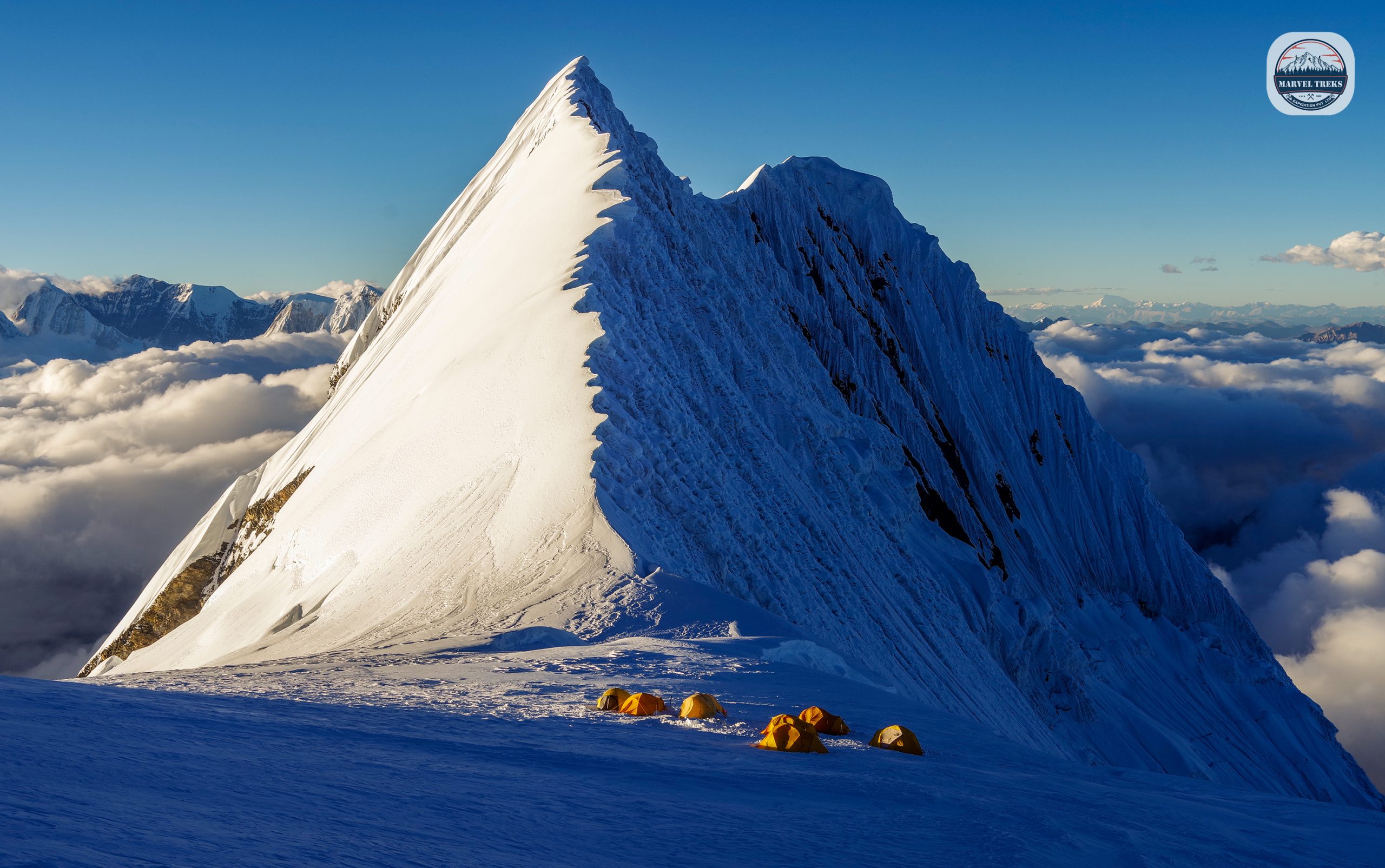
Gallery of Manaslu Expedition – 31 Days
| Day | Itinerary | Altitude | Duration |
|---|---|---|---|
| 1 | Arrival in Kathmandu & Transfer to Hotel | 1,400 m | 1 hrs |
| 2 | Drive Kathmandu → Besisahar | 760 m | 6–7 hrs |
| 3 | Drive Besisahar → Dharapani | 1,860 m | 6–7 hrs |
| 4 | Trek Dharapani → Gowa | 2,530 m | 6–7 hrs |
| 5 | Trek Gowa → Bhimthang | 3,720 m | 6–7 hrs |
| 6 | Acclimatization & Rest at Bhimthang | 3,720 m | 0–2 hrs |
| 7 | Trek Bhimthang → Samdo via Larke Pass | 3,872–5,160 m | 6–8 hrs |
| 8 | Trek Samdo → Sama Gaun | 3,541 m | 4–5 hrs |
| 9 | Trek Sama Gaun → Manaslu Base Camp | 4,700 m | 5–6 hrs |
| 10 | Acclimatization & Puja Ceremony at Base Camp | 4,700 m | 1–2 hrs |
| 11 | Base Camp → Camp I → Return to Base Camp | 4,700–5,800 m | 4–5 hrs |
| 12 | Rest Day at Base Camp | 4,700 m | - |
| 13 | Base Camp → Camp I (Overnight) | 5,800 m | 5–6 hrs |
| 14 | Camp I → Camp II → Return to Camp I | 6,400 m | 4–5 hrs |
| 15 | Base Camp → Camp I → Camp II (Overnight) | 6,400 m | 5–6 hrs |
| 16 | Touch Camp III → Descend to Camp II | 7,000 m | 6–8 hrs |
| 17 | Descend Camp II → Camp I → Base Camp | 5,800–4,700 m | 5–6 hrs |
| 18 | Weather Buffer / Additional Rotation | - | - |
| 19 | Final Rest Day at Base Camp | 4,700 m | - |
| 20 | Base Camp → Camp I | 5,800 m | 4–5 hrs |
| 21 | Camp I → Camp II | 6,400 m | 4–5 hrs |
| 22 | Camp II → Camp III (Summit Push Prep) | 7,000 m | 4–5 hrs |
| 23 | Summit Day → Descend to Camp III/Camp II | 8,163 m | 12–14 hrs |
| 24 | Descend to Base Camp | 4,700 m | 5–6 hrs |
| 25 | Trek Base Camp → Sama Gaun | 3,541 m | 5–6 hrs |
| 26 | Trek Sama Gaun → Namrung | 2,670 m | 4–5 hrs |
| 27 | Trek Namrung → Philim | 1,606 m | 4–5 hrs |
| 28 | Trek Philim → Machha Khola | 883 m | 3–4 hrs |
| 29 | Drive Machha Khola → Kathmandu & Transfer to Hotel | 1,400 m | 6–7 hrs |
| 30 | Leisure Day in Kathmandu | 1,400 m | 1 hrs |
| 31 | Transfer to International Airport for Final Departure | - | - |
Arrival and Ground Services: International and domestic airport pick-up and drop-off with a warm welcome by a Marvel Treks and Expeditions representative. All ground transportation in Kathmandu and guided sightseeing as per the itinerary are included, excluding entrance fees.
Accommodation: Kathmandu accommodation in a 3-star hotel on a twin-sharing bed and breakfast basis. Single rooms are available at an additional cost. Trekking lodges and fully serviced Base Camp and high-camp tents are provided during the expedition.
Meals and Nutrition: Welcome and farewell dinners in Kathmandu are included. Lunch and dinner in Kathmandu are excluded unless specified. During trekking and climbing, three hygienic meals per day with high-altitude nutrition and fresh vegetables are provided.
Transportation and Logistics: All required domestic flights, jeep transportation, and shared helicopter services as per the expedition itinerary. Cargo transport, porter support, and baggage movement to and from Base Camp are fully managed.
Permits and Government Requirements: All Nepal Government climbing permits, national park permits, liaison officer arrangements, route-fixing fees, garbage management charges, applicable taxes, and company service and administrative charges.
Base Camp and High Camp Infrastructure: Fully equipped Base Camp with personal tents, dining and kitchen tents, power supply, toilet facilities, and communication systems. High camps are supported with quality expedition tents, climbing hardware, ropes, and cooking systems.
Expedition Staff and Support: Experienced expedition leader with one government-licensed climbing Sherpa per member. Support staff include guides, cooks, porters, and Base Camp personnel. All staff salaries, food, equipment, and insurance are included.
Training, Oxygen, and High-Altitude Support: Pre-climb technical training and Sherpa assistance at Base Camp. Four oxygen cylinders per member, with oxygen support for Sherpas and backup oxygen available if required.
Communication, Safety, and Medical: Walkie-talkies, emergency satellite phone access, daily professional weather forecasts, and comprehensive first-aid support. Medical support is available at Base Camp where conditions permit.
Complimentary Items: Expedition duffle bags, branded apparel, route maps, and free use of basic equipment such as sleeping bags and down jackets for the duration of the expedition.
Certification: Official Government of Nepal summit certificate for successful climbers, along with expedition completion documentation from Marvel Treks and Expeditions.
International Travel and Visa: International airfare to and from Nepal, Nepal entry visa fees, and excess baggage or cargo charges on international and domestic flights.
Meals and Beverages: Lunch and dinner in Kathmandu unless clearly stated in the itinerary. Personal snacks, bottled water, soft drinks, alcohol, cigarettes, and bar bills.
Personal Equipment: Personal climbing and trekking gear, clothing, bags, packing items, personal medical kits, toiletries, and hygiene supplies.
Insurance and Medical: Mandatory personal travel insurance covering high-altitude rescue, helicopter evacuation, and emergency medical treatment. Medical examinations, clearance forms, hospitalization costs, and related expenses.
Extra Accommodation: Additional hotel nights in Kathmandu due to early arrival, late departure, flight delays, or personal itinerary changes. Accommodation and meals outside official expedition dates.
Communication and Internet: Internet usage, satellite phone calls, walkie-talkie charges, and Wi-Fi services outside Base Camp. All personal communication expenses.
Summit Bonus and Tips: Mandatory summit bonuses payable in cash after a successful ascent, including USD 2,000 per climbing Sherpa and USD 500 per kitchen staff. Tips for guides, porters, and Base Camp staff.
Oxygen and Sherpa Support: Additional oxygen beyond the included cylinders, extra climbing Sherpas, and extra masks, regulators, or oxygen systems.
Permits and Special Requests: Drone use, filming, photography, and special media permits subject to government approval. Customs duties for personal expedition equipment.
Personal and Miscellaneous Expenses: Laundry, hot showers, battery charging, personal purchases, refundable garbage deposits, banking fees, transaction charges, and any personal expenses of any nature.
Unforeseen Circumstances: Costs arising from natural disasters, extreme weather, political unrest, strikes, changes in government regulations, or any service not specifically listed under cost includes.
Detailed Itinerary
Day 01: Arrival in Kathmandu
As soon as you arrive at Tribhuvan International Airport, you will be welcomed by our representative and transferred to your hotel. After check-in, you can take time to rest from your journey or step out for a short walk around Thamel. In the evening, you can enjoy your first taste of Nepali food and get a feel for the city. Overnight at the hotel.
Day 02: Drive from Kathmandu to Besisahar
After breakfast, you begin a scenic drive from Kathmandu to Besisahar. As you leave the city behind, you will pass rivers, terraced fields, and small towns along the way. This is a long but interesting drive that introduces you to Nepal’s countryside. Overnight at a lodge. All meals included.
Day 03: Drive from Besisahar to Dharapani
Today you continue deeper into the mountains on a rough but beautiful road. The drive follows the Marsyangdi River and passes waterfalls, forests, and traditional villages. Once you reach Dharapani, you can relax and prepare for the trekking days ahead. Overnight at a lodge. All meals included.
Day 04: Trek from Dharapani to Gowa
Your trekking journey starts today. You walk through pine and rhododendron forests, crossing small bridges and passing local villages. The trail gradually climbs, helping your body adjust to the altitude. By the time you reach Gowa, you will notice cooler air and mountain surroundings. Overnight at a lodge. All meals included.
Day 05: Trek from Gowa to Bhimthang
The landscape changes as you gain altitude. You trek through alpine terrain with open views, yak pastures, and glacial streams. Bhimthang is a beautiful high valley surrounded by snow-covered peaks, making it one of the highlights of the trek. Overnight at a lodge. All meals included.
Day 06: Acclimatization and Rest Day at Bhimthang
This day is set aside to help your body adjust to the altitude. You can take short acclimatization walks around Bhimthang and enjoy the mountain views, then return to the lodge for rest. Proper acclimatization here is important for the days ahead. Overnight at a lodge. All meals included.
Day 07: Trek from Bhimthang to Samdo via Larke Pass
Today is one of the most challenging trekking days. You start early and make your way up to Larke Pass, the highest point of the trekking section. From the top, you are rewarded with incredible mountain views before descending carefully to Samdo. This is a long but very rewarding day. Overnight at a lodge. All meals included.
Day 08: Trek from Samdo to Sama Gaun
A shorter and more relaxed walk brings you to Sama Gaun, a large village beneath Manaslu. You will have time to rest, explore the village, and prepare for the approach to Base Camp. Overnight at a lodge. All meals included.
Day 09: Trek from Sama Gaun to Manaslu Base Camp
You leave the village behind and walk steadily toward Manaslu Base Camp. As you gain altitude, the environment becomes more rugged and glacial. Upon arrival, you settle into your tented camp and begin life at Base Camp. Overnight in tents. All meals included.
Day 10: Acclimatization and Puja Ceremony at Base Camp
This is a rest and preparation day. A traditional puja ceremony is performed to ask for safety and success on the mountain. You will also check your climbing equipment and receive guidance from your Sherpa team. Rest and hydration are the focus today.
Day 11: Rotation Climb to Camp I and Return to Base Camp
You make your first climb on the mountain, heading up to Camp I before returning to Base Camp. This rotation helps your body adjust to higher altitude and allows you to get familiar with the route and fixed ropes.
Day 12: Rest Day at Base Camp
You spend the day resting, eating well, and regaining energy. Weather updates and climbing plans are reviewed with the team.
Day 13: Climb from Base Camp to Camp I
You climb back to Camp I and stay overnight. The route involves glacier travel and steady climbing, guided by your Sherpa.
Day 14: Climb from Camp I to Camp II and Return to Camp I
Today you climb higher to Camp II to continue acclimatization, then descend back to Camp I for the night.
Day 15: Climb from Base Camp to Camp I to Camp II
You move back up the mountain and spend the night at Camp II, building strength and confidence at higher altitude.
Day 16: Touch Camp III and Descend to Camp II
You climb up to Camp III, experiencing thinner air and steeper terrain, then descend to Camp II. This rotation is a key step before the summit push.
Day 17: Descend from Camp II to Base Camp
You descend all the way back to Base Camp, where you can rest, recover, and prepare mentally and physically for the summit attempt.
Day 18: Weather Buffer or Additional Rotation Day
This day is kept flexible for bad weather or extra acclimatization if needed.
Day 19: Final Rest Day at Base Camp
You take a full rest day before the summit push. Final checks, weather forecasts, and briefings are completed.
Day 20: Climb from Base Camp to Camp I
The summit push begins. You climb steadily to Camp I and rest overnight.
Day 21: Climb from Camp I to Camp II
You continue upward to Camp II, maintaining a slow and steady pace. Overnight at Camp II.
Day 22: Climb from Camp II to Camp III
You climb to Camp III, where final preparations for the summit are made, including oxygen setup and rest.
Day 23: Summit Day and Descent
You start very early for the summit attempt of Mount Manaslu. After reaching the summit, you descend carefully to Camp III or Camp II, depending on conditions and your strength.
Day 24: Descend to Base Camp
You continue descending back to Base Camp, completing the climbing phase of the expedition.
Day 25: Trek from Manaslu Base Camp to Sama Gaun
After packing up Base Camp, you trek back to Sama Gaun, enjoying the feeling of lower altitude. Overnight at a lodge. All meals included.
Day 26: Trek from Sama Gaun to Namrung
You descend through forests and villages, gradually returning to warmer temperatures. Overnight at a lodge. All meals included.
Day 27: Trek from Namrung to Philim
The trail continues downhill through traditional villages and river valleys. Overnight at a lodge. All meals included.
Day 28: Trek from Philim to Machha Khola
You make your final trekking descent to Machha Khola, marking the end of the trekking section. Overnight at a lodge. All meals included.
Day 29: Drive from Machha Khola to Kathmandu
You drive back to Kathmandu and transfer to your hotel. The evening is free for rest or a quiet celebration. Overnight at the hotel.
Day 30: Leisure Day in Kathmandu
You have a free day to relax, explore Kathmandu, shop for souvenirs, or enjoy cultural sites. Overnight at the hotel.
Day 31: Final Departure
After breakfast, you are transferred to the international airport for your onward journey.
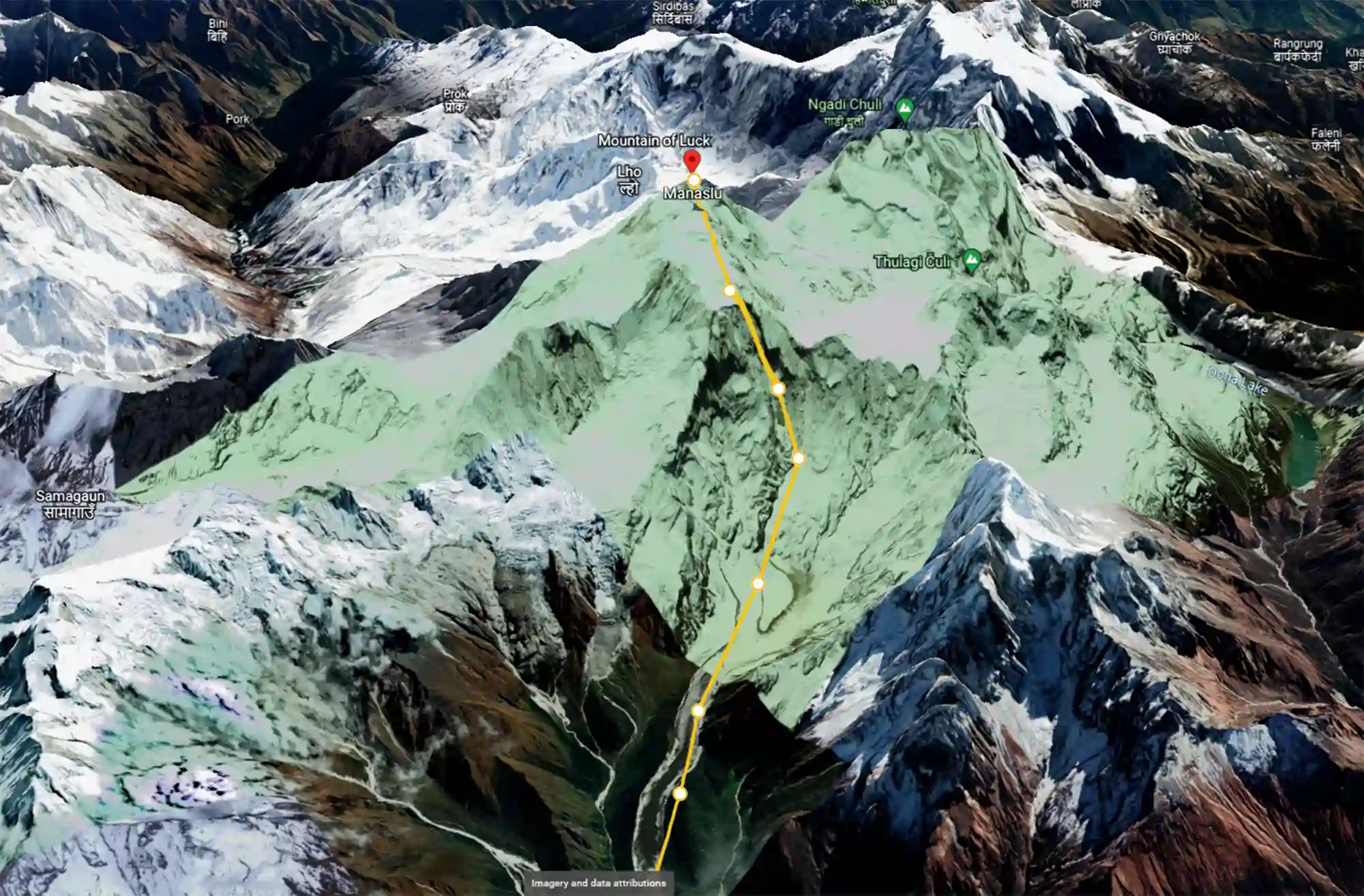
Trip Map
What Is Manaslu? The Mountain of the Spirit
Manaslu’s name is derived from the Sanskrit word manasa, meaning intellect or soul, giving the mountain its poetic title: the Mountain of the Spirit. It sits in the Mansiri Himal range, sometimes called the Manaslu Himal, in the Gorkha District of Nepal’s Gandaki Province, approximately 64 km east of Annapurna and 170 km west of Kathmandu as the crow flies. Its coordinates are 28.5497° N, 84.5597° E.
Unlike K2 or Annapurna, which require multi-day flights and complex overland approaches from Islamabad or Pokhara, Best Mountains to Climb in Nepal like Manaslu are accessible directly from Kathmandu by jeep to the trailhead at Machha Khola or Soti Khola along the Budhi Gandaki River valley. This road access is a significant logistical advantage and one reason Manaslu has become Nepal’s busiest 8,000-metre peak outside of Everest in recent years.
The mountain is entirely within the Manaslu Conservation Area (MCA), a protected territory covering 1,663 square kilometres of the Nubri Valley and Tsum Valley. The conservation area borders Tibet to the north and Annapurna Conservation Area to the west, creating one of the most biologically and culturally rich protected zones in the Himalaya. The Nubri and Tsum communities along the approach trail have maintained Tibetan Buddhist traditions for centuries, making the Manaslu approach one of the most culturally immersive expeditions in Nepal.
Manaslu Success Rate, Death Rate, and Summit Statistics
Manaslu has accumulated approximately 3,317 successful summits and around 90 fatalities as of December 2024, yielding an overall fatality rate of approximately 2.7%. This places Manaslu among the safer eight-thousanders — dramatically less deadly than Annapurna I (approximately 29%), K2 (approximately 9.5%), or Nanga Parbat (approximately 21%), and comparable to Cho Oyu and Gasherbrum II. The summit success rate for climbers reaching Base Camp is approximately 55–65%, making Manaslu one of the most achievable 8,000-metre summits for well-prepared climbers.
| Statistic | Data |
| Total successful summits (2024) | 3,317 |
| Total recorded deaths (2024) | 90 |
| Overall fatality rate | 2.7% |
| Summit success rate from BC | 55–65% |
| Manaslu vs Annapurna fatality | 2.7% vs 29% |
| Manaslu vs K2 fatality | 2.7% vs 9.5% |
| Manaslu vs Everest fatality | 2.7% vs 1–2% |
| Primary cause of death | Avalanche (90% of fatalities) |
| Deadliest single event | 1972 Korean expedition avalanche — 15 deaths at ~6,500 m |
| 2012 avalanche disaster | 9 climbers killed in September 2012 Base Camp avalanche |
| First winter ascent | January 12, 1984 — Maciej Berbeka & Ryszard Gajewski (Poland) |
| First female summiteer | None recorded in first decade; multi-national women summited through 1980s–90s |
| False summit hazard | Foresummit at ~8,125 m misidentified as true summit — significant cause of errors |
The primary objective danger on Manaslu is avalanche. Approximately 90% of recorded fatalities on the mountain are avalanche-related. The upper slopes are prone to serac release, particularly in the Japanese Cwm (the glacial basin between Camp I and Camp II) and on the Northeast Face above Camp III. The false summit, a prominent snow dome at approximately 8,125 m, separated from the true summit by a sharp corniced ridge, has caused multiple fatalities and failed summit claims. Marvel Treks guides are trained to navigate the false summit distinction and ensure all clients reach the true summit at 8,163 m.
Why Manaslu Is the Best First 8,000-Metre Peak?
Manaslu is recommended by more experienced alpine guides as a first 8,000-metre objective than any other eight-thousander. The reasons are structural, not subjective:
- Accessible logistics: Jeep access from Kathmandu to the trailhead. No domestic flights required. No cargo permits or foreign liaison officers. Permits are processed through the Nepal Mountaineering Association (NMA) in Kathmandu within 1–2 days.
- Standard route quality: The Northeast Face follows a well-defined line with fixed ropes established by the Expedition Operators Association of Nepal (EOAN) at the start of each season. The route is well-mapped, regularly traffic-checked, and supported by multiple operator teams simultaneously.
- High success rate: The 55–65% summit success rate from Base Camp is significantly higher than K2 (25%), Makalu (40%), or Kangchenjunga (30%). This makes the investment of time and money more likely to result in a summit.
- Accessible altitude: Base Camp at 4,750–4,800 m is reachable in 6–8 trekking days from the roadhead. The altitude gain is gradual and allows proper acclimatization before the technical climbing begins.
- Familiar weather patterns: Manaslu follows the South Asian monsoon pattern shared with all Nepal Himalaya peaks. Autumn windows (mid-September through late October) are well-understood and supported by professional weather forecasting services.
- Commercial infrastructure: Tea houses and lodges exist along the approach trail to Base Camp. Helicopter access to Sama Gaun and Base Camp is reliable in good weather. Emergency evacuation to Kathmandu is logistically straightforward compared to K2 or Annapurna.
| Factor | Manaslu | Cho Oyu | K2 |
| Summit success rate | 55–65% | 60–70% | 25% |
| Fatality rate | 2.7% | 1.5% | 9.5% |
| Technical difficulty | High | Moderate | Extreme |
| Permit process | NMA, Kathmandu | CMA, Tibet/Lhasa | Gilgit-Baltistan, Pakistan |
| Approach logistics | Jeep from Kathmandu | Overland via Tibet | Flight to Skardu + 6-day trek |
| Season | Autumn primary | Autumn primary | Summer only |
| Best for first-time 8000m | Yes, highly recommended | Yes, slightly less technical | No, for experienced 8000m climbers only |
Manaslu Route Description — Northeast Face (Normal Route)
The standard route to the summit of Manaslu is the Northeast Face, also referred to as the Normal Route. It climbs the northeast aspect of the mountain from Base Camp at 4,800 m, passing through four established high camps before the summit push. This route was first climbed by a Japanese expedition in 1971 (revisiting the 1956 line) and has been refined through decades of subsequent expeditions. Fixed ropes are installed from below Camp I to the summit each season by the Expedition Operators Association of Nepal (EOAN) and are available to all permitted teams.
Base Camp — 4,750–4,800 m
Base Camp is located near Sama Gaun (Samagaon) village in the Budhi Gandaki valley at approximately 4,750–4,800 m. It is one of the most comfortable Base Camps among all 8,000-metre peaks — within view of the village tea houses, accessible by helicopter in emergency, and supported by Sama Gaun’s small guesthouse infrastructure for team members who prefer to sleep lower during acclimatization. A Puja ceremony (Tibetan Buddhist blessing ritual) is performed at Base Camp at the start of every expedition — a practice mandatory for all teams on Manaslu, led by a local Lama, typically lasting 2–3 hours and involving offerings to the mountain deity.
Camp I — 5,700 m
Camp I sits at approximately 5,700 m above a heavily crevassed glacier section. The route from Base Camp to Camp I crosses the initial icefall and requires careful navigation through crevasse zones. The terrain is generally moderate in angle but objective danger from crevasses and occasional serac fall requires alert movement. Fixed ropes begin below Camp I and are maintained throughout the season.
Japanese Cwm — 5,700 to 6,400 m
Between Camp I and Camp II, the route passes through the Japanese Cwm — a large, bowl-shaped glacial basin named for the Japanese expeditions that first mapped it. The Cwm is flanked by towering ice walls and seracs that create significant avalanche exposure. Climbers cross this section as efficiently as possible, typically in early morning when temperatures are coldest and serac release risk is lowest. This section is the most avalanche-prone portion of the standard route and has been the site of multiple fatalities, including the 2012 disaster that killed nine climbers.
Camp II — 6,400 m
Camp II at 6,400 m sits at the top of the Japanese Cwm on a broader snow terrace. This is a relatively stable camp location with lower avalanche risk than the Cwm below. The acclimatization rotation from Base Camp typically involves a carry to Camp II and return to Base Camp before the summit push begins.
Camp III — 6,800 m
Camp III at 6,800 m is established on a steep snow slope above a series of ice walls that must be negotiated using fixed ropes and ice tools. The route from Camp II to Camp III involves the most technically demanding terrain below Camp IV — a series of steep mixed sections with ice walls up to 60 degrees. At this altitude, all climbers are on supplemental oxygen.
Camp IV — 7,450 m (Summit Camp)
Camp IV, the summit camp, sits at approximately 7,450 m on the upper snowfield of the Northeast Face. The route to Camp IV from Camp III continues through steep snow and ice terrain. Camp IV is the launch point for the summit push. Summit day begins at midnight to 2:00 AM from Camp IV, with the climb to the foresummit (8,125 m) taking 6–8 hours and the final push to the true summit (8,163 m) across the corniced ridge taking an additional 1–2 hours. Total summit day is 12–16 hours round trip.
The False Summit and True Summit Ridge
The final obstacle above Camp IV is the false summit at approximately 8,125 m, which appears from below to be the true summit. Many climbers have stopped here and descended believing they have summited, particularly in poor visibility. The true summit at 8,163 m lies a further 30–40 minutes across a sharp, heavily corniced ridge. Marvel Treks guides are specifically briefed on this distinction and all teams are required to reach the true summit. The corniced ridge between the foresummit and true summit is a key safety focus, overhanging snow on the right (south) side can give way without warning.
The Approach: Kathmandu to Manaslu Base Camp via Budhi Gandaki Valley
The standard expedition approach to Manaslu Base Camp follows the Budhi Gandaki River valley from the roadhead at Machha Khola or Soti Khola (also written Arughat). This approach is entirely different from the Larke Pass crossing used in the Manaslu Circuit Trek, the circuit trek uses Larke Pass as its high route to cross from the Manaslu valley to Dharapani, but expedition teams approaching Base Camp do not cross Larke Pass.
| Day | Stage | Altitude | Duration |
| 1 | Kathmandu — arrival, briefing at NMA | 1,400 m | – |
| 2 | Drive Kathmandu → Machha Khola / Soti Khola | 900 m | 7–9 hrs |
| 3 | Trek Machha Khola → Jagat | 1,340 m | 5–6 hrs |
| 4 | Trek Jagat → Deng | 1,804 m | 5–6 hrs |
| 5 | Trek Deng → Namrung | 2,630 m | 5–6 hrs |
| 6 | Trek Namrung → Lho (Bhraka) | 3,180 m | 4–5 hrs |
| 7 | Trek Lho → Sama Gaun (Samagaon) | 3,530 m | 4–5 hrs |
| 8 | Acclimatization day at Sama Gaun | 3,530 m | – |
| 9 | Trek Sama Gaun → Manaslu Base Camp | 4,800 m | 4–5 hrs |
| 10 | Puja ceremony and Base Camp setup | 4,800 m | – |
Key villages along the Budhi Gandaki approach include Machha Khola (roadhead), Jagat (first checkpoint for Restricted Area Permit), Deng, Namrung, Lho, Lihi, and Sama Gaun. Sama Gaun is the largest village beneath Manaslu and has basic tea houses, a health post, and helicopter access. Above Sama Gaun, teams pass the Manaslu Glacier snout before reaching Base Camp at 4,800 m with views of the Northeast Face.
Manaslu Expedition Cost 2026 — Complete Budget Breakdown
Understanding the Cost of Manaslu Expedition, Marvel Treks’ $6,500 per person covers the operator service package, the logistics, staff, equipment, and support managed by our team. The total all-in expedition budget includes additional mandatory costs that every climber pays regardless of operator. Here is a transparent breakdown:
| Cost Component | Estimated Amount (USD) |
| Marvel Treks Service Package | $6,500 — included in our quote |
| Nepal Climbing Royalty Permit (autumn, per person) | $3,000 — autumn season 2025–26 rates |
| Manaslu Restricted Area Permit (7 days, autumn) | $100 per person — Marvel Treks arranges |
| Manaslu Conservation Area Permit (MCAP) | $30 per person |
| TIMS Card | $20 per person (where applicable) |
| Garbage deposit (refundable) | $500 per team |
| International flights to/from Kathmandu | $700–$2,000 depending on origin |
| Nepal entry visa | $50 (15 days) / $100 (90 days) |
| Personal climbing gear (if purchasing) | $3,000–$10,000 |
| High-altitude insurance (mandatory) | $1,500–$3,500 |
| Summit bonus — Climbing Sherpa (mandatory cash) | $2,000 per Sherpa |
| Summit bonus — Kitchen staff | $500 per staff member |
| Personal snacks and supplements | $300–$800 |
| Tips (guides, porters — recommended) | $300–$1,000 |
| Personal expenses and contingency | $1,000–$3,000 |
| ESTIMATED TOTAL ALL-IN BUDGET | $18,000 – $35,000 per climber |
Climbers with personal gear, existing insurance, and shorter international flights can budget toward the lower end of this range. Those purchasing gear for the first time, requiring larger oxygen allocations, or booking last-minute international flights should plan toward $30,000–$35,000. Contact Marvel Treks for a personalised cost estimate based on your specific situation.
Manaslu Expedition Permits 2026 — Costs, Process, and Requirements
All Permits for Manaslu Expedition require four permits, all processed through registered Nepal expedition operators. Marvel Treks manages the entire permit application on your behalf. No individual applications are possible, all permits must be obtained through a licensed operator. Below is what climbers need to know:
1. Climbing Royalty Permit (Nepal Department of Tourism / NMA)
The primary climbing permit for Manaslu is issued by Nepal’s Department of Tourism through the Nepal Mountaineering Association (NMA). Following the September 2025 fee revision:
- Autumn season (September–November): approximately $3,000 per person
- Spring season (March–May): approximately $3,000 per person
- Winter / Summer: lower rates, not recommended for summit attempts
- Maximum team size: 15 members per permit group
- A mandatory NMA briefing must be attended in Kathmandu before departure
📌 Permit fees were significantly revised upward effective September 1, 2025 by the Nepal government. The previous rate structure (approximately $7,500–$10,000 per team of 7) was replaced with individual per-person royalty fees. All climbers departing from September 2025 onward pay the new individual rate. Marvel Treks accounts for current rates in all 2026 expedition pricing.
2. Manaslu Restricted Area Permit (RAP)
- Issued by the Department of Immigration, Kathmandu
- Required for the restricted zone between Jagat and Sama Gaun
- Autumn (September–November): $100 per person for first 7 days, $15 per additional day
- Spring / Winter / Summer: $75 per person for first 7 days, $10 per additional day
- Original passport required — Marvel Treks collects on arrival and processes within 24–48 hours
- A minimum of 2 trekkers per group — solo access to the restricted area is not permitted
3. Manaslu Conservation Area Permit (MCAP)
- Issued by the Manaslu Conservation Area Project office
- Cost: approximately 3,000 NPR (~$23–$30 USD) per person, fixed regardless of season
- Required for all visitors to the Manaslu Conservation Area
- Valid for single entry
4. TIMS Card (Trekkers’ Information Management System)
- Required for the approach trek through the Budhi Gandaki valley
- Cost: approximately $20 per person
- Arranged simultaneously with RAP and MCAP through Marvel Treks
Permit Processing Timeline
All Manaslu permits are processed in Kathmandu after arrival. Marvel Treks collects passports on Day 1 and has all permits ready within 24–48 hours for autumn departures. The NMA briefing (mandatory) is typically scheduled for Days 2–3 in Kathmandu. Budget 3 full days in Kathmandu at the start of the expedition for briefings, permit processing, gear checks, and final purchases in Thamel.
Manaslu Climbing History — Key Expeditions and Milestones
1950–1955: Discovery and Early Reconnaissance
Manaslu was relatively unknown to the outside world until 1950, when Western expeditioners began exploring Nepal’s interior following the country’s opening to foreigners. Between 1950 and 1955, multiple Japanese expeditions explored Manaslu’s north and east faces without summiting. The Himalayan Committee of Japan took a systematic approach, sending teams in 1952, 1953, and 1954 to progressively map the route and establish the Northeast Face as the viable line to the summit.
1956: First Ascent — Japanese Expedition
Manaslu was first summited on May 9, 1956 by Toshio Imanishi (Japan) and Gyalzen Norbu Sherpa (Nepal) as part of a Japanese expedition led by Maki Yuko (also known as Aritsune Maki). A second summit followed two days later. The Japanese maintained such a strong and exclusive connection to Manaslu through the 1950s and 1960s that the mountain earned the informal title Japan’s mountain — a counterpart to the British connection to Everest. The first ascent was made without supplemental oxygen, a remarkable achievement given the knowledge and technology of the era.
1971–1972: Early Tragedies and the Korean Disaster
After the 1956 first ascent, the next successful summit of Manaslu did not occur until 1971, when a Japanese team reached the top via the northwest spur. In 1972, a Korean expedition led by Kim Ho-sup attempted Manaslu’s northeast face. On an unknown date in April 1972, an avalanche struck the Korean camp at approximately 6,500 m, killing 15 people — including the Korean expedition leader Kim Ho-sup, Japanese climber Kazunari Yasuhisa, and 10 Sherpas. This single event remains the deadliest in Manaslu’s history and established the mountain’s reputation as a serious avalanche risk at all elevations.
1972: Reinhold Messner and the Southwest Face
In 1972, legendary Austrian-Italian climber Reinhold Messner climbed Manaslu’s southwest face as part of an Austrian expedition. Messner later returned to Manaslu in 1975 and summited again — one of his 14 eight-thousander ascents. Messner’s eight-thousander project, completed in 1986, validated Manaslu as a worthy and serious high-altitude objective for elite mountaineers.
1984: First Winter Ascent
On January 12, 1984, Polish climbers Maciej Berbeka and Ryszard Gajewski made the first winter ascent of Manaslu via the normal route during a Polish expedition led by L. Korniszewski. Winter conditions on Manaslu bring temperatures below -40°C and wind speeds exceeding 100 km/h. The 1984 winter ascent placed Poland at the forefront of winter Himalayan climbing — an era when Polish mountaineers dominated winter eight-thousander ascents.
2012: The September Base Camp Avalanche
On September 22–23, 2012, a massive avalanche swept through Manaslu Base Camp and the lower mountain during the early autumn season, killing nine climbers and injuring several others. The dead included climbers of Nepali, Spanish, German, French, and Italian nationalities. This event prompted significant revisions to Base Camp placement protocols on Manaslu and raised renewed attention to serac fall risk on the lower mountain. Marvel Treks applies the post-2012 revised Base Camp placement and morning departure protocols informed by this event.
2018: Hilaree Nelson and the First Ski Descent
In October 2018, American ski mountaineers Hilaree Nelson and Jim Morrison completed the first ski descent from the summit of Manaslu, skiing from 8,163 m to Base Camp in a single run. Nelson and Morrison used supplemental oxygen during their ascent and made the descent on skis from the true summit. This achievement placed Manaslu on the international ski mountaineering map alongside K2, Everest, and Shishapangma as a ski descent objective.
Manaslu Acclimatization Strategy — Rotations, HAPE, HACE, and Oxygen Protocol
- 8,000-metre expeditions. The human body requires time above 4,000 m to increase red blood cell production, widen capillary beds, and adapt its respiratory response to reduced atmospheric oxygen. Marvel Treks builds three structured rotation cycles into the expedition before the summit push.
Acclimatization Rotation Schedule
Rotation Climb To Sleep At Purpose Rotation 1 Camp I (5,700 m) Base Camp (4,800 m) Initial altitude exposure, load carry Rotation 2 Camp II (6,400 m) Camp I (5,700 m) Establish Camp II, extend altitude exposure Rotation 3 Camp III (6,800 m) Camp II (6,400 m) Upper mountain acclimatization, oxygen introduction Weather hold Base Camp Base Camp Rest, recovery, weather window monitoring Summit push Camp IV → Summit Camp III or lower Summit attempt and rapid descent High-Altitude Medical Risks on Manaslu
The three primary altitude-related medical conditions that kill climbers on Manaslu are HAPE (High Altitude Pulmonary Edema), HACE (High Altitude Cerebral Edema), and hypothermia.
- HAPE (High Altitude Pulmonary Edema): Fluid accumulation in the lungs. Symptoms: breathlessness at rest, persistent cough, pink frothy sputum, low SpO2. Most common onset between 3,000–6,000 m during initial acclimatization or after too-rapid re-ascent. Treatment: immediate descent, supplemental oxygen, Nifedipine (prescription). Marvel Treks guides carry Nifedipine for emergency HAPE management.
- HACE (High Altitude Cerebral Edema): Fluid accumulation in the brain. Symptoms: severe headache unresponsive to ibuprofen, ataxia (loss of coordination — test: walk a straight line), confusion, drowsiness, hallucinations. Can progress to coma within hours above 7,000 m. Treatment: immediate descent, supplemental oxygen, Dexamethasone (prescription). All Marvel Treks guides carry Dexamethasone above Camp II.
- Diamox (Acetazolamide): A prescription carbonic anhydrase inhibitor that stimulates faster acclimatization by increasing respiratory rate. Many climbers use prophylactic Diamox from Base Camp arrival. Consult your physician before departure — side effects include increased urination, tingling in extremities, and altered taste of carbonated drinks.
- Pulse Oximetry: Marvel Treks guides monitor SpO2 (blood oxygen saturation) at every camp. A reading below 75% at altitude combined with symptoms triggers a mandatory evaluation. Readings below 65% typically require immediate descent.
Oxygen Protocol
Marvel Treks includes four 4-litre oxygen cylinders per climber in the expedition package. Oxygen use begins at Camp III (6,800 m) on the upper mountain and continues through the summit push. Supplemental oxygen is available for Sherpas and as emergency backup in high camps. The flow rate is typically 1–2 litres per minute during sleep at high camps and 2–4 litres per minute during active climbing on summit day.
Wildlife and Culture on the Manaslu Approach
The Manaslu Conservation Area is one of Nepal’s most biodiverse protected zones. The Budhi Gandaki valley supports ecosystems ranging from subtropical jungle at 900 m to alpine glacier environments above 5,000 m within a single approach route. The area is home to over 110 bird species, 33 mammal species, and several hundred plant species.
Key Wildlife Species
- Snow Leopard (Panthera uncia): Manaslu Conservation Area is one of Nepal’s most important Snow Leopard habitats. Estimated 20–50 individuals in the reserve. Rarely seen by expedition teams but tracks are frequently found above Sama Gaun. UNESCO has designated the Manaslu Conservation Area as part of the larger Snow Leopard conservation zone.
- Himalayan Tahr (Hemitragus jemlahicus): A large wild goat common on rocky ridges above 3,000 m. Often seen near Namrung and Sama Gaun in herds of 10–30 animals.
- Red Panda (Ailurus fulgens): Present in the lower rhododendron forests below 3,500 m. Most likely encountered between Machha Khola and Deng in dense bamboo and rhododendron zones. Classified Endangered by the IUCN.
- Himalayan Black Bear (Ursus thibetanus): Active in the lower forest zones. Primarily nocturnal. Village dogs in Jagat and Deng are partly kept as bear deterrents.
- Lammergeier / Bearded Vulture (Gypaetus barbatus): The sky dominant above Base Camp. Distinguishable by its 2.8 m wingspan and russet-orange underparts. Feeds primarily on bone marrow, dropping bones from height to crack them.
- Himalayan Wolf (Canis lupus chanco): Occasionally seen above Sama Gaun. A subspecies distinct from European grey wolves, adapted to high-altitude terrain above 4,000 m.
Cultural Context — Nubri Valley and Tsum Valley Communities
The Nubri Valley, the upper Budhi Gandaki corridor between Jagat and Sama Gaun, is home to the Nubri people, a Tibetan-speaking community that has maintained traditional Buddhist culture largely unchanged for centuries. Monasteries in Lho, Sama Gaun, and the nearby Pungyen Gompa (one of the most sacred Buddhist sites in the region) are active religious centres. The Tsum Valley, a side valley accessible from Chhekampar near Sama Gaun, is home to the Tsumba people and sees occasional expedition crossover traffic. Both valleys have maintained restricted access for decades, limiting cultural disruption from tourism.
- Puja Ceremony: A Tibetan Buddhist blessing ritual performed at Base Camp at the start of every Manaslu expedition. Led by a local Lama from Sama Gaun, the Puja involves constructing a stone altar (lha pho), hanging prayer flags, burning juniper branches, and offering tsampa (roasted barley flour), butter, and beer to the mountain deity. The ceremony typically lasts 2–3 hours. Participation by all expedition members — Sherpas, guides, and clients, is expected and respected. No team has ever left for Base Camp at Marvel Treks without completing the Puja.
- Prayer Flags: Strings of five-coloured prayer flags (lung ta) are raised at Base Camp during the Puja. The colours represent the five elements, blue (sky), white (wind/air), red (fire), green (water), yellow (earth), and the flags are believed to carry prayers to the heavens as they flutter.
Training for Manaslu — 6-Month Preparation Plan
Manaslu requires a base of physical fitness that can sustain 12–16 hours of continuous movement at altitudes above 7,000 m while carrying a pack, wearing an oxygen mask, and making life-critical decisions. The training plan below assumes a 6-month lead time with an autumn expedition departure.
Months 6–4 Before Departure, Base Building
- Establish 5–6 hours weekly of Zone 2 cardio (conversational pace): hiking, cycling, or running
- Strength training 3x weekly targeting posterior chain: deadlifts, Romanian deadlifts, Bulgarian split squats, step-ups with weighted pack
- Begin weekend hiking with 10–15 kg pack on steep terrain — aim for 1,000+ m of vertical gain per session
- Core stability: dead bugs, single-leg RDLs, Copenhagen planks
Months 4–2: Altitude and Load-Carrying Preparation
- If possible, plan a 6,000–7,000 m altitude objective (e.g., Mera Peak 6,476 m or an Ecuadorian volcano like Cotopaxi 5,897 m)
- Increase pack weight to 20–25 kg on long hikes
- Begin crampon and ice axe practice on local ice or mixed terrain
- Back-to-back long days (2-day mountain weekends) to build recovery tolerance
- VO2 Max training: 1–2 high-intensity sessions per week (hill sprints or cycling intervals)
Months 2–0: Expedition-Specific Conditioning
- Simulate summit day: 10–14 hour continuous movement with 20 kg pack
- Cold weather training: early morning sessions in full expedition clothing
- Mental preparation: reading expedition accounts (e.g., Nirmal Purja’s ‘Beyond Possible’, Anatoli Boukreev’s ‘The Climb’) builds tactical awareness
- Complete medical assessment: ECG, pulmonary function test, altitude medicine consultation
- Vaccinations: ensure Hepatitis A/B, typhoid, tetanus, and rabies are current for Nepal travel
- Finalize gear, test-fit all equipment in cold conditions, and send gear list to Marvel Treks for final review
Manaslu Expedition Gear Checklist — Complete Equipment List
Current page lists personal gear only as a cost-exclude with no detail. This checklist is required content for buyers making $20,000–$35,000 purchase decisions.
Footwear
- 8,000 m boots (La Sportiva G2 Evo, Scarpa Phantom 8000, or Millet Everest) — mandatory above Camp II
- Camp boots (Baffin Impact or equivalent) for Base Camp and lower camps
- Trekking boots (waterproof, ankle support) for approach
- Approach shoes for camp use
- Crampons — 12-point, compatible with 8,000 m boots (BD Serac Pro or Petzl Vasak)
- Gaiters — full-length, waterproof
- Liner socks + heavy mountaineering socks x3 pairs (Darn Tough or Smartwool HD)
Insulation and Clothing
- Down suit — 8,000 m rated, minimum 800-fill power (Rab Neutrino Endurance, Feathered Friends Alyeska, or custom suit)
- Down jacket — mid-weight, for lower camps and Base Camp
- Hardshell jacket + trousers — waterproof, windproof, taped seams
- Softshell jacket + trousers
- Fleece mid-layer x2
- Merino wool thermal base layer set x3
- High-altitude mittens + liner gloves + shell gloves — carry all three
- Heavyweight balaclava
- Neoprene face mask for above Camp III
- Glacier glasses — Category 4 lenses
- Mountaineering goggles — Category 4 lenses
- Sun hat and warm beanie
Climbing Hardware
- UIAA-certified harness (Petzl Altitude or BD Couloir)
- Ascender (Petzl Ascension or BD Reaktor)
- Auto-blocking descender (Petzl Grigri or ID)
- Locking carabiners x6
- Prussik loops x2
- Ice axes x2 — one technical, one standard walking axe
- UIAA-certified helmet
- 60 m dynamic rope (team use) — Marvel Treks provides all fixed ropes
Oxygen System (Provided by Marvel Treks)
- 4 x 4-litre oxygen cylinders per climber — provided above Camp III
- Oxygen mask — Summit Oxygen or TopOut, fitted before departure
- Oxygen regulator — 1 per climber with backup
- Pulse oximeter — mandatory; Marvel Treks guides carry team units
4 oxygen bottles is above the industry standard (2–3 bottles). Marvel Treks includes an additional bottle to allow for extended summit day use, high-camp sleep oxygen, and emergency reserve.
Navigation and Communication
- Personal GPS device with pre-loaded Manaslu waypoints
- Satellite communicator (Garmin inReach or SPOT) — required
- Headlamp x2 with lithium batteries x6 per lamp
- Walkie-talkie — Marvel Treks provides team units; personal unit optional
Medical Kit
- Diamox (Acetazolamide) — prescription required — begin 24 hours before altitude gain
- Dexamethasone 8 mg injectable + oral (HACE emergency) — prescription required
- Nifedipine 30 mg (HAPE emergency) — prescription required
- Ibuprofen 400 mg, Paracetamol 500 mg, anti-nausea (Ondansetron)
- Blister kit, wound care, sterile gloves x4
- Sunscreen SPF 50+ x2 (UV intensity at 8,000 m is 50–75% stronger than sea level)
- Lip balm SPF 30+
- Rehydration sachets (ORS) x20
Safety, Rescue, and Emergency Protocols on Manaslu
Manaslu is the most avalanche-prone eight-thousander relative to its technical difficulty. Marvel Treks applies the following specific safety protocols that go beyond the minimum expedition requirements:
- Early morning departures: All movements above Base Camp are timed to begin before dawn and complete the most exposed sections before 10:00 AM when solar warming increases serac and ice wall instability.
- Camp siting review: Marvel Treks uses post-2012 revised Base Camp placement criteria. The team Base Camp is positioned away from the direct avalanche runout zones identified after the 2012 disaster.
- Turnaround time: All summit attempts carry a mandatory hard turnaround time of 14:00 regardless of position on the mountain. This rule is non-negotiable — even within striking distance of the summit.
- Daily weather forecasting: Marvel Treks subscribes to professional Himalayan weather forecasting (Meteotest or equivalent) during the expedition. Forecasts are received twice daily via satellite phone at Base Camp.
- Helicopter evacuation: Helicopter rescue from Sama Gaun to Kathmandu is available in suitable weather. Response time from notification to aircraft arrival at Sama Gaun is typically 1.5–3 hours. Marvel Treks maintains emergency contact protocols with helicopter operators in Kathmandu throughout the expedition.
- False summit briefing: Every Marvel Treks team is specifically briefed on the foresummit / true summit distinction before departing Camp IV. GPS coordinates for the true summit (28.5497° N, 84.5597° E) are pre-loaded into every team member’s device.
Error: Contact form not found.
Price W/O Addons: US$ 6500 per person
Arrival and Ground Services: International and domestic airport pick-up and drop-off with a warm welcome by a Marvel Treks and Expeditions representative. All ground transportation in Kathmandu and guided sightseeing as per the itinerary are included, excluding entrance fees.
Accommodation: Kathmandu accommodation in a 3-star hotel on a twin-sharing bed and breakfast basis. Single rooms are available at an additional cost. Trekking lodges and fully serviced Base Camp and high-camp tents are provided during the expedition.
Meals and Nutrition: Welcome and farewell dinners in Kathmandu are included. Lunch and dinner in Kathmandu are excluded unless specified. During trekking and climbing, three hygienic meals per day with high-altitude nutrition and fresh vegetables are provided.
Transportation and Logistics: All required domestic flights, jeep transportation, and shared helicopter services as per the expedition itinerary. Cargo transport, porter support, and baggage movement to and from Base Camp are fully managed.
Permits and Government Requirements: All Nepal Government climbing permits, national park permits, liaison officer arrangements, route-fixing fees, garbage management charges, applicable taxes, and company service and administrative charges.
Base Camp and High Camp Infrastructure: Fully equipped Base Camp with personal tents, dining and kitchen tents, power supply, toilet facilities, and communication systems. High camps are supported with quality expedition tents, climbing hardware, ropes, and cooking systems.
Expedition Staff and Support: Experienced expedition leader with one government-licensed climbing Sherpa per member. Support staff include guides, cooks, porters, and Base Camp personnel. All staff salaries, food, equipment, and insurance are included.
Training, Oxygen, and High-Altitude Support: Pre-climb technical training and Sherpa assistance at Base Camp. Four oxygen cylinders per member, with oxygen support for Sherpas and backup oxygen available if required.
Communication, Safety, and Medical: Walkie-talkies, emergency satellite phone access, daily professional weather forecasts, and comprehensive first-aid support. Medical support is available at Base Camp where conditions permit.
Complimentary Items: Expedition duffle bags, branded apparel, route maps, and free use of basic equipment such as sleeping bags and down jackets for the duration of the expedition.
Certification: Official Government of Nepal summit certificate for successful climbers, along with expedition completion documentation from Marvel Treks and Expeditions.
International Travel and Visa: International airfare to and from Nepal, Nepal entry visa fees, and excess baggage or cargo charges on international and domestic flights.
Meals and Beverages: Lunch and dinner in Kathmandu unless clearly stated in the itinerary. Personal snacks, bottled water, soft drinks, alcohol, cigarettes, and bar bills.
Personal Equipment: Personal climbing and trekking gear, clothing, bags, packing items, personal medical kits, toiletries, and hygiene supplies.
Insurance and Medical: Mandatory personal travel insurance covering high-altitude rescue, helicopter evacuation, and emergency medical treatment. Medical examinations, clearance forms, hospitalization costs, and related expenses.
Extra Accommodation: Additional hotel nights in Kathmandu due to early arrival, late departure, flight delays, or personal itinerary changes. Accommodation and meals outside official expedition dates.
Communication and Internet: Internet usage, satellite phone calls, walkie-talkie charges, and Wi-Fi services outside Base Camp. All personal communication expenses.
Summit Bonus and Tips: Mandatory summit bonuses payable in cash after a successful ascent, including USD 2,000 per climbing Sherpa and USD 500 per kitchen staff. Tips for guides, porters, and Base Camp staff.
Oxygen and Sherpa Support: Additional oxygen beyond the included cylinders, extra climbing Sherpas, and extra masks, regulators, or oxygen systems.
Permits and Special Requests: Drone use, filming, photography, and special media permits subject to government approval. Customs duties for personal expedition equipment.
Personal and Miscellaneous Expenses: Laundry, hot showers, battery charging, personal purchases, refundable garbage deposits, banking fees, transaction charges, and any personal expenses of any nature.
Unforeseen Circumstances: Costs arising from natural disasters, extreme weather, political unrest, strikes, changes in government regulations, or any service not specifically listed under cost includes.
Departures & Availability of Manaslu Expedition – 31 Days
Dates of Trip
6500Save 650
April 2, 2023 - May 11, 2023
6500Save 650
April 7, 2023 - May 16, 2023
6500Save 650
April 9, 2023 - May 18, 2023
6500Save 650
April 11, 2023 - May 20, 2023
6500Save 650
April 12, 2023 - May 21, 2023
6500Save 650
April 16, 2023 - May 25, 2023
6500Save 650
August 24, 2023 - October 2, 2023
6500Save 650
August 26, 2023 - October 4, 2023
6500Save 650
August 28, 2023 - October 6, 2023
6500Save 650
August 30, 2023 - October 8, 2023
6500Save 650
September 1, 2023 - October 10, 2023
6500Save 650
September 3, 2023 - October 12, 2023
6500Save 650
September 5, 2023 - October 14, 2023
6500Save 650
September 7, 2023 - October 16, 2023
6500Save 650
September 8, 2023 - October 17, 2023
6500Save 650
April 2, 2024 - May 11, 2024
6500Save 650
April 7, 2024 - May 16, 2024
6500Save 650
April 9, 2024 - May 18, 2024
6500Save 650
April 11, 2024 - May 20, 2024
6500Save 650
April 12, 2024 - May 21, 2024
6500Save 650
April 16, 2024 - May 25, 2024
6500Save 650
August 24, 2024 - October 2, 2024
6500Save 650
August 26, 2024 - October 4, 2024
6500Save 650
August 28, 2024 - October 6, 2024
6500Save 650
August 30, 2024 - October 8, 2024
6500Save 650
September 1, 2024 - October 10, 2024
6500Save 650
September 3, 2024 - October 12, 2024
6500Save 650
September 5, 2024 - October 14, 2024
6500Save 650
September 7, 2024 - October 16, 2024
6500Save 650
September 8, 2024 - October 17, 2024
6500Save 650
April 2, 2025 - May 11, 2025
6500Save 650
April 7, 2025 - May 16, 2025
6500Save 650
April 9, 2025 - May 18, 2025
6500Save 650
April 11, 2025 - May 20, 2025
6500Save 650
April 12, 2025 - May 21, 2025
6500Save 650
April 16, 2025 - May 25, 2025
6500Save 650
August 24, 2025 - October 2, 2025
6500Save 650
August 26, 2025 - October 4, 2025
6500Save 650
August 28, 2025 - October 6, 2025
6500Save 650
August 30, 2025 - October 8, 2025
6500Save 650
September 1, 2025 - October 10, 2025
6500Save 650
September 3, 2025 - October 12, 2025
6500Save 650
September 5, 2025 - October 14, 2025
6500Save 650
September 7, 2025 - October 16, 2025
6500Save 650
September 8, 2025 - October 18, 2025
Group Discount Prices
Gear List
Frequently Asked Questions
Traveler Reviews




1-12 Pax from 7150
$ 6500/pax
speak to an Experts



We are featured on