
Is It Possible to Summit Everest Without a Sherpa?
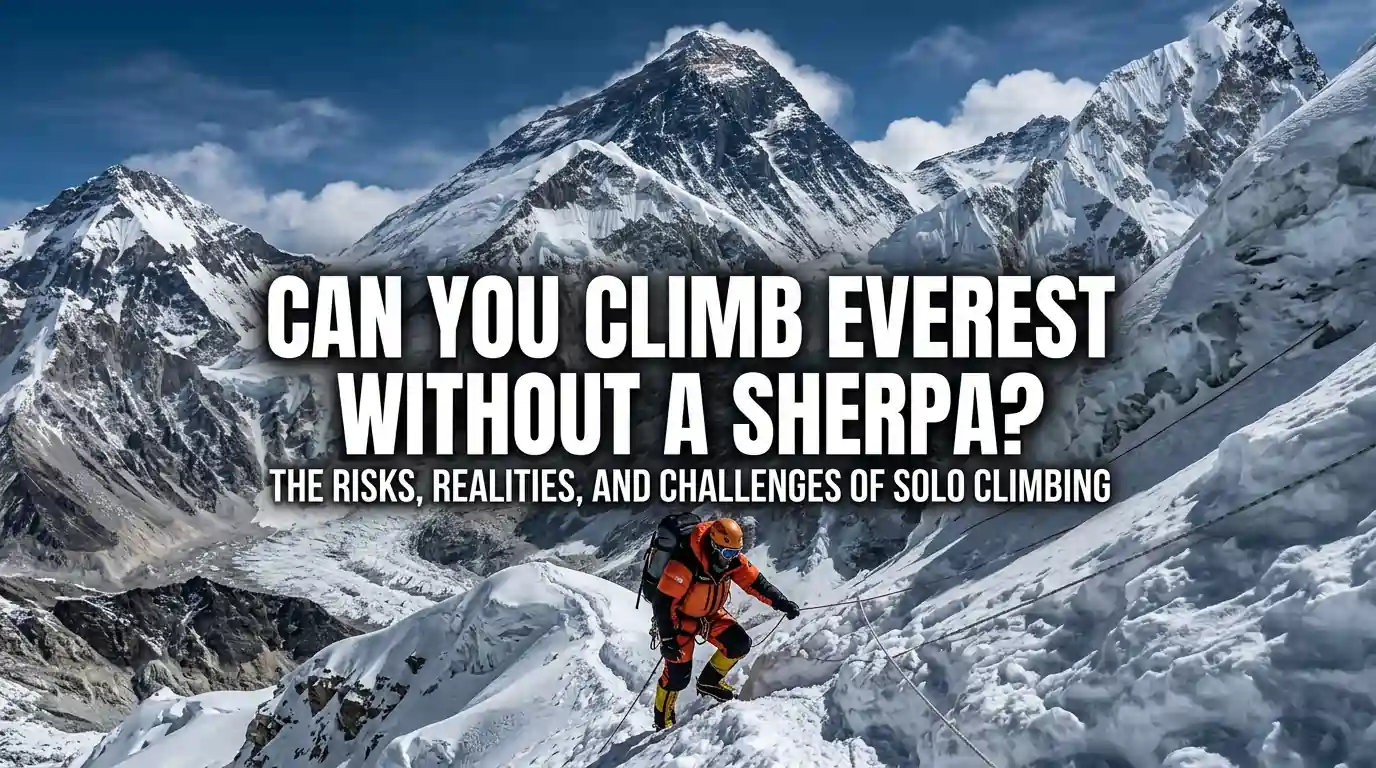
Picture this: you’re at 8,000 meters on Everest’s South Col, alone in the death zone, making every decision yourself while your oxygen-starved brain struggles to function. No Sherpa to manage your cylinders, no rescue if you collapse, no decades of route knowledge to draw on. Just you and the mountain in the most unforgiving environment on Earth.
In this blog about, can you climb Everest without a sherpa, we’ll explore whether this extreme approach is possible under current regulations and what is truly demanded from mountaineers. We’ll cover legal requirements in Nepal and Tibet, examine rare climbers who’ve succeeded independently on their Everest Expedition, break down essential skills needed, and explain why most serious mountaineers choose professional Sherpa support for summit attempts.
Can you legally climb Everest without a Sherpa?
Yes, climbing Mount Everest without a Sherpa is technically possible, but it’s exceptionally rare, dangerous, and often illegal under current regulations. Nepal officially requires foreign climbers to be paired with a registered guide or expedition company, with names and passport numbers documented by authorities. While a handful of elite mountaineers have circumvented or predated these rules, the vast majority of climbers choose Sherpa support not as a luxury but as a survival strategy.
The death rate for unsupported climbers runs significantly higher than for guided teams. Only a few individuals in mountaineering history have successfully summited without Sherpa assistance, and nearly all of them were professional climbers with decades of extreme altitude experience.
Start Your Everest Expedition Journey
1. Current Nepal Regulations for Independent Climbers
Nepal’s Department of Tourism requires all foreign climbers on Everest to be affiliated with a registered expedition company. The permit application process documents each climber’s name, passport number, and assigned guide, making truly independent climbing officially prohibited. Some climbers attempt to work around these rules, though doing so puts them in legal jeopardy and removes access to emergency support systems.
The regulations also stipulate a minimum ratio of one Sherpa guide per two climbers, though most serious expeditions provide one-to-one support.
2. Tibet and China Permit Requirements
The North Ridge route from Tibet has its own bureaucratic requirements that effectively prevent true solo attempts. Chinese authorities require expedition company affiliation, liaison officer assignment, and group permit applications. Independent climbing from the Tibet side faces even stricter enforcement than Nepal, with military checkpoints and mandatory group structures.
3. What “without Sherpa support” Actually Means
The phrase “climbing without a Sherpa” can mean very different things depending on who’s using it. Here’s the spectrum:
- Personal Sherpa guide: A dedicated support climber who carries loads, manages oxygen, assists with decisions, and provides rescue capability
- Fixed rope infrastructure: Routes prepared by Icefall Doctors and Sherpa teams each season, including ladders through the Khumbu Icefall and fixed lines to the summit
- Fully independent ascent: No use of any Sherpa-placed equipment, infrastructure, or support, the rarest form of Everest climbing
Most climbers who claim to have climbed “without Sherpas” still relied on fixed ropes installed by Sherpa teams. A truly independent alpine-style ascent, with no infrastructure whatsoever, has been achieved by only a handful of people in history.
What Sherpas Actually Do on Everest Expedition?
Sherpas provide comprehensive operational support that makes Everest expeditions possible. Their role includes load carrying, route fixing, oxygen management, emergency rescue, and weather decision support. Understanding these critical functions helps climbers appreciate why professional Sherpa support is essential for safe summit attempts rather than just a convenience.
1. Load Carrying and High Camp Setup
Sherpas carry supplies, tents, oxygen cylinders, food, and fuel to establish camps at 6,400m (Camp 1), 6,500m (Camp 2), 7,300m (Camp 3), and 7,950m (Camp 4). This involves multiple rotations through dangerous terrain, often carrying 25-30kg loads at altitudes where most climbers struggle to carry themselves. Without this support, you’d carry everything yourself, an additional 40-60kg of gear across the most hazardous sections of the mountain.
2. Route Fixing and Rope Installation
Each spring, the Icefall Doctors, a specialized Sherpa team, fix ropes and ladders through the Khumbu Icefall, the most technically dangerous section of the climb. Additional Sherpa teams install fixed lines from Camp 2 to the summit, a process that takes weeks and involves extreme risk. Even climbers who consider themselves “independent” typically rely on this infrastructure.
3. Oxygen Management and Emergency Rescue
Above 7,000m, Sherpas manage supplemental oxygen systems, monitor cylinder usage, swap regulators, and ensure climbers receive adequate flow rates. They also serve as the primary rescue resource in emergencies, if you collapse in the death zone, your Sherpa is likely the only person capable of getting you down alive.
4. Weather Monitoring and Summit Decision Support
Experienced Sherpas interpret conditions based on decades of collective knowledge, advising on go/no-go decisions that can mean the difference between summiting and dying. They communicate with base camp weather services, read cloud formations, and recognize wind patterns that signal incoming storms.
Plan Your Himalayan Journey with Experts
Get professional support from Marvel Treks or take on the ultimate challenge of the Everest Expedition with our experienced team.
Who Has Successfully Climbed Everest Without Sherpa Support?
Only a handful of elite mountaineers have successfully summited Everest without Sherpa support, fewer than ten people in history. These aren’t ambitious amateurs who trained hard; they’re world-class professionals like Reinhold Messner and Göran Kropp who spent decades mastering extreme altitude climbing. The list is so short because the challenge demands not just exceptional skill, but also the physiological adaptation and decision-making ability that comes only from years of 8,000-meter peak experience.
| Climber | Achievement |
| Reinhold Messner | First solo ascent without supplemental oxygen (1980) |
| Göran Kropp | Cycled from Sweden, climbed without Sherpa support or oxygen (1996) |
Messner spent years preparing for his solo ascent, and even he described it as the most dangerous thing he’d ever done. Kropp’s expedition, cycling 13,000km to Nepal, then climbing without support, remains one of the most remarkable feats in adventure history.
For context, over 6,000 people have summited Everest. The number who did so without any Sherpa support can be counted on two hands.
Climbing Everest Without Sherpas vs Without oxygen
Climbing without Sherpas and climbing without oxygen are two completely different challenges that many people mistakenly combine. You can choose to climb with Sherpa support but skip supplemental oxygen, use oxygen without Sherpa assistance, or take on the extremely rare challenge of attempting both. Each approach presents its own unique set of risks and requirements that climbers need to understand before making their decision.
1. What Climbing Without Supplemental Oxygen Means
Above approximately 8,000 meters in the death zone, the human body cannot acclimatize and starts breaking down rapidly. Supplemental oxygen systems deliver bottled air through masks and regulators, helping climbers maintain cognitive function, coordination, and consciousness at extreme altitudes. Without this support, your brain and body begin shutting down, making even simple decisions nearly impossible. Most climbers rely on oxygen to survive the final push to the summit and safely return to lower camps.
2. How Many Climbers Have Summited Everest Without Oxygen
Only about 200 people have successfully reached the summit without supplemental oxygen, representing roughly 3% of all successful Everest summits throughout history. These climbers possess exceptional physiological adaptation to high altitude, a rare trait usually discovered through years of climbing progressively higher peaks. The extremely low percentage shows just how difficult and dangerous climbing without oxygen truly is. Even experienced mountaineers with multiple 8,000-meter peaks often choose to use supplemental oxygen on Everest.
3. Why These Are Separate Mountaineering Challenges
The distinction matters because some climbers pursue one challenge while accepting help with the other:
- Without Sherpas: Removes logistical support, rescue capability, and route knowledge
- Without oxygen: Removes physiological assistance, dramatically increasing death zone exposure risk
- Without both: The rarest and most dangerous approach, achieved by only elite mountaineers
Skills and Experience Required to climb Everest Independently
Climbing Everest without Sherpa support demands exceptional technical skills, years of high-altitude experience, and the ability to manage every aspect of survival in the death zone. You need mastery of advanced mountaineering techniques, proven experience on multiple 8,000-meter peaks, and the mental fortitude to make critical decisions while your brain is starved of oxygen. This isn’t about being fit or determined; it’s about having the specific skill set that only comes from decades of progressive mountaineering experience.
1. Technical Mountaineering Prerequisites
Independent climbing demands complete mastery of glacier travel, crevasse self-rescue, fixed-line ascent and descent, high-altitude camping, ice axe arrest, and crampon technique on slopes steeper than 50 degrees. These technical skills cannot be learned on Everest itself; they require years of practice on progressively more challenging terrain across multiple expeditions. You must be proficient in rope work, anchor building, and technical ice climbing in conditions where a single mistake means death. Most climbers spend 5 to 10 years developing these competencies on lower peaks before even considering an independent Everest attempt.
2. Recommended Peak Progression Before Everest
Most mountaineers who attempt independent Everest climbs have already summited multiple 7,000-meter and 8,000-meter peaks without support, building both technical skills and physiological adaptation. A typical progression includes peaks like Island Peak (6,189m), Mera Peak (6,476m), Ama Dablam (6,812m), and at least one other 8,000-meter peak before considering Everest. This progression allows you to test your systems, understand your body’s response to extreme altitude, and develop the judgment needed for independent decision-making. Skipping these preparatory climbs dramatically increases your risk of failure or death on Everest.
3. Self-rescue and High-Altitude Navigation Competency
Without Sherpa support, you become entirely responsible for your own survival in every situation, from minor equipment failures to life-threatening emergencies. This means navigating in whiteout conditions using GPS and compass, recognizing and treating altitude sickness symptoms in yourself, performing self-rescue from crevasses, and making life-or-death decisions while cognitively impaired by altitude. You need the ability to assess your own deteriorating condition objectively, something that becomes nearly impossible above 8,000 meters. Most climbers who die on Everest do so because they fail to recognize when they’ve crossed the line from manageable difficulty to fatal emergency.
Risks of Climbing Everest Without Sherpa Assistance
Climbing Everest without Sherpa support dramatically increases your risk of death compared to professionally guided expeditions. The absence of experienced support means you face medical emergencies, rescue challenges, and critical weather decisions entirely alone. Understanding these specific dangers helps explain why mortality rates climb sharply for independent attempts in the death zone.
1. Altitude Sickness and Medical Emergencies
HACE and HAPE (High Altitude Cerebral Edema and High Altitude Pulmonary Edema) can progress from mild symptoms to life-threatening emergencies within hours at extreme altitude. Sherpas are trained to recognize early warning signs like confusion, coordination problems, or breathing difficulties and initiate immediate descent before conditions become critical. Without this professional monitoring, climbers often fail to recognize their own deteriorating condition until it’s too late to self-rescue. Your oxygen-starved brain loses the ability to assess your own symptoms objectively, making independent medical decision-making extremely dangerous above 7,000 meters.
2. Rescue Limitations for Independent Climbers
Above base camp, rescue operations depend almost entirely on Sherpa teams who have the strength, acclimatization, and technical skills to assist injured climbers. Helicopter evacuation becomes impossible above approximately 6,000m due to thin air, and even at lower elevations, weather conditions often prevent flights for days at a time. If you collapse in the death zone without Sherpa support, your chances of rescue approach zero since other climbers are typically too exhausted and oxygen-depleted to provide assistance. The mountain is littered with bodies of climbers who got into trouble without support systems in place.
3. Weather Decisions Without Professional Support
Everest’s weather can shift from calm to deadly conditions in under an hour, with storms bringing hurricane-force winds and whiteout visibility. Experienced Sherpas read subtle signs like specific cloud formations, wind direction changes, and temperature drops that indicate incoming storms, drawing on decades of collective knowledge passed down through generations. Independent climbers lack this accumulated expertise and weather pattern recognition, making them far more vulnerable to sudden changes that can trap them in exposed positions. Making the wrong call on summit day timing or turnaround decisions without professional input has killed more climbers than technical climbing difficulties.
What it Costs to Climb Everest With and Without Sherpa Support?
Climbing Everest without Sherpa support does not save money and often costs more than guided expeditions. Independent climbers face permit complications, higher insurance premiums for unsupported attempts, and must purchase all expedition-grade gear themselves. The extended timeline on the mountain increases food, fuel, and permit costs. When you factor in potential evacuation expenses and the difficulty of obtaining truly independent permits, the total cost frequently exceeds professionally guided expeditions that include comprehensive Sherpa support.
1. Base Costs for Independent Expeditions
Nepal’s climbing permit alone costs $11,000 USD. Add liaison officer fees, base camp services, garbage deposit, and required insurance, and you’re looking at $15,000-20,000 before buying any gear. The challenge is that permits typically require expedition company affiliation, truly independent permits are difficult or impossible to obtain under current regulations.
2. What Professional Sherpa Support Adds to the Price
A fully supported Everest expedition through a reputable operator typically costs $35,000-65,000 USD. This includes permits, logistics, base camp infrastructure, high camp support, oxygen systems, one licensed climbing Sherpa per member, weather forecasting, medical support, and emergency evacuation coordination.
3. Hidden Costs of Climbing Unsupported
Independent climbers face additional expenses that guided clients avoid:
- Gear purchases: $15,000-25,000 for expedition-grade equipment
- Rescue insurance: Higher premiums for unsupported attempts, often $2,000-5,000
- Extended timeline: More days on the mountain means more food, fuel, and permit extension fees
- Potential evacuation: $10,000-50,000 if something goes wrong and rescue is even possible
Why Most Serious Climbers Choose Sherpa-Supported Expeditions?
The climbers who know Everest best, those who have summited multiple times, who have seen what goes wrong, who understand the mountain’s true dangers almost universally choose Sherpa support. This isn’t weakness or inexperience. It’s wisdom.
Sherpa-supported expeditions organized by the best expedition and trekking company in Nepal provide safety systems dramatically improving survival odds: professional rescue capability, oxygen management, weather expertise, and accumulated high-altitude specialist knowledge. For climbers serious about reaching summits and returning home, questions aren’t whether climbing without Sherpa support is possible, but whether marginal personal achievement increases are worth dramatically increased death risks.
Marvel Treks’ Everest Expedition provides one licensed climbing Sherpa per member, robust oxygen systems, comprehensive base camp infrastructure, and decades of local expertise.
FAQs about climbing Everest without a Sherpa
What happens if you get injured climbing Everest without Sherpa support?
Rescue above base camp depends almost entirely on Sherpa teams, and independent climbers may face severely limited evacuation options in the death zone. Other climbers are typically too exhausted and oxygen-depleted to assist.
Can you hire a Sherpa partway through an Everest expedition?
This is sometimes possible at base camp if personnel are available, but it requires prior arrangement and isn’t guaranteed during climbing season when most Sherpas are already committed to other expeditions.
Do independent climbers still use fixed ropes installed by Sherpas?
Yes, most climbers who describe themselves as “independent” still rely on infrastructure like fixed ropes and ladders placed by Icefall Doctors and Sherpa teams each season.
What insurance do you need for an unsupported Everest climb?
High-altitude evacuation insurance is essential, and premiums are typically higher for unsupported attempts due to increased risk. Look for policies that explicitly cover climbing above 8,000m.
Is the death rate higher for climbers without Sherpa support?
Yes, unsupported climbers face significantly higher mortality due to lack of rescue capability, oxygen management assistance, and professional support in emergencies.
What is the 2pm rule on Everest?
This turnaround time guideline suggests that climbers who haven’t reached the summit by early afternoon turn back to allow safe descent before dark and deteriorating afternoon conditions.

Ready for your next Himalayan adventure?
Plan Your Next Big Adventure with Us
Explore Our AdventuresJoin our expert-guided journeys across Nepal and beyond, from classic trails to epic summits.