
Helicopter Rescue in Nepal: What to Expect and How to Prepare
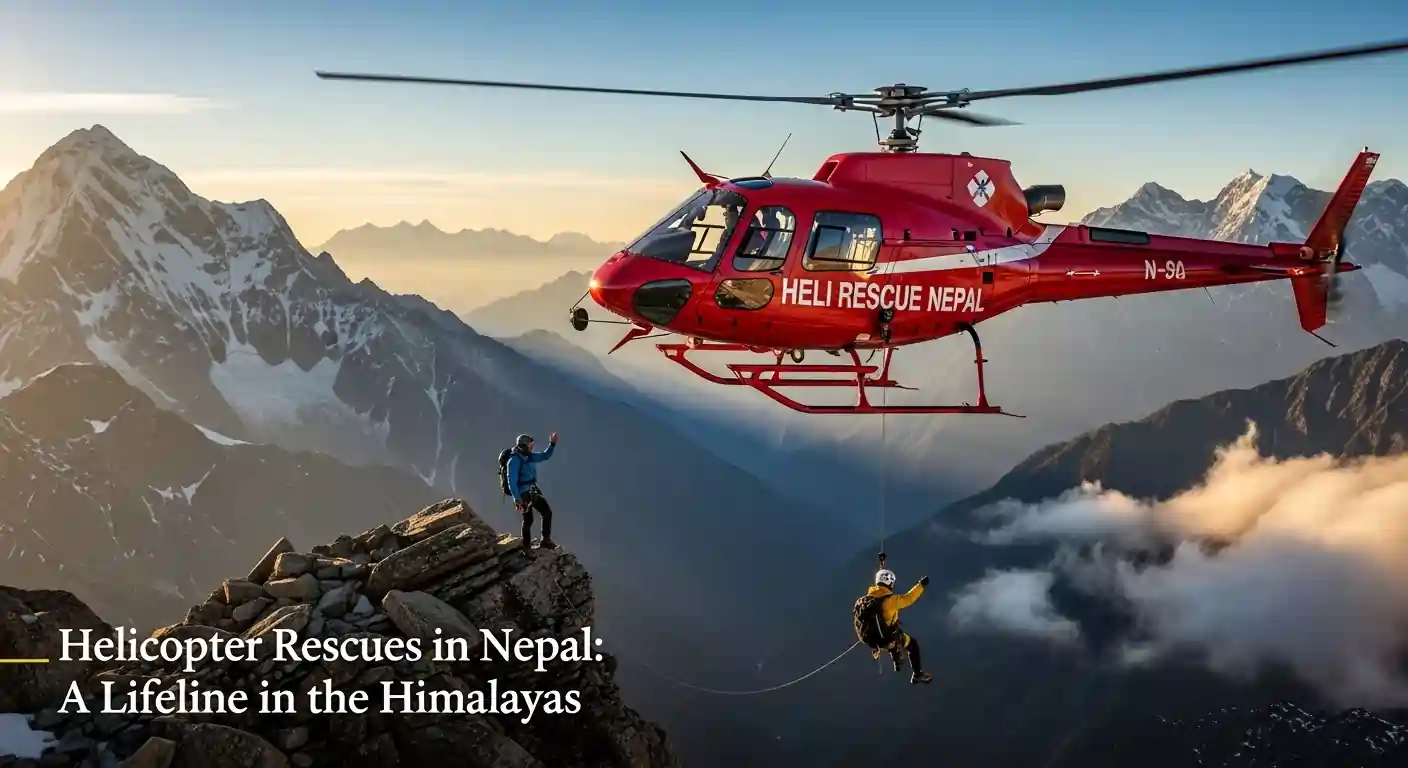
Imagine you’re standing at 5,000 meters, the air is thin, and suddenly, that persistent headache isn’t just “altitude”, it’s a signal that your body has hit its limit. In the remote, jagged peaks of the Himalayas, where there are no roads and the nearest clinic is a three-day walk away, the distant thwack-thwack-thwack of rotor blades is the most beautiful sound in the world. A mountain rescue isn’t just a flight; it’s a high-stakes, precision operation where elite pilots battle unpredictable winds and thin air to pluck you from the side of a giant. I
In this blog, we’re breaking down everything you need to know about a helicopter rescue in Nepal, from the technical reality of how pilots navigate “hot and high” conditions to the logistical steps you need to take to trigger an evacuation. We’ll talk about what the blog is going to be about: we will cover the critical role of travel insurance, how to communicate your coordinates in a dead zone, and what actually happens from the moment you board the bird to the moment you land in a Kathmandu hospital. Whether you’re a solo trekker or part of an expedition, this guide is your essential briefing on the mechanics of Himalayan rescues, ensuring that if the worst happens, you’re ready to act with total confidence during your adventure trekking in Nepal.
What Is Helicopter Rescue in Nepal?
A helicopter rescue in Nepal is an emergency aero-medical evacuation designed to uplift trekkers or climbers from remote, roadless areas of the Himalayas to medical facilities in Kathmandu or Pokhara. It is a critical life-saving intervention used when life-threatening conditions like HAPE, HACE, or severe trauma occur in high-altitude zones where ground evacuation is impossible or too slow to be effective.
In the vertical world of the Nepal Himalayas, a helicopter rescue is often the only viable “ambulance” service available. Because much of the trekking network, including the Everest Base Camp and Annapurna Circuit routes, exists in regions entirely devoid of roads, a medical crisis at 5,000 meters cannot be solved by a simple drive to a clinic. Instead, elite pilots fly specialized, high-performance aircraft (typically the Airbus H125 B3) into “hot and high” conditions to perform precision landings on tiny, carved-out ledges or rocky moraines. These missions are triggered by severe altitude sickness, debilitating physical injuries like broken limbs, or acute medical emergencies that require immediate hospital-grade intervention.
While these rescues can happen anywhere in the country, they are most frequent in high-traffic regions like the Khumbu (Everest), the Annapurna massif, and the Langtang Valley. In these areas, the combination of extreme elevation and unpredictable weather makes the “window” for a safe evacuation incredibly tight. A rescue isn’t just a flight; it is a coordinated logistical feat involving your trekking guide, a satellite communication link, an insurance provider, and a ground-based rescue coordinator in Kathmandu. Knowing that this safety net exists allows trekkers to push their limits, but it requires a deep understanding of the protocols involved to ensure the rotors start spinning the moment they are needed.
Also Read: Helicopter Tour in Nepal
Why Helicopter Rescue Is Important in Nepal’s Trekking Regions?
Helicopter rescue in Nepal is the only reliable “life-line” in the Himalayas because the vast majority of trekking routes are located in roadless, high-altitude wilderness where ground evacuation is physically impossible. In a medical crisis, these high-performance aircraft bridge the gap between a remote mountain trail and a life-saving hospital in Kathmandu within minutes instead of days.
- Zero Road Infrastructure: Most world-class trekking routes, like the Everest Base Camp trail, exist entirely in regions accessible only by foot or animal, meaning a sick trekker cannot simply be “driven” to safety.
- Combatting Rapid Altitude Sickness: Conditions like HAPE (fluid in lungs) and HACE (brain swelling) can become fatal within hours; a helicopter is the only way to achieve the mandatory “immediate descent” of thousands of meters.
- The Golden Hour Rule: In trauma cases or cardiac events, reaching a surgical theater within the “golden hour” is critical for survival, a feat only possible via an aero-medical lift.
- Extreme Weather Isolation: High passes can be choked by sudden blizzards, trapping ground teams; helicopters can often utilize small “weather windows” to extract patients who would otherwise be stranded.
- Logistical Efficiency for Guides: Having a pre-arranged rescue protocol allows expedition leaders to focus on stabilizing the patient while the air support handles the heavy lifting of the evacuation.
Common Situations That Require Helicopter Rescue in Nepal
Helicopter rescue in Nepal is typically triggered by life-threatening high-altitude illnesses like HAPE and HACE, traumatic orthopedic injuries from falls, or sudden medical crises like cardiac distress. In these critical scenarios, the extreme geography of the Himalayas makes ground evacuation impossible, leaving a rotor-wing extraction as the only viable method to reach a hospital within the “golden hour” of survival.
Altitude Sickness (AMS, HAPE, HACE)
While mild AMS can often be managed with rest or descent on foot, severe cases like High Altitude Pulmonary Edema (HAPE) or Cerebral Edema (HACE) are absolute medical emergencies that require immediate evacuation. These conditions involve fluid buildup in the lungs or brain swelling, leading to extreme breathlessness, confusion, and loss of coordination. Because the only definitive cure is a rapid loss of altitude, a helicopter is the only tool capable of dropping a patient 2,000 meters in minutes. In these life-or-death moments, the speed of a helicopter rescue in Nepal is the difference between a full recovery and a fatal outcome.
Injuries and Accidents During Trekking
The rugged, unstable trails of the Everest or Annapurna regions are prime environments for traumatic injuries, ranging from compound fractures to severe spinal trauma caused by falls on steep moraine. When a trekker is unable to walk due to a broken limb or a debilitating head injury, carrying them manually over a high mountain pass is often dangerously slow and physically grueling for the rescue team. A helicopter can reach remote “landing zones” near most major campsites, providing a stable, fast platform to transport the injured party directly to a surgical theater in Kathmandu. This precision extraction prevents further tissue damage and speeds up the onset of professional orthopedic care.
Sudden Illness or Medical Emergencies
Beyond altitude and trauma, trekkers can fall victim to acute medical crises such as heart attacks, strokes, or severe systemic infections like sepsis from untreated gastrointestinal issues. The physical stress of trekking at 5,000 meters can exacerbate underlying conditions, turning a minor health concern into a critical emergency in a matter of hours. Because most trekking lodges lack even basic diagnostic equipment, a helicopter becomes a flying intensive care unit, often equipped with oxygen and basic monitoring tools to keep a patient stable during the flight. Rapid transport to a city hospital ensures that specialized doctors can begin life-saving interventions that simply aren’t possible in a plywood teahouse.
Weather-Related Emergencies
The Himalayas are notorious for sudden, violent shifts in weather that can turn a sunny trail into a death trap of waist-deep snow or trigger massive landslides that cut off entire valleys. In situations where a trekking group is stranded behind a closed pass or buried in a remote high camp, a helicopter is the only vehicle capable of breaking the isolation. Pilots often utilize tiny “weather windows” to swoop in and extract trekkers before the next storm front moves in. These rescues are essential for preventing mass hypothermia or starvation when groups are trapped without adequate supplies or shelter due to environmental catastrophes.
How Does Helicopter Rescue in Nepal Work?
The process of a helicopter rescue in Nepal is a highly coordinated logistical operation that moves from the initial distress signal on the trail to insurance authorization and the rapid dispatch of a high-altitude aircraft. This system relies on a seamless link between your trekking guide, your insurance provider’s emergency hotline, and the helicopter operators in Kathmandu to ensure a “Guarantee of Payment” is secured before the rotors even start spinning. It is a race against both the clock and the unpredictable mountain weather to extract a patient safely.
Step 1: Emergency Communication
The moment a medical crisis is identified, the trekking guide or lodge owner must establish a communication link with the trekking agency’s base in Kathmandu or the nearest rescue coordination center. In remote “dead zones,” this is often done via satellite phones or SOS devices like a Garmin inReach, providing the patient’s exact GPS coordinates, current altitude, and a detailed summary of symptoms. Accurate communication is vital, as pilots need to know the specific terrain and weather conditions at the landing site to determine if a safe approach is possible. This initial call sets the entire rescue machinery in motion, alerting the medical teams and flight crews that a mission is imminent.
Step 2: Insurance Verification
Once the agency receives the distress call, they immediately contact your travel insurance provider to secure a “Guarantee of Payment” (GOP), which is required by helicopter companies before a rescue can be officially dispatched. This step involves a rapid exchange of your policy details, passport copy, and a medical validation from the guide or a local HRA doctor to confirm the necessity of the flight. If there is a delay in insurance approval, some agencies may ask for a credit card guarantee to avoid wasting precious time during a life-threatening emergency. Having digital and printed copies of your insurance policy easily accessible in your pack is the best way to speed up this administrative hurdle.
Step 3: Dispatching the Rescue Helicopter
After financial clearance is obtained, the rescue helicopter, usually a high-performance Airbus H125 B3, is dispatched from the nearest available hub, such as Kathmandu, Pokhara, or Lukla. The pilot navigates through complex mountain valleys using visual flight rules (VFR), often battling high winds and thin air to reach the designated landing zone. Upon arrival, the crew performs a precision landing or, in extreme terrain, a “long-line” extraction to pluck the patient from the slope. The efficiency of this stage is entirely dependent on the “weather window,” as pilots must be able to see the terrain clearly to perform these high-stakes maneuvers safely.
Step 4: Evacuation to Hospital
Once the patient is securely on board, the helicopter flies directly to the nearest airstrip or medical hub, such as Lukla or Pokhara, for initial stabilization before the final leg to Kathmandu. In the capital, an ambulance is usually waiting at the helipad to transport the patient directly to an international-standard hospital specializing in altitude-related illnesses and trauma. The trekking agency continues to coordinate with the hospital and the insurance company, ensuring that medical reports are shared and that family members are kept updated on the patient’s condition. This final transition ensures that the trekker moves from a primitive mountain environment to a modern ICU in a matter of hours.
Related Topic: Everest Heli Tour
Cost of Helicopter Rescue in Nepal
On average, a helicopter rescue in Nepal costs between $3,000 and $10,000 USD per mission, depending on the altitude and the distance from Kathmandu or Pokhara. While this price tag is significant, it covers the specialized high-altitude aircraft, elite pilot expertise, and the complex logistics required to operate in one of the world’s most unforgiving environments.
Average Rescue Costs
For popular routes like the Everest Base Camp trek, you can expect to pay between $4,000 and $7,500 for a one-way evacuation to Kathmandu. Rescues from the Annapurna or Langtang regions are slightly more affordable, typically ranging from $2,500 to $5,500, due to their proximity to major aviation hubs. However, if you are in a truly remote “restricted area” like Upper Mustang, Kanchenjunga, or the far west, the bill can easily climb toward $15,000 or more because of the extended flight time and the need for multiple fuel stops. These costs are usually billed by the “flight hour,” which in 2026 averages around $2,500 to $3,500 per hour for a high-performance Airbus H125.
Factors Affecting Cost
The primary driver of the price is the altitude of the pickup point, as flying above 5,000 meters requires specialized “B3” series helicopters that are more expensive to operate and maintain. Distance is the second factor; a rescue from Gorak Shep (near Everest) takes much longer and consumes more fuel than a lift from Namche Bazaar. Weather also plays a hidden role, if a pilot has to circle or wait for a “cloud window” to open, the hourly meter keeps running, adding hundreds of dollars to the final invoice. Finally, the time of day matters, as “search and rescue” missions that extend into the late afternoon or require specialized “long-line” technical maneuvers often carry a premium surcharge.
Who Pays for the Rescue?
In almost all cases, the financial responsibility lies with the trekker, which is why having specialized high-altitude travel insurance is non-negotiable. If your policy is valid, your insurance company will issue a “Guarantee of Payment” (GOP) to the helicopter operator, allowing the rescue to proceed without you paying a cent upfront. However, if you don’t have insurance or your policy excludes your current altitude (often capped at 3,000m or 4,000m), you will be required to provide a credit card guarantee or a cash deposit before the rotors start spinning. It is critical to choose a policy that offers “Direct Payment” to the provider, so you aren’t left trying to find $5,000 on your card while struggling with altitude sickness.
Importance of Travel Insurance for Helicopter Rescue
Specialized travel insurance is the single most important document for a helicopter rescue in Nepal because it provides the financial guarantee required to dispatch an aircraft immediately. Without a verified policy that covers high-altitude evacuation, you may face life-threatening delays while rescue agencies wait for a massive upfront cash deposit or credit card clearance.
What to Look for in Insurance Coverage
When selecting a policy, the most critical factor is the altitude limit, which must explicitly cover your trek’s highest point, typically 6,000 meters for routes like Everest Base Camp or the Annapurna Circuit. You must also ensure the policy includes “Search and Rescue” as a separate benefit from “Medical Evacuation,” as some insurers will only pay if a doctor has already diagnosed a condition. Additionally, look for “Direct Billing” or “Cashless” provisions, which allow the insurance company to coordinate directly with the helicopter operator. This removes the burden of you having to pay $5,000 to $10,000 out-of-pocket and filing for a reimbursement later, which can be a financial nightmare.
Popular Insurance Requirements for Nepal Treks
Most reputable trekking agencies and local authorities now require a minimum medical coverage limit of $100,000 and an evacuation limit of at least $50,000 to $100,000 to account for complex rescue scenarios. Your policy documentation should be clearly printed and kept in an accessible part of your pack, featuring the 24-hour emergency assistance number and your specific policy ID. It is also common for insurers to require that you trek with a licensed guide and through a registered agency to keep the policy valid. Always verify that your specific activities, such as “trekking up to 6,000m” ,are listed in the “Included Activities” section of your Product Disclosure Statement (PDS) before you leave home.
Risks of Trekking Without Insurance
Trekking in the Himalayas without specialized insurance is a massive financial gamble that can result in a debt of $10,000 or more for a single 90-minute flight. Beyond the money, the real danger is delayed rescue, as helicopter companies often refuse to launch a mission until they have a “Guarantee of Payment” from a recognized insurer or a massive cash deposit. In cases of HAPE or HACE, where survival depends on descending thousands of meters within an hour, these administrative delays can be fatal. Furthermore, you will be personally liable for all hospital bills in Kathmandu, which can quickly spiral into the thousands for intensive care and specialized altitude treatments.
How to Prepare for Helicopter Rescue in Nepal?
Preparing for a helicopter rescue involves securing high-altitude travel insurance, keeping your vital documents accessible, and ensuring your trekking guide has a clear “Emergency Action Plan” (EAP) for your specific route. While no one plans to be evacuated, having these logistics finalized before you hit the trail reduces the “dispatch time” from hours to minutes, which is often the difference between a successful recovery and a critical medical crisis.
Carry Essential Documents
You must always have physical and digital copies of your passport and your travel insurance policy, specifically the page showing your high-altitude coverage limit and the 24-hour emergency assistance number. In a rescue scenario, the helicopter operator and the hospital in Kathmandu will require these documents immediately to verify your identity and secure a “Guarantee of Payment.” Keeping these in a waterproof, “grab-and-go” pouch in your daypack ensures they aren’t buried in your main duffel when the rotors are spinning.
Inform Your Guide or Trekking Agency
Before you leave Kathmandu, provide your trekking agency with a detailed medical history, including any allergies, current medications, and previous experiences with altitude. Your guide should also have the direct contact details for your primary emergency contact and your insurance provider’s global hotline. This transparency allows the ground team to communicate effectively with medical professionals and insurance adjusters while you are being stabilized on the mountain.
Pack Emergency Gear
Every trekker should carry a personal communication device, such as a Garmin inReach or a satellite phone, especially if trekking in “dead zones” where cellular signal is non-existent. Additionally, a whistle, a high-visibility emergency blanket (space blanket), and a small mirror are vital for signaling a pilot once the helicopter is in your vicinity. Providing your exact GPS coordinates via a satellite messenger is the most effective way to ensure the pilot finds your location on the first pass, saving precious fuel and time.
Understand Rescue Protocols Before Trekking
Take the time to walk through the “Evacuation Drill” with your guide before you cross the 3,000-meter mark, ensuring you know exactly how to behave when a helicopter approaches. This includes understanding hand signals, knowing how to secure loose gear at the landing zone, and recognizing the “Abort” signals used by pilots in turbulent weather. Being mentally prepared for the noise, downwash, and rapid transition of a heli-rescue prevents panic and ensures the safety of both the trekking group and the flight crew.
Safety Tips to Avoid Needing a Helicopter Rescue
Preventing a helicopter rescue in Nepal is primarily about mastering the “art of the slow ascent” and maintaining a rigorous self-monitoring routine to catch minor symptoms before they become medical emergencies. While these high-performance aircraft are a vital safety net, the goal of every successful trekker should be to reach the summit and return to the trailhead on their own two feet by respecting the physiological limits of the human body.
- Adhere to a Conservative Acclimatization Schedule by never increasing your sleeping altitude by more than 300 to 500 meters per night once you cross the 3,000-meter threshold. Taking mandatory rest days in villages like Namche Bazaar or Manang allows your blood chemistry to adapt naturally, significantly reducing the risk of life-threatening HAPE or HACE.
- Master the “Himalayan Shuffle” by maintaining a slow, rhythmic walking pace that keeps your heart rate in a sustainable zone. Overexertion at high altitude rapidly depletes your oxygen reserves and suppresses your immune system, making you far more susceptible to sudden exhaustion or acute altitude sickness.
- Hydrate Aggressively with Electrolytes by consuming 4 to 5 liters of water daily to combat the rapid fluid loss caused by thin, dry mountain air. Proper hydration keeps your blood volume stable and helps your kidneys efficiently process the bicarbonate buildup that occurs as you breathe faster to compensate for low oxygen levels.
- Strictly Follow Your Lead Guide’s Instructions regarding pace, diet, and symptoms, as their years of experience allow them to spot “altitude brain” or physical decline long before you notice it yourself. If a veteran guide tells you to stop or descend, doing so immediately is the best way to avoid a forced medical evacuation.
- Monitor Weather Patterns and Trail Conditions using reliable satellite forecasts or local reports before attempting high passes like Thorong La or Cho La. Pushing into a developing storm or ignoring “avalanche or landslide” warnings is the fastest way to become stranded in a situation where only a high-risk helicopter extraction can save you.
- Perform “Self-Check” Health Audits every morning and evening, paying close attention to persistent headaches, loss of appetite, or a “wet” cough. Catching these early warning signs and taking a “buffer day” at a lower elevation can resolve 90% of issues that would otherwise require a $5,000 flight back to Kathmandu.
Challenges of Helicopter Rescue in Nepal
Conducting a helicopter rescue in Nepal is an extreme aviation challenge due to the combination of volatile mountain weather, thin high-altitude air, and the lack of prepared landing zones in the deep Himalayas. These factors create narrow “operation windows” where pilots must execute precision maneuvers in environments that push the mechanical limits of even the most advanced aircraft.
Weather Limitations
The Himalayas are notorious for sudden, violent shifts in weather that can ground all aviation in a matter of minutes. High winds, dense fog, and heavy snowfall often create “whiteout” conditions, making it impossible for pilots to navigate the deep, narrow valleys of regions like Everest or Annapurna. Because these rescues rely on Visual Flight Rules (VFR), even a small cloud bank sitting over a high pass can delay a life-saving flight for hours or even days, forcing ground teams to stabilize patients in primitive conditions while waiting for a clear window.
High-Altitude Flying Risks
As altitude increases, the air becomes significantly “thinner,” which drastically reduces the lift generated by a helicopter’s rotors and the power output of its engine. Flying a helicopter rescue in Nepal above 5,000 meters requires specialized “hot and high” aircraft like the Airbus H125, which are stripped of non-essential weight to maximize performance. Pilots must manage a very narrow “power margin,” meaning a single gust of wind or a slight miscalculation in air density can lead to a catastrophic loss of control during the most critical phases of the mission.
Remote Landing Zones
Unlike city hospitals with paved helipads, a Himalayan landing zone is often nothing more than a jagged rocky ledge, a sloped moraine, or a tiny clearing between towering peaks. In many cases, the terrain is so steep or unstable that the pilot cannot actually “land,” instead performing a “hover-exit” where the skids lightly touch the ground while the rotors remain at full power. If a patient is stranded on a vertical face or a crevassed glacier, the crew may have to resort to “long-line” rescues, suspending a rescuer on a cable below the aircraft, which is the most technically demanding and dangerous maneuver in mountain aviation.
Conclusion
A helicopter rescue in Nepal is much more than just a flight; it is a sophisticated, life-saving operation that bridges the gap between the world’s most remote trails and modern medical care. While the sight of a rescue bird against the backdrop of the Himalayas is awe-inspiring, it serves as a sobering reminder of the power of high altitude and the importance of professional preparation. By securing the right insurance, choosing a reputable trekking agency, and respecting your body’s signals, you ensure that this critical resource remains a reliable “plan B” while you focus on the journey of a lifetime.
Ultimately, the goal of any trekker should be to reach the pass and return to the valley on their own two feet. However, knowing that a network of elite pilots, experienced guides, and medical professionals is standing by gives you the mental freedom to push your boundaries safely. Whether you’re navigating the Everest moraine or the Annapurna forests, stay informed, stay insured, and respect the mountains, they are as unforgiving as they are beautiful.
Ready to Trek with the Safety Experts?
Don’t leave your mountain safety to chance. Marvel Treks provides the industry’s most robust emergency protocols, ensuring every client is backed by 24/7 satellite communication and priority helicopter rescue coordination.
Frequently Asked Questions (FAQs)
How long does it take for a rescue helicopter to arrive?
Depending on weather and your location, a helicopter can typically reach major trekking hubs like Everest Base Camp or Annapurna Base Camp within 1 to 3 hours of dispatch. However, if insurance verification is delayed or if there is a “cloud cap” over a high pass, you may have to wait until the next clear weather window, which can sometimes take until the following morning.
Does travel insurance pay the helicopter company directly?
Most “premium” high-altitude policies provide “Direct Payment” or a “Guarantee of Payment” (GOP) to the operator, meaning you don’t have to pay anything upfront. It is vital to check your policy for this feature, as “reimbursement-only” plans require you to pay the $5,000+ bill out-of-pocket before you can claim it back.
Can helicopters fly at night in the Himalayas?
No, helicopter rescues in Nepal are strictly conducted under Visual Flight Rules (VFR), meaning they can only fly during daylight hours. If an emergency occurs after sunset, the trekking guide must stabilize the patient at a lodge or camp until the first light of the following day when it is safe for the pilot to navigate the terrain.
What is a “long-line” rescue?
A long-line rescue is a technical maneuver where a rescuer is suspended on a 50-meter cable below the helicopter to pluck a patient from a vertical cliff or a glacier where the aircraft cannot land. This is the most dangerous and expensive type of rescue, reserved for extreme terrain where a standard landing is physically impossible.
Can I request a helicopter rescue just because I’m tired?
While you can technically request a private charter, insurance companies will NOT cover the cost unless there is a legitimate medical necessity documented by a guide or doctor. Using a rescue flight as a “shortcut” is considered a non-emergency charter and will result in a personal bill of several thousand dollars.
Where is the nearest hospital after a rescue?
Most rescue flights from the Everest or Annapurna regions fly directly to specialized hospitals in Kathmandu, such as CIWEC Clinic or Era Health. These facilities are internationally accredited and specialize in high-altitude medicine, frostbite treatment, and mountain trauma.
What happens if the weather is too bad for a helicopter?
If the weather is “grounded,” your trekking guide will initiate a ground-based evacuation, which may involve horses, porters, or a manual stretcher to move you to a lower altitude. This is why carrying a comprehensive medical kit is essential, as you may need to be stabilized for 12–24 hours before a flight becomes possible.
How many people can fit in a rescue helicopter?
Due to the thin air at high altitudes, a rescue helicopter can usually only lift the patient and one medical attendant or guide at a time. At lower elevations, the aircraft may have more “lift,” but in the “death zone” or high camps, pilots must keep the weight to an absolute minimum to ensure a safe takeoff.

Ready for your next Himalayan adventure?
Plan Your Next Big Adventure with Us
Explore Our AdventuresJoin our expert-guided journeys across Nepal and beyond, from classic trails to epic summits.