
How Many Days Does It Takes to Climb Mount K2: Complete Guide
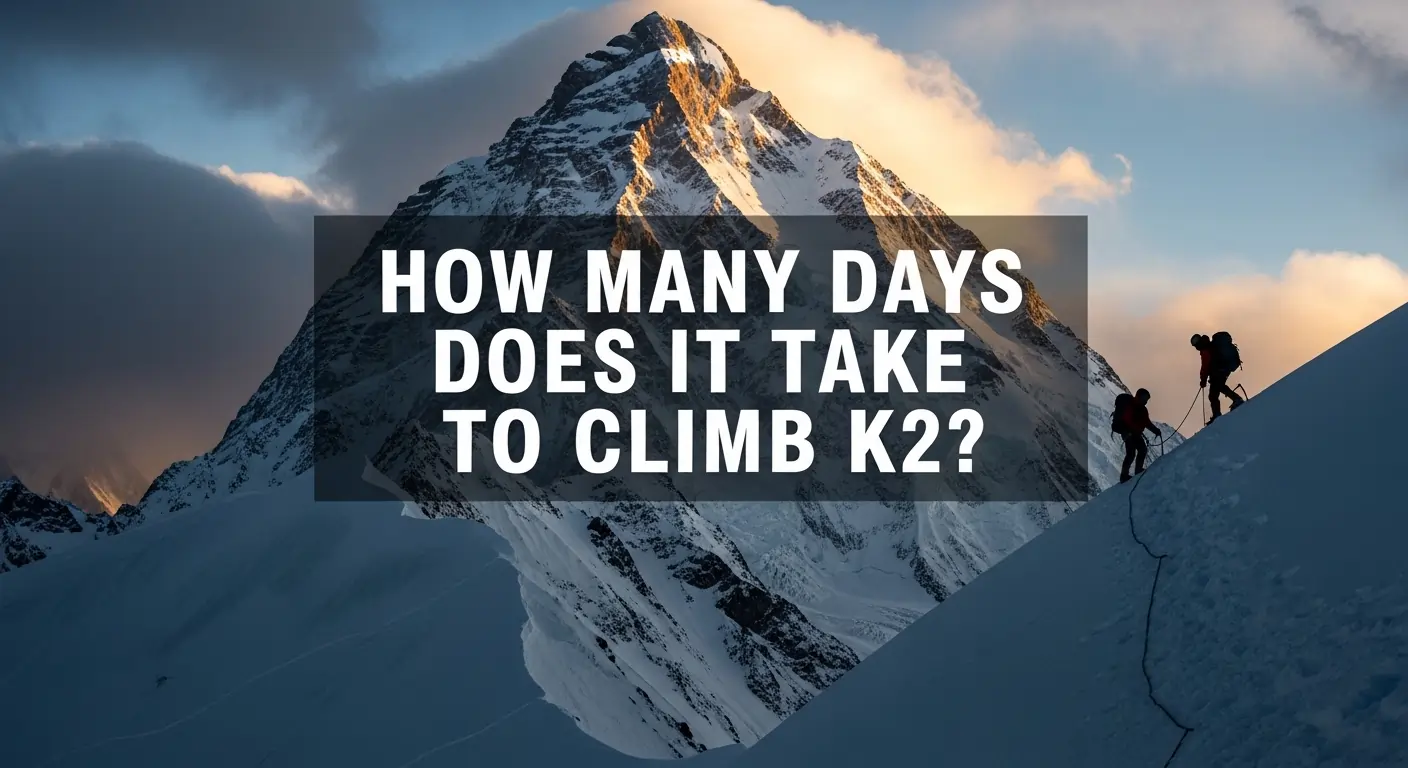
Climbing K2 Mountain, the “Savage Mountain,” is widely considered the ultimate challenge in high-altitude mountaineering. Standing at 8,611 meters (28,251 feet) in the Karakoram Range of Pakistan, it is notorious for its extreme technical difficulty, unpredictable weather, and the iconic “Bottleneck” traverse. Unlike Everest, this peak demands a higher level of technical skill and mental fortitude. In the modern era of climbing, the timeline for an expedition is a high-stakes balancing act between physical preparation, technical rope fixing, and waiting for a stable window in one of the most volatile environments on Earth.
In this guide, we will break down exactly how many days it does it takes to climb K2. We will explore the journey from the sweltering heat of Islamabad to the frozen heights of the Abruzzi Spur. Understanding this timeline is vital for any climber looking to test their limits against a mountain that earns its reputation with every vertical meter.
Introduction to Climbing K2
A standard K2 expedition generally takes between 60 to 75 days, depending on weather stability and the team’s technical pace. Located in the heart of the Karakoram Range on the border between Pakistan and China, K2 is famously known as the “Savage Mountain” due to its near-vertical slopes and extreme technical difficulty. Unlike other 8,000-meter peaks, K2 offers almost no flat ground once the climb begins, requiring athletes to commit to a grueling two-month timeline that balances physical power with the patience required to wait out Karakoram’s notorious storms.
Climbers attempt K2 not for its height, as it is the second-tallest on Earth, but for the prestige of conquering its technical defenses, such as the House’s Chimney and the Black Pyramid. The journey begins with a long approach through the Baltoro Glacier, leading to a month of establishing high camps and acclimatizing to the thinning air. Because the weather windows in northern Pakistan are significantly shorter and more violent than those in the Himalayas, the 60-to-75-day schedule is essential to provide climbers with enough “buffer time” to safely navigate the “Death Zone” and return from the 8,611-meter summit.
Explore the Ultimate K2 Expedition
How Many Days Does It Take to Climb K2?
A standard K2 expedition takes approximately 60 to 75 days to complete, with the vast majority of that time dedicated to technical acclimatization and waiting for a viable weather window. This timeline covers the initial 14-day trek to Base Camp, followed by roughly 40 days of establishing high camps and rotating between them to adapt to the extreme altitude. When figuring out how to climb k2 mountain, you’ve gotta realize that because K2 is located further north than Everest, the climbing season is shorter and more volatile, it’s basically like trying to host a garden party in the middle of a hurricane, making this two-month commitment a biological and logistical necessity for a safe return.
Why Climbers Spend Weeks Acclimatizing
Acclimatization is a life-saving process that allows the body to survive in the “Death Zone” above 8,000 meters, where oxygen levels are dangerously low. Climbers spend weeks moving between Base Camp (5,150m) and higher camps, essentially “training” their blood to produce more red cells to transport oxygen more efficiently. While many wonder how far is K2 from Everest in terms of geographic distance, the physiological jump between these two giants is even more significant, as the slow progression used here is the only way to prevent High Altitude Pulmonary Edema (HAPE) and ensure the brain remains functional during the highly technical sections of the upper mountain.
Typical Expedition Timeline from Arrival to Summit
The journey begins with a 7-to-10-day trek across the Baltoro Glacier just to reach the mountain’s foot, followed by a month-long cycle of fixing ropes and stocking high camps. Once the team is fully acclimatized and a 3-to-4-day weather window is identified, the final summit push begins, involving a grueling ascent through the Bottleneck and a rapid descent. Totaling roughly 11 weeks, this schedule accounts for the high probability of being pinned down by storms, which are far more frequent in the Karakoram than in other ranges.
Why Does It Take So Long to Climb K2?
It takes approximately 60 to 75 days to climb K2 because the mountain’s extreme technicality and volatile weather patterns require a much longer preparation phase compared to other peaks. Beyond the month-long biological process to acclimatize during K2 expedition, climbers must spend weeks physically fixing thousands of meters of rope and hauling essential gear to four high camps. The timeline is further extended by Karakoram’s notorious storms, which tend to have the temperament of a hangry toddler, often forcing teams to remain at Base Camp for 10 to 14 days at a time while waiting for a safe window.
High Altitude Acclimatization
Adapting to the “thin air” of the Karakoram is a slow, mandatory process that cannot be rushed without risking life-threatening altitude sickness. Climbers perform multiple “rotations,” moving from Base Camp to Camp II or III and back down, to stimulate the production of red blood cells. This biological adjustment is the only way to ensure the heart and lungs can function when oxygen levels drop to nearly one-third of sea-level capacity above 8,000 meters.
Establishing High Camps on the K2 Route
Unlike more commercialized peaks, K2 requires immense effort to establish its four staging areas: Camp I (6,050m), Camp II (6,700m), Camp III (7,250m), and Camp IV (8,000m). Sherpas and high-altitude porters must ferry hundreds of kilograms of oxygen, food, and tents up nearly vertical rock and ice faces like the House’s Chimney. This logistical chain takes weeks to finalize, as each camp must be fully stocked and the safety ropes must be perfectly anchored before the final summit push can even be considered.
Waiting for a Safe Weather Window
K2 is infamous for having some of the most unpredictable and violent weather on Earth, with the Jet Stream frequently battering the summit with hurricane-force winds. Because the climbing season is so short, expeditions often spend two to three weeks in a state of “active waiting,” monitoring satellite forecasts for a rare 48-to-72-hour lull in the wind. Attempting the summit outside of these precise windows is virtually impossible due to extreme wind chill and zero visibility.
Technical and Dangerous Terrain
The sheer steepness and technicality of K2 mean that progress is measured in meters per hour rather than kilometers. Sections like the Black Pyramid and the avalanche-prone Bottleneck require slow, methodical movement and constant vigilance against rockfall and shifting ice. This slow pace is a safety necessity; the terrain is so unforgiving that a single error can be fatal, forcing teams to move with extreme caution and allowing for extra “buffer days” in the itinerary to manage unexpected obstacles.
Ready for Your Next Adventure in Nepal?
Discover unforgettable trekking, mountaineering, and expedition experiences with Marvel Treks – your trusted adventure partner in the Himalayas.
K2 Expedition Timeline Breakdown
The K2 expedition is a multi-phased operation that typically spans 60 to 75 days, involving a meticulous progression from the sweltering lowlands of Pakistan to the “Savage” heights of the Karakoram. The timeline is strategically divided into the approach trek, multiple high-altitude rotations for acclimatization, and a high-stakes waiting period for a viable weather window. Each phase is critical, as K2 offers almost no room for error, requiring climbers to be at their peak physical and mental state for the final push through the Bottleneck.
| Phase | Core Activities | Typical Duration | Focus & Logistics |
| Preparation | Arrival & Islamabad Logistics | 3–5 Days | Finalizing climbing permits with the Alpine Club of Pakistan, gear checks, and official briefings. |
| The Approach | Trek to K2 Base Camp | 10–14 Days | A rugged journey from Skardu through the Baltoro Glacier, passing Concordia to reach Base Camp (5,150m). |
| Base Camp Setup | Puja & Technical Drills | 5–7 Days | Establishing a semi-permanent home, checking technical gear, and performing safety drills on nearby ice. |
| Rotations | Acclimatization Cycles | 25–35 Days | Multiple climbs to Camp 1 (6,050m), Camp 2 (6,700m), and Camp 3 (7,250m) to stimulate red blood cell production. |
| The Wait | Weather Window Monitoring | 10–20 Days | A period of “active waiting” at Base Camp, monitoring the volatile Karakoram Jet Stream for a 3-day window. |
| Summit Push | The Final Ascent | 5–7 Days | A continuous push from Base Camp through the high camps, culminating in a midnight start for the 8,611m summit. |
| The Descent | Return & Pack-up | 5–8 Days | A rapid descent from the summit to Base Camp, followed by the trek back to Skardu or a helicopter extraction. |
Distance and Climbing Stages from Base Camp to the K2 Summit
The climb from Base Camp to the summit of K2 involves navigating four distinct high camps across a vertical gain of roughly 3,461 meters. This journey is characterized by relentless steepness, with the route offering almost no flat ground for resting. Each stage presents a unique technical hurdle, from the shattered rock of the lower ridges to the massive overhanging ice of the Bottleneck, requiring an average of 5 to 7 days for the final push.
Base Camp to Camp I
The journey begins at K2 Base Camp (5,150m) and immediately hits the steep, mixed terrain of the Abruzzi Spur. Climbers must navigate a complex glacier to reach the base of the mountain before ascending roughly 900 vertical meters of rock and snow to reach Camp I (6,050m). This stage is physically demanding and serves as the first major test of a climber’s technical efficiency on K2’s lower rock ribs.
Camp I to Camp II
The climb from Camp I to Camp II (6,700m) is famously technical, featuring the “House’s Chimney,” a 30-meter crack in a vertical rock wall. This section requires intense concentration and physical strength, as climbers must haul themselves and their packs up narrow, exposed rock chimneys while wearing heavy boots and crampons. The camps at this level are often perched on tiny, precarious rock ledges, offering a true sense of the mountain’s verticality and exposure.
Camp II to Camp III
To reach Camp III (7,250m), climbers must conquer the “Black Pyramid,” a massive buttress of dark rock and ice that is considered the most technically difficult rock climbing on the mountain. Over several hours, you navigate steep, shattered cliffs and icy couloirs that require constant use of fixed ropes. Once above the Pyramid, the terrain transitions into steep snow slopes that lead to the tents, which are often battered by high-altitude winds coming off the Broad Peak side.
Camp III to Camp IV
The ascent to Camp IV (8,000m) involves crossing high-altitude snowfields that lead into the “Death Zone,” the point where the human body can no longer recover. The climb is physically exhausting rather than technically complex compared to the lower sections, but the lack of oxygen makes every step feel like a monumental effort. Camp IV is situated on a broad, sloping shoulder of the mountain, serving as the final, oxygen-starved staging ground for the midnight summit bid.
Camp IV to Summit
The final push to the 8,611-meter summit is defined by the “Bottleneck,” a steep, narrow couloir located directly beneath a massive, overhanging ice cliff known as the Serac. Climbers must traverse this hazardous section, where icefall is a constant threat, before reaching the final summit slopes. This stage takes between 10 to 14 hours of continuous climbing in the dark and extreme cold, representing the most dangerous and iconic portion of the entire K2 expedition.
Factors That Affect How Many Days It Takes to Climb K2
The duration of a K2 expedition is primarily determined by the extremely narrow weather windows in the Karakoram and the technical speed at which a team can fix thousands of meters of rope. While a standard climb takes 60 to 75 days, this timeline can be drastically extended by the “K2 Cloud”, a persistent localized storm ,or shortened by the use of modern “Flash Expedition” protocols and pre-acclimatization technology. Ultimately, the mountain’s relentless steepness means that physical exhaustion and logistical delays are the primary factors that dictate how many days you spend between Base Camp and the summit.
Weather Conditions in the Karakoram
K2’s weather is significantly more volatile and unpredictable than that of the Everest region, primarily because it sits further north and is more directly exposed to the Jet Stream. Unlike the relatively stable pre-monsoon windows in Nepal, the Karakoram experiences sudden, violent storms that can trap teams in high camps or pin them at Base Camp for weeks. Since the best time to climb K2 usually boils down to a “perfect” summit window condensed into just a few days in late July or early August, the expedition’s length is entirely at the mercy of shifting atmospheric pressures.
Climbers’ Experience and Mountaineering Skills
The technical nature of K2, featuring sustained rock climbing at high altitudes, means that a climber’s individual skill level directly impacts the expedition timeline. Experienced mountaineers who are proficient in vertical rock and ice climbing can move through sections like the House’s Chimney or the Black Pyramid much faster, reducing their exposure and time spent in the “Death Zone.” Conversely, those with less technical background may require more rest days and slower rotations to manage the immense physical and mental strain of the ascent.
Route Selection (Abruzzi Spur vs. Other Routes)
The specific route chosen for the ascent plays a major role in how many days the climb will take. The Abruzzi Spur is the most common and “fastest” route due to established camps and fixed lines, but it is highly prone to rockfall and avalanches. Alternative routes, such as the Cesen (Basque) Route or the North Ridge, may offer different technical challenges or better protection from certain weather patterns but often require more time for the team to break trail and fix their own safety ropes from scratch.
Expedition Team Size and Logistics
The efficiency of your support team and the size of the overall expedition can add or subtract weeks from the schedule. Larger, well-supported teams often have the manpower to fix ropes and establish camps more quickly, even in challenging conditions. Logistics such as the availability of supplemental oxygen, the ratio of Sherpas to climbers, and the frequency of supply runs between camps ensure that climbers can maintain a steady pace toward the summit rather than being delayed by gear shortages or camp setup issues.
What Is the Fastest Time to Climb K2?
The fastest time to climb K2 is 14 hours and 40 minutes, a record set by French climber Benoit Chamoux in 1986 from Base Camp to the summit via the Abruzzi Spur. While this feat represents the extreme edge of human performance, most mountaineers still require weeks of acclimatization and multiple rotations to safely manage the mountain’s technical defenses. For the average climber, attempting to rush the ascent would lead to rapid physical collapse in the “Death Zone,” making the standard two-month timeline the only viable option for a safe return from the 8,611-meter peak.
Best Time of Year to Climb K2
The best time of year to climb K2 is during the summer months of June, July, and August, when temperatures are slightly more manageable and the Karakoram weather is at its most stable. Unlike Everest, which is primarily a spring peak, K2’s northern latitude makes it nearly impossible to climb during other times of the year. This narrow window is the only period when the Jet Stream typically moves away from the summit, providing the rare 48-to-72-hour “weather windows” required for a safe ascent.
Summer Climbing Season (June–August)
The summer season is the official window for almost all K2 expeditions, as the deep winter snows begin to melt and the extreme cold temporarily relents. Most teams arrive at Base Camp in late June to begin their month-long acclimatization rotations, aiming for a summit bid in late July or early August. This period offers the highest probability of clear skies and lower wind speeds, though the mountain still remains prone to sudden, violent storms even during these “optimal” months.
Winter Climbing Attempts
Climbing K2 in winter is widely considered the greatest challenge in high-altitude mountaineering and was only successfully achieved for the first time in 2021. During the winter, temperatures on the Savage Mountain can plummet to -60°C, and hurricane-force winds are a constant presence, making technical climbing nearly impossible. These expeditions are extremely rare, dangerous, and reserved only for the world’s most elite climbers who can survive the brutal isolation and extreme physiological strain of the Karakoram winter.
Risks and Challenges of Climbing K2
Climbing K2 is significantly more dangerous than most other 8,000-meter peaks due to its extreme technicality, persistent rockfall, and the threat of “The Serac”, a massive ice cliff hanging over the Bottleneck traverse. With a fatality-to-summit ratio that remains one of the highest in the world, the mountain presents a relentless series of objective hazards that can shift in seconds. These risks make the extended 60-to-75-day timeline essential, as it allows teams to wait for the most stable conditions before entering the mountain’s most exposed zones.
Extreme Weather and Avalanches
The weather in the Karakoram is famously volatile, often shifting from clear skies to hurricane-force winds in a matter of hours. These sudden changes, combined with the mountain’s steep, 45-to-60-degree slopes, create a high risk of catastrophic avalanches, particularly in the Bottleneck and the Abruzzi Spur. Climbers must be prepared to retreat to Base Camp at a moment’s notice to avoid being trapped in high camps during the multi-day storms that characterize K2’s climate.
Technical Climbing Difficulty
K2 is a “climber’s mountain,” requiring sustained rock and ice climbing skills that are rarely needed on more commercialized 8,000-meter peaks. From the vertical rock crack of the House’s Chimney to the shattered cliffs of the Black Pyramid, there is almost no walking terrain once you leave Base Camp. Because of this, having the right K2 climbing gear, and knowing how to use it when your fingers feel like frozen sausages ,is absolutely critical. This constant technical demand leads to rapid physical exhaustion and mental fatigue, which are the primary causes of errors during the final, high-stakes descent from the summit.
Limited Rescue Options in Remote Karakoram
Unlike the Everest region, where helicopters can reach high altitudes relatively quickly, K2 is located in the extremely remote Gilgit-Baltistan region, where rescue logistics are far more complex. The distance from the nearest military airbases and the unpredictable wind patterns mean that helicopter evacuations are often delayed by days or are entirely impossible above Base Camp. This isolation requires expedition teams to be entirely self-sufficient, as any medical emergency on the upper mountain must be managed internally by the climbing team and their Sherpas.
Conclusion
Climbing K2 is an expedition that demands far more than just physical fitness; it requires a level of patience and technical skill that only the world’s most elite mountaineers possess. While the question of how many days does it take to climb K2 can be answered with a standard 60 to 75-day timeframe, the reality is that the mountain itself ultimately decides the schedule. From the grueling two-week trek across the Baltoro Glacier to the high-stakes navigation of the Bottleneck, every day is a calculated move in one of the most hostile environments on Earth.
As the second-highest point on the planet, K2 remains a “climber’s mountain”—unforgiving, unpredictable, and undeniably majestic. Success on its slopes is not measured just by reaching the 8,611-meter summit, but by the discipline shown during the weeks of waiting and the technical precision maintained during the descent. For those ready to face the ultimate challenge of the Karakoram, the journey is as much about the resilience of the human spirit as it is about the climb itself.
Are You Ready to Challenge the Savage Mountain?
K2 is not a mountain for the faint of heart, and it is certainly not a journey to be taken without the best support in the industry. Best Expedition and Trekking Company in Nepal offers world-class K2 expeditions featuring elite 1:1 Sherpa support, advanced weather tracking, and the logistical expertise required to navigate Karakoram’s unique challenges.
FAQS
How many days does it take to climb K2?
A standard K2 expedition typically takes between 60 and 75 days. This 11-week timeline includes a 14-day trek to reach Base Camp, approximately 30 to 40 days for acclimatization rotations and fixing technical ropes, and a final 5-to-7-day window for the summit push and descent to safety.
Why is climbing K2 longer than other 8,000m peaks?
K2 takes longer because of its extreme technical difficulty and more volatile weather patterns compared to peaks like Everest. The “Savage Mountain” requires sustained rock and ice climbing, which is slower than walking on snow. Additionally, the Karakoram Range has fewer stable weather windows, often forcing teams to wait at Base Camp for weeks at a time.
Can you climb K2 in 30 days?
While possible through “Flash Expeditions” using pre-acclimatization technology, it is extremely rare for K2 due to the technical workload. Setting up the route through the House’s Chimney and the Black Pyramid requires a massive team effort that usually spans several weeks. Only the most elite climbers using high-flow oxygen and pre-acclimatized biology can shorten the trip to a month.
How many hours is the K2 summit day?
K2’s final summit day is typically a 16 to 22-hour round-trip odyssey from Camp IV. Climbers usually depart around 8:00 PM or 9:00 PM to navigate the treacherous Bottleneck in the dark, aiming to reach the 8,611m summit by mid-morning and descend back to the safety of Camp IV before nightfall.
What is the fastest time to climb K2?
The speed record for climbing K2 from Base Camp to the summit is 14 hours and 40 minutes, set by Benoit Chamoux in 1986. For the vast majority of mountaineers, this same distance takes 4 to 6 days during the final summit push after weeks of preparation and camp-building.
Is climbing K2 more dangerous than Everest?
Yes, K2 is statistically much more dangerous than Everest, with a significantly higher fatality-to-summit ratio. The risks include frequent rockfall, more technical climbing sections, and objective hazards like the massive overhanging serac above the Bottleneck that can collapse without warning.
What is the best month to climb K2?
July and August are the best months for a K2 summit. Because K2 is located further north in the Karakoram, the climbing season starts later than the Nepalese Himalayas. The most successful summits historically occur in the last week of July when the summer weather is most stable.
How much does a K2 expedition cost?
A guided K2 expedition typically costs between $35,000 and $65,000. This includes the logistics of trekking through the Baltoro Glacier, climbing permits from the Pakistani government, Sherpa support, supplemental oxygen, and high-altitude food for the two-month duration.

Ready for your next Himalayan adventure?
Plan Your Next Big Adventure with Us
Explore Our AdventuresJoin our expert-guided journeys across Nepal and beyond, from classic trails to epic summits.