
How Many Days Will It Take to Climb Everest? Complete Guide 2026
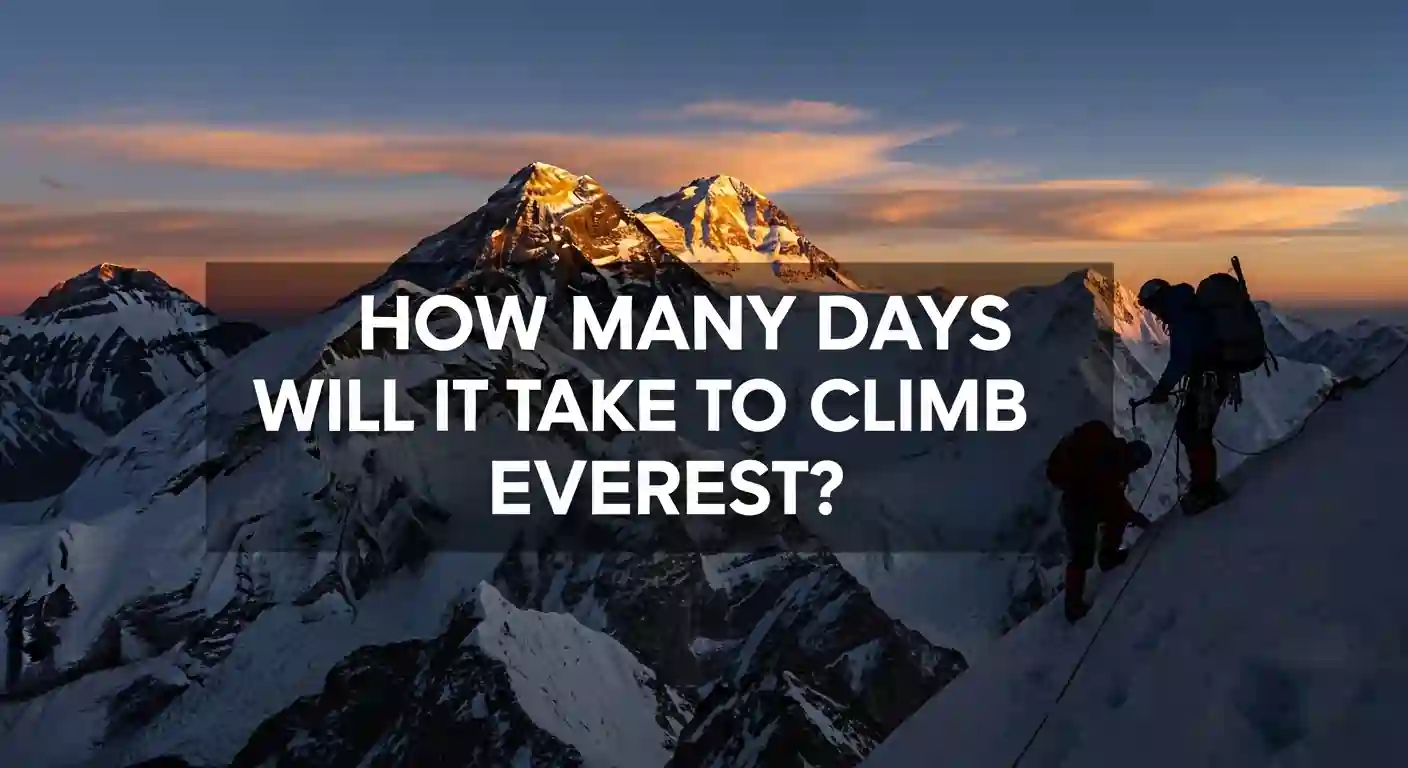
Mount Everest, the “Sagarmatha” of Nepal, is the ultimate test of human endurance, standing at a staggering 8,848.86 meters (29,032 feet). Climbing this Himalayan giant is not a sprint; it is a marathon of patience, biology, and logistics. For most, the journey to the top of the world is a multi-month commitment that begins long before the first step is taken on the Khumbu Icefall. In 2026, with evolving safety regulations and environmental protocols, the timeline for an Everest expedition has become even more structured to ensure maximum safety and success.
In this guide, we will break down exactly how many days will it take to climb Mount Everest. We will explore the critical phases of a standard expedition, from the initial trek to Base Camp and the grueling weeks of acclimatization rotations to the high-stakes summit push and the final descent. Understanding this timeline is essential for any aspiring climber or armchair adventurer who wants to grasp the sheer scale of effort required to stand on the highest point on Earth.
Introduction to Climbing Mount Everest
Climbing Mount Everest typically takes between 60 to 70 days (8 to 10 weeks) for a standard expedition starting from Kathmandu. While the actual ascent from Base Camp to the 8,848.86-meter summit only occupies a small fraction of this time, the vast majority of the journey is dedicated to the physiological necessity of acclimatization. In 2026, safety protocols and the strategic wait for a stable weather window in May remain the primary reasons why this ultimate Himalayan challenge is measured in months rather than days.
The extended duration of an Everest expedition is fundamentally a battle with biology; at the summit, the air contains only one-third of the oxygen found at sea level. To survive in the “Death Zone” above 8,000 meters, climbers must spend weeks performing “rotations”, climbing to high camps and descending back to Base Camp, to stimulate the production of extra red blood cells. Beyond the physical adaptation, the timeline accounts for the trekking approach through the Khumbu Valley, the technical setup of the Khumbu Icefall by “Icefall Doctors,” and the patience required to wait for the jet stream to shift, providing a safe window to reach the top of the world.
⛰ Begin Your Everest Summit Journey
How Many Days Will It Take to Climb Mount Everest?
A standard Mount Everest expedition takes approximately 60 to 70 days (8 to 10 weeks) from the time you arrive in Kathmandu until your return. While the actual climb from Base Camp to the summit only takes about 5 to 7 days, the vast majority of the time is spent on essential acclimatization rotations and waiting for a safe weather window in May.
This extensive 65-day average is a biological requirement, as spending nearly six weeks moving between high-altitude camps allows the body to produce the extra red blood cells needed to survive the “Death Zone” above 8,000 meters. While commercial guided expeditions follow a structured, conservative timeline to ensure client safety and logistical preparedness, world-class experienced climbers may occasionally opt for “Flash” expeditions that utilize pre-acclimatization technology to summit in as little as 21 to 30 days. Ultimately, whether you are on a luxury guided trip or a fast-track ascent, the final schedule in 2026 remains at the mercy of the shifting jet stream and the technical challenges of the Khumbu Icefall.
Why Does It Take So Long to Climb Mount Everest?
It takes approximately 60 to 70 days to climb Mount Everest because the human body requires weeks of “rotations” to biologically adapt to the extreme lack of oxygen at 8,848.86 meters. This lengthy timeline is essential for building red blood cells to survive the “Everest Death Zone,” establishing a chain of high-altitude camps, and waiting for the precise 3-to-5-day window in May when the Jet Stream moves off the summit.
Acclimatization to High Altitude
Acclimatization is the most critical and time-consuming phase of the expedition, lasting nearly 40 days. Because oxygen levels at the summit are only one-third of those at sea level, climbers must follow a “climb high, sleep low” strategy, ascending to higher camps and returning to Base Camp multiple times. This process forces the body to produce more hemoglobin, which is the only way to prevent life-threatening conditions. Understanding the physiological nuances of HAPE vs HACE is vital for every climber, as these biological steps remain the leading cause of failed summits and medical emergencies in the 2026 season, even with advanced supplemental oxygen.
Establishing Multiple High Camps
Logistically, Everest cannot be climbed in one go; it requires the establishment of four distinct high camps above Base Camp (5,364m) to act as staging areas. Camp I (6,065m) and Camp II (6,400m) are established first, followed by the grueling work of hauling gear and oxygen to Camp III (7,200m) on the Lhotse Face and Camp IV (7,920m) on the South Col. Sherpa teams spend weeks fixing miles of safety ropes and carrying hundreds of pounds of supplies to these locations. These camps provide the necessary infrastructure for climbers to rest and rehydrate during the final, high-stakes push toward the summit.
Waiting for the Right Weather Window
The timing of the final summit push is entirely dependent on a “weather window,” a rare period where wind speeds at the summit drop below 30–40 mph. For most of the year, the Jet Stream sits directly on the peak, making climbing impossible due to extreme wind chill and hurricane-force gusts within the protected boundaries of Sagarmatha National Park. Expeditions often spend 10 to 14 days at Base Camp simply waiting for meteorologists to identify a 3-to-5-day lull in the weather, typically occurring in mid-to-late May. This period of “active waiting” requires immense mental patience and is the final hurdle before the 12-to-18-hour summit day begins.
Ready to Conquer the World’s Highest Peak?
Join Marvel Treks for a life-changing Everest Expedition experience with expert guides, premium logistics, and unforgettable Himalayan adventures.
Everest Expedition Timeline Breakdown
The journey to the top of Mount Everest is a phased operation that typically spans 60 to 70 days, meticulously designed around the biological limits of the human body. This timeline begins with a 10-to-12-day trek through the Khumbu Valley for initial acclimatization, followed by a month-long cycle of “rotations” between high-altitude camps. Each phase, from the spiritual Puja ceremony at Base Camp to the final midnight departure from the South Col, is a critical link in the chain of success for reaching the 8,848.86-meter summit.
| Phase | Core Activities | Typical Duration | Focus & Logistics |
| Preparation | Arrival & Kathmandu Logistics | 3–5 Days | Final gear inspections, permit briefings at the Ministry of Tourism, and team introductions. |
| The Approach | Trek to Everest Base Camp (EBC) | 10–12 Days | A slow-paced trek through Namche Bazaar (3,440m) and Dingboche (4,410m) to begin natural acclimatization. |
| Base Camp Life | Puja & Technical Training | 5–7 Days | Seeking blessings in a traditional Sherpa ceremony and practicing ladder/fixed-rope skills for the Icefall. |
| Rotations | Acclimatization Cycles | 25–35 Days | Repeated climbs to Camp 1 (6,065m), Camp 2 (6,400m), and Camp 3 (7,200m) followed by recovery at EBC. |
| The Wait | Weather Window Monitoring | 7–14 Days | Resting at Base Camp while meteorologists track the Jet Stream to identify a 3–5 day period of calm winds. |
| Summit Push | The Final Ascent | 5–7 Days | Moving from EBC to C2, C3, and C4 (South Col). The final bid begins at midnight from C4 to the summit. |
| The Descent | Return to Base Camp & Kathmandu | 5–7 Days | A rapid descent from the summit to C2, then back to EBC to pack up, followed by a trek or helicopter flight to Lukla. |
Everest Base Camp to Summit Climbing Duration
The actual climbing duration from Base Camp to the summit of Mount Everest typically takes 5 to 7 days during the final summit push. While this represents the culmination of the expedition, the movement between these Everest expedition camps is physically taxing and technically demanding, requiring climbers to navigate the Khumbu Icefall to reach Camp 1 (6,065m), the Western Cwm to Camp 2 (6,400m), and the steep Lhotse Face to reach Camp 3 (7,162m) and the South Col (7,950m). Each station serves as a critical biological checkpoint within the “Death Zone” above 8,000 meters, making them a vital area of research for anyone seeking the tactical logistics of how to climb Everest.
Base Camp to Camp I
The journey begins with the most dangerous section of the climb: the Khumbu Icefall. Covering a distance of roughly 2.5 kilometers, this leg takes between 6 to 8 hours as climbers navigate a shifting river of ice, crossing deep crevasses using aluminum ladders. Due to the high risk of serac collapses and avalanches, this section is almost exclusively climbed in the dark, early morning hours when the ice is most stable.
Camp I to Camp II
The route from Camp I to Camp II (6,400m) leads through the Western Cwm, a broad, flat glacial valley known as the “Valley of Silence.” While the distance is about 4 kilometers with relatively low technical difficulty, the valley acts as a solar oven, trapping heat and making the 3 to 5-hour trek incredibly exhausting. This section serves as an advanced base of operations for the final summit bid.
Camp II to Camp III
Leaving the Western Cwm, climbers face the daunting Lhotse Face—an icy, 45 to 55-degree slope of blue ice. This segment takes approximately 5 to 7 hours of hard climbing using fixed ropes to reach the small, carved-out tent platforms of Camp III (7,200m). This is often the first point where many climbers begin using supplemental oxygen to counter the extreme physical strain and thinning air.
Camp III to Camp IV
The climb to Camp IV on the South Col (7,920m) is a grueling 6 to 8-hour endeavor that requires crossing the Yellow Band and the Geneva Spur. As climbers pass the 8,000-meter mark, they enter the “Death Zone,” where the body can no longer recover and oxygen is essential for survival. Camp IV serves as the final, wind-swept staging area where climbers rest for just a few hours before their midnight summit attempt.
Camp IV to Summit
The final push to the summit is the most intense, involving a 10 to 14-hour round-trip odyssey. Climbers leave at night to reach the summit by sunrise, navigating the Balcony, the South Summit, and the iconic Hillary Step. After reaching the peak (8,848.86m), they must quickly descend back to the safety of the lower Everest expedition camps, as staying at this altitude for more than 24 hours is physically unsustainable.
Factors That Affect How Many Days It Takes to Climb Mount Everest
The duration of an Everest expedition is primarily dictated by the unpredictable Himalayan weather and the biological requirement for acclimatization, which varies for every climber. While the standard timeline is roughly 60 to 70 days, factors such as the choice of climbing route, the level of Sherpa support, and the individual’s previous high-altitude experience can either streamline the process or lead to significant delays. Understanding these variables is essential for managing expectations on a mountain where the environment is in a constant state of flux.
Weather Conditions on Everest
The single most powerful factor affecting the expedition clock is the weather, particularly the movement of the high-altitude Jet Stream. Climbers can spend weeks at Base Camp waiting for a “weather window,” a brief period when wind speeds at the summit drop below 30 mph and temperatures stabilize. Sudden snowstorms or high-velocity winds can trap teams in high camps for days or force a full retreat to lower elevations, resetting the acclimatization clock and extending the total duration of the trip, making the window in late May the best time for Everest expedition success.
Climbers’ Experience and Fitness
A climber’s physical conditioning and previous history with extreme altitude significantly influence the expedition’s efficiency. Highly fit and experienced mountaineers often acclimatize more reliably and can maintain a faster pace through technical sections like the Khumbu Icefall or the Lhotse Face, reducing their time spent in the “wear-and-tear” zones. Conversely, those newer to the 8,000-meter environment may require additional rest days and slower rotations to ensure their bodies adapt safely to the thinning atmosphere.
Route Choice
The timeline varies slightly between the South Col route in Nepal and the North Ridge route in Tibet. The South side involves a 10-to-14-day trek to reach Base Camp, whereas the North Base Camp is accessible by vehicle, allowing for a faster initial arrival but often featuring harsher, windier conditions during the climb. While the South route is more popular due to its established rescue infrastructure and warmer sunlight, the technical challenges and weather patterns unique to each side of the mountain can add or subtract days from the final summit bid.
Expedition Logistics and Support
The level of logistical support can make a difference of several weeks in the total expedition length. Full-service guided expeditions provide pre-established camps, fixed ropes, and heavy Sherpa support for carrying oxygen and supplies, which allows climbers to focus entirely on their health and movement. In contrast, independent or semi-supported teams must manage their own load-carrying and camp setup, which often results in a longer, more physically draining timeline as they perform extra carries between the high camps.
What Is the Fastest Time to Climb Mount Everest?
The fastest time to climb Mount Everest is 10 hours and 56 minutes, a record set by Lhakpa Gelu Sherpa in 2003 on the South Side (Nepal). For the North Side (Tibet), the record is held by Christian Stangl, who reached the summit in 16 hours and 42 minutes in 2006.
These extraordinary speed records were achieved by world-class mountain athletes using established fixed ropes and, in some cases, supplemental oxygen to bypass the standard two-month acclimatization period. While a typical climber takes nearly two months to complete the journey, these elite records represent the extreme limits of human physiology and speed in the “Death Zone.” In the modern era, “Flash Expeditions” have utilized pre-acclimatization in hypoxic tents to bring the average expedition time down to just 21 days, though the single-day speed records of the early 2000s remain the gold standard for pure mountain velocity.
Best Time of Year to Climb Mount Everest
The best time of year to climb Mount Everest is during the pre-monsoon spring season (April and May) and the post-monsoon autumn season (September to November). While spring is the most popular due to more stable weather windows and clear skies, autumn offers a quieter mountain with crisp views, whereas winter and summer remain too dangerous for standard commercial expeditions.
These two primary windows are chosen to avoid the heavy precipitation and avalanche risks of the summer monsoon and the hurricane-force winds and extreme sub-zero temperatures of the winter months. Timing an expedition correctly is the difference between a successful summit bid and a forced retreat, as climbers must align their final push with the brief moment the Jet Stream moves off the peak.
Spring Climbing Season (April–May)
Spring is widely regarded as the premier window for Everest expeditions because it offers the most reliable “weather windows” for a safe summit. During this time, temperatures begin to rise, and the fierce winter winds subside just before the arrival of the summer monsoon rains. The majority of successful ascents take place in the last two weeks of May, when the atmosphere is at its most stable, though this also makes it the busiest season on the mountain.
Autumn Climbing Attempts
Autumn serves as the second-best window for climbing, beginning after the monsoon clouds dissipate and before the winter cold sets in. While visibility is often superior to spring, climbers must deal with fresh, deep snow on the upper slopes and shorter daylight hours as the season progresses. Because fewer teams attempt the peak in autumn, it is an ideal choice for those seeking a more solitary and authentic experience away from the spring crowds.
Winter Expeditions
Climbing Mount Everest in the heart of winter is a feat reserved only for the world’s most elite and resilient mountaineers due to the brutal, life-threatening conditions. Temperatures routinely plummet to -40°C, and the Jet Stream sits permanently on the summit, delivering winds exceeding 100 mph that can strip the mountain to bare blue ice. These expeditions are rare, requiring specialized gear and a high tolerance for extreme isolation, as rescue options are virtually non-existent during this time.
Preparation Required Before Climbing Mount Everest
Preparing for Mount Everest requires a multi-year commitment involving rigorous cardiovascular training, technical mountaineering experience on other 7,000m and 8,000m peaks, and significant financial planning. In addition to physical readiness, climbers must secure necessary government permits, hire experienced Sherpa support, and undergo extensive medical evaluations to ensure they can handle the extreme altitude.
The preparation phase is just as critical as the climb itself, as it builds the foundation for survival in the “Death Zone.” Beyond simple gym workouts, successful climbers spend years developing “mountain sense,” learning to navigate icefalls, manage technical Everest climbing equipment, and understand their body’s specific reactions to thinning air. Proper preparation minimizes risks and ensures that when you finally arrive at Base Camp, you are mentally and physically equipped for the two-month journey ahead.
Physical Training and Endurance
A successful Everest bid demands an elite level of cardiovascular fitness and functional strength. Training typically starts at least a year in advance, focusing on high-volume aerobic exercise, such as trail running and stair climbing with a weighted pack, to build the endurance needed for 18-hour summit days. Strength training for the core and legs is equally vital to help carry heavy loads and maintain stability while navigating steep, icy terrain at high altitudes.
Mountaineering Skills and Experience
Aspiring Everest climbers must possess a solid resume of technical high-altitude experience, often including summits of peaks like Manaslu, Cho Oyu, or Ama Dablam. Mastery of essential skills, such as crampon technique, ice axe arrest, and moving efficiently on fixed ropes, is non-negotiable for safely navigating the Khumbu Icefall and the Lhotse Face. This background experience also helps climbers develop the mental resilience required to endure the extreme cold and isolation of a long Himalayan expedition.
Permits, Guides, and Expedition Costs
The logistical preparation involves securing a climbing permit from the Department of Tourism, which currently costs $11,000 per person for the spring season. Beyond the permit, choosing a reputable expedition company is vital for providing the necessary infrastructure, including Sherpa guides, supplemental oxygen, food, and communication systems. Total expedition costs can range significantly, requiring climbers to manage budgets for gear, insurance, and travel well before their departure for Kathmandu.
Conclusion
Climbing Mount Everest is far more than a simple ascent; it is a profound test of patience and human biology. While the question of how many days it will take to climb Mount Everest can be answered with a standard 60 to 70-day window, the reality is a complex dance with the elements. From the initial trek through the Khumbu Valley to the grueling weeks of acclimatization rotations and the high-stakes wait for a weather window, every day spent on the mountain is a necessary step toward the 8,848.86-meter summit.
As we look at the modern landscape of high-altitude mountaineering, the emphasis remains on safety, preparation, and respect for the mountain’s power. Whether you are aiming for a traditional two-month expedition or exploring the newer, high-tech “Flash” itineraries, standing on the highest point on Earth remains one of humanity’s most significant physical achievements. The peaks are waiting, the fixed ropes are set, and the journey of a lifetime is ready when you are.
Ready to Stand on Top of the World?
The journey to the summit of Everest requires more than just ambition, it requires the world’s best logistical support. Best Company For Everest Expedition specializes in high-success, safety-first Everest expeditions, providing veteran Sherpa support, premium oxygen systems, and unparalleled base camp luxury.
FAQS
How many days will it take to climb Mount Everest?
A standard Mount Everest expedition takes approximately 60 to 70 days (8 to 10 weeks) from Kathmandu to the summit and back. This duration is required for the initial 10-day trek to Base Camp, followed by 4 to 6 weeks of acclimatization rotations, and a final 5-to-9-day window for the summit push and descent.
Why does climbing Everest take so long?
The long duration is primarily due to the physiological need for acclimatization. Because the air at 8,848.86 meters contains only one-third of the oxygen found at sea level, climbers must spend weeks “rotating” between camps to stimulate the production of red blood cells. Without this process, climbers would risk fatal altitude sickness in the “Death Zone.”
Can you climb Everest in 20 days?
Yes, “Flash Expeditions” allow elite climbers to summit in 21 days by using hypoxic tents for pre-acclimatization at home. By sleeping in these tents for 6–8 weeks before arriving in Nepal, climbers can skip the initial weeks of rotations, though these expeditions are significantly more expensive and requires a very high fitness level.
How long is the final summit push on Mount Everest?
The final summit push from Base Camp to the peak and back to lower camps typically takes 5 to 7 days. Climbers move from Base Camp to Camp II, then to Camp III and Camp IV (South Col) before making their midnight summit attempt and descending rapidly to avoid exhaustion.
What is the fastest time to climb Mount Everest?
The world record for the fastest ascent of Mount Everest is 10 hours and 56 minutes, set by Lhakpa Gelu Sherpa in 2003. This record was achieved on the South Side (Nepal) using supplemental oxygen and pre-fixed ropes. For most commercial climbers, the same journey takes several days during the final push.
How many hours is the final summit day?
Summit day is a grueling 12 to 18-hour round-trip journey from Camp IV (the South Col). Most climbers leave their tents between 9:00 PM and midnight to reach the summit by sunrise, aiming to return to the safety of Camp IV before the dangerous afternoon winds pick up.
What is the best month to climb Everest?
May is the best month to climb Everest because it offers the most stable “weather window” of the year. During this time, the Jet Stream typically moves north of the mountain, resulting in calmer winds and clearer skies just before the summer monsoon arrives in June.
How long do you stay at Everest Base Camp?
Climbers typically spend a cumulative 4 to 6 weeks living at Everest Base Camp (5,364m). This time is not spent sitting still; it involves active recovery days between rotations to higher camps, technical training on the icefall, and waiting for the official “weather window” to begin the summit push.

Ready for your next Himalayan adventure?
Plan Your Next Big Adventure with Us
Explore Our AdventuresJoin our expert-guided journeys across Nepal and beyond, from classic trails to epic summits.