
Mardi Himal Trek Vs Annapurna Base Camp: Which is Best For You?
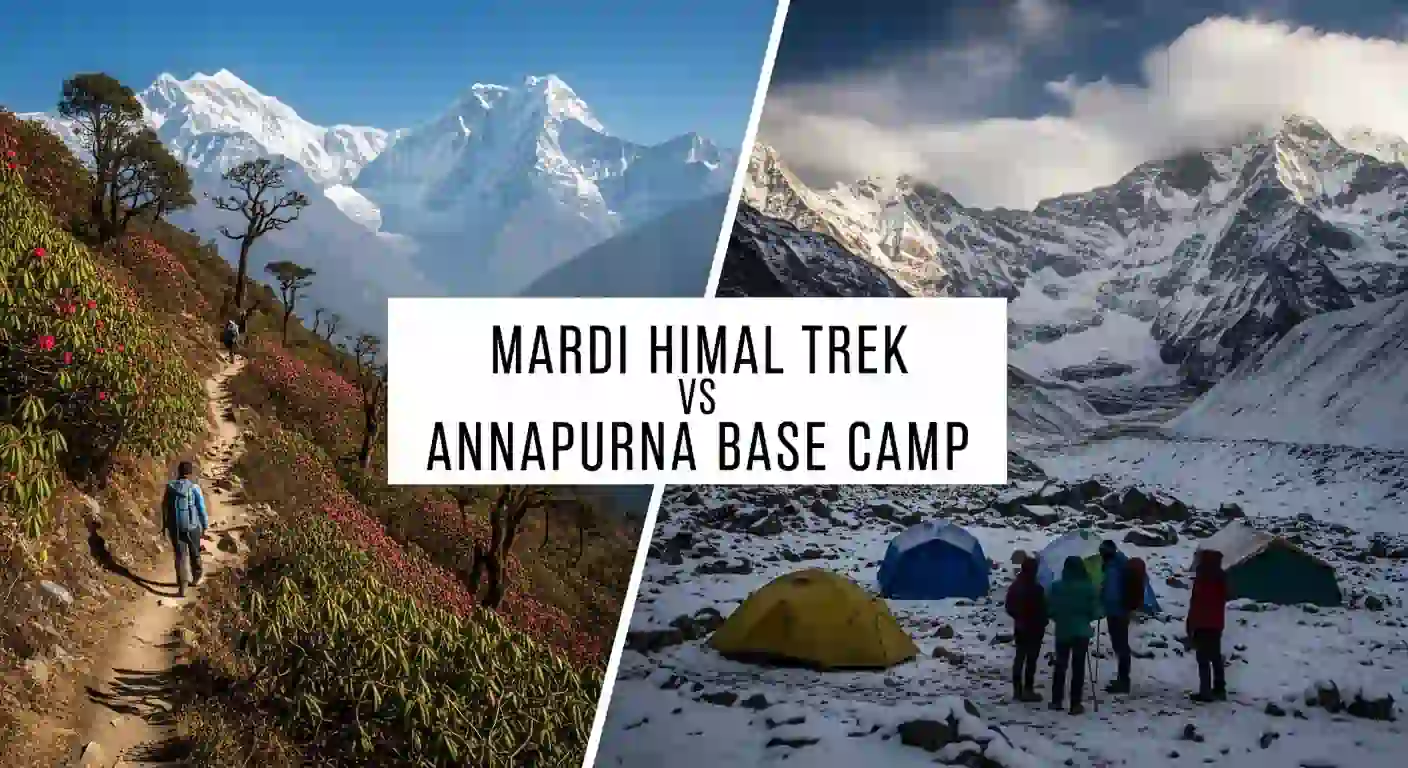
Choosing between the mardi himal trek vs annapurna base camp is a common dilemma for trekkers visiting the Annapurna region of Nepal. Both routes offer stunning vistas of the Himalayas, yet they provide vastly different experiences in terms of terrain, crowd levels, and cultural immersion. While one takes you into a deep glacial basin surrounded by 8,000-meter peaks, the other leads you along a high-altitude ridge with panoramic views of the “Fishtail” mountain.
In this blog, we will explore the key differences between the mardi himal trek vs annapurna base camp, comparing their itineraries, difficulty levels, and scenic highlights. Whether you are looking for a short, quiet escape or a legendary journey into the heart of the mountains, this guide will help you decide which trek is the perfect fit for your next Himalayan adventure, especially if you are researching trekking in Nepal for beginners.
Overview of the Mardi Himal Trek
Mardi Himal Trek is a hidden gem located on a high ridge just east of the Annapurna Base Camp route, offering an “off-the-beaten-path” alternative for those seeking solitude. It provides a unique perspective of Machapuchare (Fishtail) and the Annapurna range without the heavy foot traffic of its more famous neighbors. This trek is ideal for hikers who prefer quiet, mossy forests and dramatic ridgeline views over the busier, stairs-heavy valley trails.
Location and Route in the Annapurna Region
This trek is situated in the central Annapurna region, typically starting from Kande or Phedi, just a short drive from the lakeside city of Pokhara. The trail winds through ancient rhododendron and oak forests before breaking out onto a narrow ridge that climbs steadily toward the base of Mardi Himal itself. Along the way, you pass through key points like Australian Base Camp and Pothana, which offer early hints of the majestic mountain views that await at higher elevations. It is a route that feels intimate and wild, yet remains surprisingly accessible from civilization.
Duration and Distance of the Mardi Himal Trek
A standard Mardi Himal itinerary spans roughly 5 to 6 days, covering a total walking distance of approximately 40 to 50 kilometers (25 to 31 miles) depending on your start and end points. It is considered a short-duration trek, making it perfect for travelers with limited time who still want a high-altitude experience. While the daily distances are manageable, the vertical gain is significant, as you climb from around 1,700m at the trailhead to 4,500m at the Upper Viewpoint. This rapid ascent makes it a compact but punchy physical challenge compared to the longer, more gradual ABC route.
Major Attractions on the Mardi Himal Trail
The trek’s main draw is the stunning transition from mossy, enchanted forests at lower altitudes to the stark, alpine beauty of High Camp (3,580m) and beyond. At the Upper Viewpoint and Base Camp, you are treated to an incredible “face-to-face” look at the iconic Fishtail mountain, which appears close enough to touch. The ridgeline walk between Low Camp and High Camp offers 360-degree panoramas of Annapurna South, Hiunchuli, and Gangapurna that are simply unmatched. For many, the quiet sunrise from High Camp, where the peaks glow in fiery orange, is the definitive highlight of the entire journey.
Overview of the Annapurna Base Camp Trek
Annapurna Base Camp trek is a legendary journey into the “Annapurna Sanctuary,” a high-altitude glacial basin surrounded by a ring of ten peaks over 6,000 meters. It is one of the most iconic treks in the world, combining deep cultural immersion with a dramatic transition from tropical farmland to the stark, icy heart of the Himalayas. This trek is perfect for those who want to experience the classic teahouse culture of Nepal while standing at the base of the world’s tenth-highest mountain.
Route and Starting Points
The Annapurna Base Camp trek route typically begins from Nayapul or Ghandruk, just a few hours’ drive from Pokhara. Most trekkers follow the trail through the lush Modi Khola valley, passing through vibrant forests and terraced fields before entering the narrow “gate” between the peaks of Hiunchuli and Machapuchare. The path is famous for its thousands of stone stairs, particularly the challenging climb to the Gurung village of Chomrong. This ABC trek Nepal itinerary is often combined with a side trip to Poon Hill, providing a diverse mix of low-altitude culture and high-alpine scenery within the Annapurna Sanctuary trek.
Trek Duration and Total Distance
A standard expedition to Annapurna Base Camp usually takes between 7 to 11 days, depending on the chosen starting point and whether you include acclimatization side-trips. The total walking distance is approximately 110 to 115 kilometers (68 to 71 miles), making it significantly longer than the Mardi Himal route. Trekkers should expect to walk 5 to 7 hours daily, navigating a high volume of elevation gain and loss throughout the journey. While the distance is substantial, the well-developed trail and gradual ascent into the sanctuary make it a manageable goal for hikers with a moderate level of fitness.
Highlights of the Annapurna Base Camp Trek
The definitive highlight is reaching the base camp itself at 4,130m, where you are treated to a 360-degree theater of snow-capped giants, including the south face of Annapurna I. Watching the sunrise hit the vertical walls of the sanctuary from your teahouse doorstep is a spiritual experience that remains a lifelong memory for most travelers. Beyond the peaks, the trek offers rich cultural encounters in traditional Gurung villages and a relaxing finish at the natural hot springs of Jhinu Danda. These combined elements of nature and hospitality are what make ABC the quintessential Nepalese trekking experience.
Mardi Himal Trek vs Annapurna Base Camp: Key Differences
The primary differences between these two treks lie in their topography and the density of the experience; Mardi Himal is a shorter, steeper ridge walk for those seeking solitude, while Annapurna Base Camp is a longer, more social journey into a massive glacial basin. While Mardi Himal offers panoramic ridge views of the “Fishtail” peak, ABC provides an immersive 360-degree theater experience at the base of 8,000m giants.
| Feature | Mardi Himal Trek | Annapurna Base Camp (ABC) |
| Total Duration | 5 – 6 Days | 7 – 11 Days |
| Total Distance | 40 – 45 km | 110 – 115 km |
| Max Altitude | 4,500m (Upper Viewpoint) | 4,130m (Base Camp) |
| Difficulty Level | Moderate (Steep & Rugged) | Moderate to Strenuous (Thousands of Stairs) |
| Acclimatization | Rapid ascent; higher risk of AMS | Gradual ascent; better natural adjustment |
| Trail Condition | Narrow, forest, and ridge paths | Stone steps, valley floor, and glacial moraine |
| Crowd Levels | Low (Quiet and Peaceful) | High (Vibrant and Social) |
| Scenery Type | Ridgeline panoramas (Bird’s-eye) | Glacial Sanctuary (Inside the basin) |
| Best For | Solo hikers, photographers, and short trips | Classic Nepal seekers and social trekkers |
What Are the Scenic Differences Between Mardi Himal Trek vs Annapurna Base Camp?
The main scenic difference is that Mardi Himal offers bird’s-eye, panoramic views of the Himalayas from a high-altitude ridge, whereas Annapurna Base Camp (ABC) provides an immersive, “inside-the-sanctuary” experience surrounded by 360-degree vertical walls of ice and rock. While Mardi Himal focuses on a constant, close-up perspective of the iconic Machapuchare (Fishtail), ABC delivers the awe-inspiring scale of standing directly at the foot of 8,000-meter giants within a glacial basin.
Mountain Views on the Mardi Himal Trek
On the Mardi Himal trail, the mountains are always by your side as you traverse a narrow, soaring ridgeline that leads you directly toward the base of Machapuchare. From the Upper Viewpoint (4,500m), you get a unique, unobstructed panorama of Annapurna South, Hiunchuli, and Gangapurna that feels intimate and expansive at the same time. The “S-curve” of the ridge provides a dramatic foreground for photographers, making the peaks appear much closer than on most other moderate treks.
Landscape and Glacier Views at Annapurna Base Camp
The landscape of ABC is defined by the “Annapurna Sanctuary,” a natural amphitheater where massive glaciers flow down from the towering summits of the Annapurna Massif. As you reach the base camp, you are completely encircled by ten peaks over 6,000 meters, creating a stark, high-alpine environment of moraines, ice falls, and jagged cliffs. This “bowl-like” geography offers a sense of being deep within the heart of the mountains, a stark contrast to the open-air horizons found on the Mardi ridge.
Forests, Rivers, and Wildlife Along the Trails
The ABC trek follows the Modi Khola river valley, taking you through vibrant bamboo groves, cascading waterfalls, and terraced farmland where you might spot langur monkeys or Himalayan tahrs. In contrast, Mardi Himal is famous for its “enchanted” rhododendron and oak forests, which are heavily draped in moss and lichen, creating a prehistoric atmosphere. While ABC offers the soothing sound of rushing rivers throughout the journey, Mardi Himal provides a quieter, more mysterious forest experience that suddenly breaks into high alpine scrub.
Trekking Difficulty: Mardi Himal Trek vs Annapurna Base Camp
The difficulty of the Mardi Himal Trek lies in its steep, relentless ridgeline ascent, whereas the Annapurna Base Camp trek is challenging due to its longer duration and thousands of stone stairs. While neither trek requires technical climbing skills, they both demand a high level of cardiovascular fitness and the ability to manage trekking difficulty Nepal standards, including variable weather and high-altitude conditions.
Elevation Gain and Altitude Challenges
Both routes present significant altitude sickness Annapurna risks, but the pacing of the elevation gain differs greatly. On the Mardi Himal trek, you ascend from around 1,700m to 4,500m in just three to four days, which is a very rapid gain that requires careful monitoring for symptoms of AMS. In contrast, the ABC trek has a more gradual approach through the valley, reaching a maximum height of 4,130m. However, the constant “ups and downs” of the ABC trail can be more draining on your energy reserves than the steady, albeit steep, climb of the Mardi Himal altitude profile.
Trail Conditions and Technical Difficulty
The trail conditions on the Annapurna Base Camp route are well-developed, consisting mostly of wide paths and thousands of stone steps that can be punishing on the knees during the descent. Mardi Himal, being a newer route, features narrower and more rugged forest paths that can become quite slippery or muddy after rain. As you move higher toward the Upper Viewpoint, the Mardi trail becomes a narrow ridgeline with steep drop-offs on either side, requiring a better sense of balance and steady footwork compared to the broader glacial basin trails of the Annapurna Sanctuary.
Which Trek Is Better for Beginners?
For absolute beginners with limited time, the Mardi Himal Trek is often recommended because it provides a spectacular Himalayan experience in a shorter 5-day window. However, those who struggle with steep inclines may find the ABC trek more “user-friendly” due to its gradual ascent and the higher quality of teahouse infrastructure along the way. Ultimately, ABC is better for beginners who want a social, classic experience with plenty of rest stops, while Mardi Himal is perfect for beginners who are physically fit and prefer a shorter, more intense adventure away from the main trekking crowds.
Cost Comparison: Mardi Himal Trek vs Annapurna Base Camp
The Mardi Himal Trek is generally more budget-friendly, costing between $400 and $600 for a 5-day trip, whereas Annapurna Base Camp (ABC) typically ranges from $700 to $1,000 due to its longer 7-10 day duration. While the daily expenses for food and permits are nearly identical, the total Nepal trekking budget is significantly influenced by the number of days you spend on the trail and the amount of porter support required. In 2026, price stability in the Annapurna region makes both treks excellent value for money compared to the more expensive Everest region.
| Expense Category | Mardi Himal Trek (5–6 Days) | Annapurna Base Camp (7–10 Days) | Details/Context |
| Permits (ACAP & TIMS) | $40 – $50 | $40 – $50 | Both treks require the same regional permits. |
| Accommodation | $50 – $80 | $100 – $150 | Based on $10–$15 per night in standard teahouses. |
| Food & Water | $150 – $200 | $250 – $350 | Based on $30–$35 per day for three meals. |
| Professional Guide | $150 – $180 | $250 – $300 | Daily rate is $30 including their insurance/food. |
| Porter Support | $125 – $150 | $200 – $250 | Daily rate is $25 (carries up to 20kg). |
| Transportation | $30 – $50 | $40 – $60 | Private jeep/bus from Pokhara to trailheads. |
| Total Estimated Cost | $545 – $710 | $880 – $1,160 | Total per person for a full-service trek. |
Best Time to Trek: Mardi Himal Trek vs Annapurna Base Camp
The best time for Annapurna trekking is during the spring (March to May) and autumn (September to November) seasons, as these months offer the most stable weather and clearest mountain views. While both treks share the same general weather patterns, Mardi Himal is slightly more accessible in late winter due to its ridge-based topography, whereas Annapurna Base Camp can face higher avalanche risks in the narrow valley sections after heavy snowfall, making these months the undisputed best season for trekking in Nepal.
Spring Trekking Season (March–May)
Spring is one of the most vibrant Nepal trekking seasons, characterized by blooming rhododendron forests that turn the Mardi Himal ridges into a sea of red and pink. For ABC trekkers, this season offers warmer temperatures at the base camp and the spectacular sight of melting snow-fed waterfalls along the Modi Khola river. It is an ideal time for those who enjoy moderate temperatures and lush, green landscapes before the heat of summer.
Autumn Trekking Season (September–November)
Autumn is widely considered the peak season for both treks because the post-monsoon air is incredibly crisp, providing the sharpest visibility of the Annapurna Massif and Machapuchare. The trails are at their busiest during this time, but the reward is a high probability of cloudless skies and perfect trekking conditions every day. This is the best window for photographers wanting to capture the high-contrast peaks against deep blue Himalayan skies.
Winter and Monsoon Trekking Conditions
Winter (December–February) brings heavy snow and freezing temperatures, which can make the Mardi Himal ridge slippery and the ABC valley prone to avalanches, though the views remain exceptionally clear. The monsoon (June–August) is generally avoided due to heavy rain, leeches, and obscured views, but it is the quietest time for those who don’t mind the wet. In 2026, many trekkers are choosing early winter for Mardi Himal to experience the quietest trails with manageable gear.
Accommodation and Facilities on Both Treks
Accommodation on both routes follows the traditional teahouse trekking Nepal model, offering basic but comfortable lodges that provide a warm bed, communal dining areas, and cooked meals. While the Annapurna Base Camp route features larger, more established guest houses with a wider range of facilities, the Mardi Himal Trek offers a more rustic and intimate experience with smaller, family-run lodges. Choosing between them often comes down to whether you prefer the social atmosphere of a popular hub or the quiet charm of a mountain ridge retreat.
Teahouse Lodges on the Mardi Himal Trek
The Annapurna trekking accommodation along the Mardi Himal ridge is relatively simple and intimate, reflecting the route’s status as a newer trekking destination. Most lodges are small, often featuring twin-sharing rooms with thin wooden walls and shared bathroom facilities that may only offer cold water or solar-heated showers for an extra fee. Because the lodges are situated on a narrow ridge, space is limited, but the dining areas are exceptionally cozy, often heated by a central wood-burning stove where trekkers gather for evening meals.
Lodges and Guesthouses on the ABC Trek
Accommodation on the Annapurna Base Camp trek is much more developed, with larger lodges designed to handle high volumes of international trekkers throughout the peak seasons. Many guesthouses in villages like Chomrong or Ghandruk offer modern amenities such as attached bathrooms, gas-heated showers, and even Wi-Fi and electronic charging stations in private rooms. As you move higher into the sanctuary toward MBC and ABC, the lodges become more functional and dormitory-style to maximize space within the protected glacial basin.
Food and Trekking Amenities
Both trails offer a surprisingly diverse menu that caters to international tastes, featuring everything from the traditional “Dal Bhat” to pasta, pancakes, and even apple pie. On the ABC route, you will find more extensive menus and specialized bakeries, whereas Mardi Himal offers a more limited but authentic selection of local and continental dishes. Basic amenities like boiled drinking water, snacks, and extra blankets are readily available on both routes, though prices for these items typically increase as you reach higher altitudes.
Why Choose Mardi Himal Trek?
You should choose the Mardi Himal Trek if you are looking for a short, 5-to-6-day high-altitude adventure that offers stunning, “face-to-face” views of Mount Machapuchare without the massive crowds of traditional routes. It is the perfect choice for trekkers who value a quiet, ridgeline experience over the high-traffic valley floors found on more famous trails.
- Pristine Solitude: As a relatively “new” route, it remains much quieter than ABC, providing a peaceful connection with nature through enchanted, moss-covered forests.
- Unique Ridge Topography: Unlike valley-based treks, you walk along a soaring ridge, giving you constant 360-degree panoramas of the Annapurna and Dhaulagiri ranges.
- Iconic Mountain Proximity: It offers the closest and most dramatic view of the sacred Machapuchare (Fishtail) peak available on any moderate trek in Nepal.
- Time Efficiency: You can reach an impressive altitude of 4,500m and experience true Himalayan majesty in less than a week, making it ideal for those on a tight schedule.
- Photographic Excellence: The sunrise from High Camp and the Upper Viewpoint provides an unobstructed horizon, perfect for capturing the alpenglow on the Annapurna Massif.
Why Choose Annapurna Base Camp Trek?
You should choose the Annapurna Base Camp trek if you want the quintessential Himalayan experience of standing in a 360-degree amphitheater of 7,000m and 8,000m peaks after journeying through vibrant local cultures. It is the ideal route for those who want to combine the physical challenge of the “Sanctuary” with the comfort of Nepal’s most established trekking infrastructure and social atmosphere.
- Standing Inside a Sanctuary: Unlike most treks that view mountains from a distance, ABC places you directly inside a glacial basin surrounded by a vertical wall of ten massive peaks.
- Rich Cultural Immersion: You will trek through iconic Gurung and Magar villages like Ghandruk and Chomrong, offering a deep look into the traditional lifestyles of Nepal’s mountain people.
- Diverse Ecosystems: The trail offers incredible ecological variety, transitioning from subtropical terraced farmland and bamboo groves to alpine forests and stark glacial moraines.
- Established Comfort: As one of Nepal’s most popular routes, it features high-quality teahouses with extensive menus, Wi-Fi, and even natural hot springs at Jhinu Danda to soothe your muscles.
- Poon Hill Bonus: Most ABC itineraries include a sunrise hike to Poon Hill, providing one of the most famous wide-angle views of the Dhaulagiri and Annapurna ranges in the world.
- The Social Experience: It is the perfect trek for solo travelers or social hikers, as the well-traveled path and lively communal dining halls make it easy to meet adventurers from across the globe.
Who Should Choose Which Trek?
The best trek for you depends on your priorities: choose Mardi Himal if you want a short, quiet, and scenic ridge walk, or choose Annapurna Base Camp if you want a social, culturally rich journey into a deep mountain sanctuary. While both are considered among the best treks in the Annapurna region, they offer completely different atmospheres. Mardi Himal is for those who prefer nature over infrastructure, while ABC is for those who want the full, classic “teahouse experience” with all the amenities.
Best Trek for Beginners
For those new to beginner trekking Nepal, Annapurna Base Camp is often the top recommendation because the trail is exceptionally well-developed with wide paths and clear markers. The social vibe of the teahouses makes it easy to find support, and the gradual ascent allows for more natural acclimatization. However, if a beginner is physically fit and prefers a shorter challenge without thousands of steep stone stairs, the Mardi Himal trek provides a spectacular “mountain hit” with less overall time spent on the trail.
Best Trek for Short Travel Itineraries
If you have a limited window of 5 to 6 days, the Mardi Himal trek is the clear winner as it allows you to reach a high-altitude base camp (4,500m) and return to Pokhara much faster than the ABC route. Annapurna Base Camp typically requires a minimum of 7 to 10 days to complete safely without rushing the acclimatization process. Mardi Himal offers the most “bang for your buck” in terms of elevation gain and scenery per day, making it the premier choice for trekkers on a tight schedule.
Best Trek for Stunning Himalayan Views
Deciding which trek has the best views depends on your perspective: Mardi Himal offers a panoramic, bird’s-eye view from a high ridge, while ABC puts you directly at the bottom of a massive mountain “bowl.” For many, the “face-to-face” look at Machapuchare from the Mardi ridge is the ultimate scenic highlight. However, if your goal is to be surrounded 360-degrees by vertical walls of ice and stand at the foot of an 8,000m peak, the immersive experience of the Annapurna Sanctuary is unrivaled.
Conclusion
In conclusion, deciding between the mardi himal trek vs annapurna base camp comes down to your personal trekking style and how much time you have. If you want a short, 5-day adventure that offers incredible panoramic ridge views and a peaceful, “off-the-beaten-path” atmosphere, Mardi Himal is the clear winner. However, if you want the classic Nepal experience, including the cultural immersion of Gurung villages and the awe-inspiring scale of standing inside a 360-degree mountain sanctuary, Annapurna Base Camp remains an unbeatable choice.
Both treks provide a deep connection to the Himalayas that will stay with you long after you return home. Regardless of which path you take, the Annapurna region’s magic is guaranteed to deliver the adventure of a lifetime. By choosing a professional team like Marvel Treks, you ensure that your journey is safe, professionally managed, and perfectly tailored to your goals.
Ready to Start Your Annapurna Adventure?
Don’t settle for a generic trekking package. Marvel Treks specializes in curated experiences for both Mardi Himal and ABC, providing world-class logistics and veteran local guides. Let us handle the details so you can focus on the view.
FAQS
Which trek is shorter, Mardi Himal or ABC?
Mardi Himal is significantly shorter, typically taking 5-6 days, compared to the 7-11 days usually required for Annapurna Base Camp.
Is there a high risk of altitude sickness?
Yes, both treks exceed 4,000m. Proper acclimatization and hydration are vital, though the risk is considered moderate compared to Everest.
Which trek is better for avoiding crowds?
Mardi Himal is the much quieter option, as ABC is one of the most popular and social trekking routes in the world.
Can I see the “Fishtail” mountain on both treks?
Yes, but Mardi Himal offers a much closer, “face-to-face” perspective of Machapuchare from its high-altitude ridge.
Are there charging facilities and Wi-Fi?
Yes, both routes have teahouses with charging and Wi-Fi, though ABC generally has more established and consistent facilities.
Do I need a permit for these treks?
Yes, both require the Annapurna Conservation Area Project (ACAP) permit and the TIMS card, which your guide will arrange.
What is the highest point on the Mardi Himal trek?
The highest point is the Upper Viewpoint at 4,500m, which is actually higher than Annapurna Base Camp (4,130m).
Which trek is better for photography?
Mardi Himal is often preferred for panoramic horizons, while ABC is better for immersive, wide-angle shots of glacier basins.

Ready for your next Himalayan adventure?
Plan Your Next Big Adventure with Us
Explore Our AdventuresJoin our expert-guided journeys across Nepal and beyond, from classic trails to epic summits.