
Mount Vinson Expedition Complete Guide
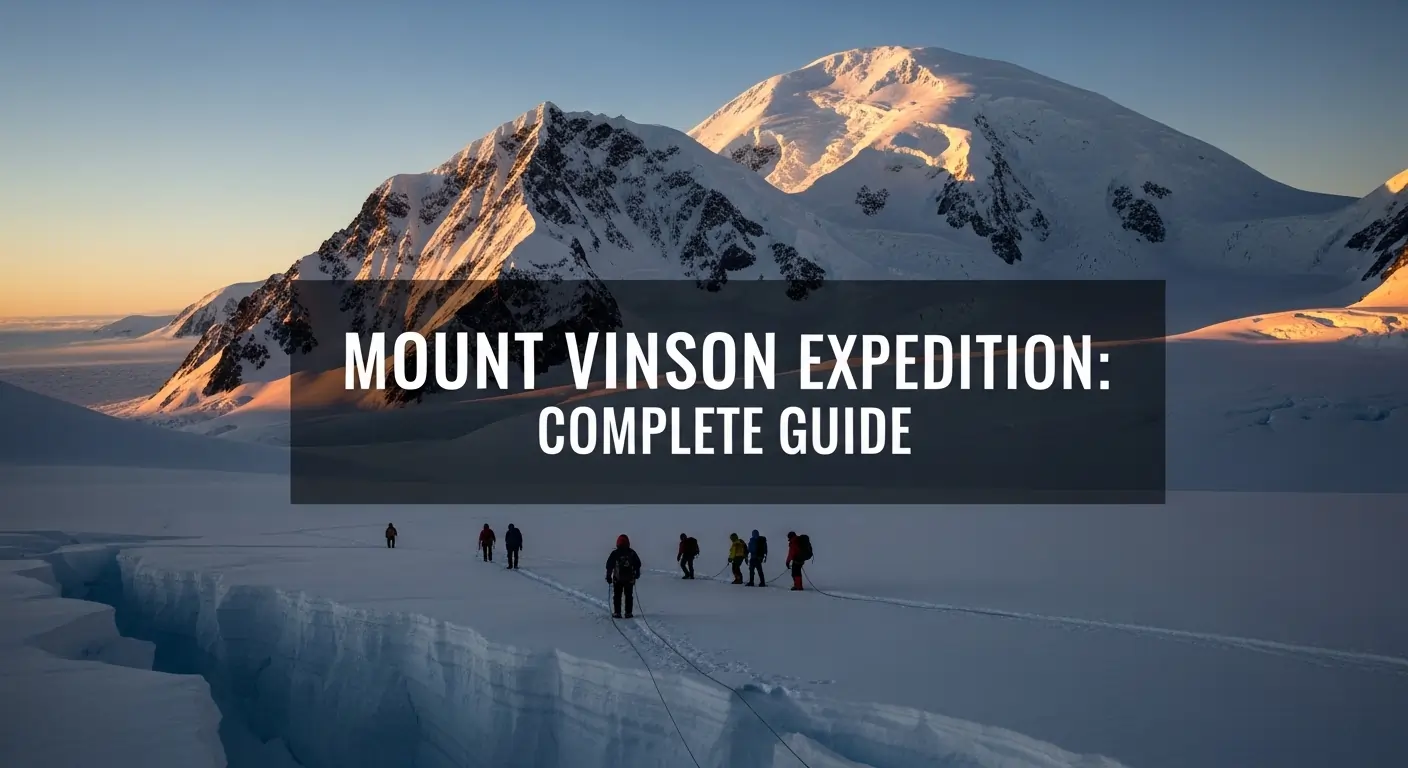
Think you’ve seen the best of the world’s peaks, or is there a frozen giant at the bottom of the map still calling your name? Mount Vinson, the highest peak in Antarctica, isn’t just a mountain; it’s a 16,050-foot ice sculpture standing in the most silent, remote desert on Earth.
In 2026, conquering this member of the Seven Summits remains a badge of honor for those who can handle the “big freeze” and the logistical puzzle of reaching the seventh continent. It’s a place where the sun never sets during the climbing season, but the wind can still bite through the best down suit you can buy.
In this blog, we provide the Mount Vinson Expedition Complete Guide to help you navigate the icy extremes of the Ellsworth Mountains. We’ll break down everything from the eye-watering costs of polar logistics to the physical grit required to haul a 50-pound sled across the Branscomb Glacier.
Introduction to Mount Vinson Expedition
Standing tall as the icy monarch of Antarctica, Mount Vinson is a glittering 16,050-foot challenge at the very bottom of our spinning blue marble. It’s not just a mountain; it’s a high-stakes poker game played against the most brutal, silent desert on Earth, where the wind chill makes ice look warm. For those chasing the legendary Seven Summits, this frozen titan in the Sentinel Range is the ultimate test of cold-weather grit and polar survival skills.
Reaching this peak involves a wild logistical dance across ice-covered runways and vast glaciers where the sun literally refuses to set. Unlike the crowded paths of other giants, Vinson offers a raw, untouched solitude that feels like stepping onto another planet entirely. It’s a place where your shadow is your only companion, and the air is so crisp it feels like you’re breathing in shards of pure, frozen diamonds.
Where Is Mount Vinson Located?
Mount Vinson is located in the Sentinel Range of the Ellsworth Mountains, approximately 1,200 kilometers (750 miles) from the South Pole. Specifically, it sits in the West Antarctic region, overlooking the Ronne Ice Shelf and the vast, white expanse of the interior desert. This isolated giant is the crown jewel of the continent, serving as the highest point in Antarctica and a critical destination for adventurers worldwide.
Mount Vinson Location in Antarctica
The precise coordinates for the summit of Mount Vinson are 78°31’S and 85°37’W, placing it deep within the frozen heart of the seventh continent. As part of the Sentinel Range, it belongs to a dramatic spine of mountains that rises sharply above the Antarctic ice sheet, offering some of the most rugged terrain in the southern hemisphere. Reaching this location is a feat of engineering and logistics, requiring multiple flights from the southern tip of South America to specialized blue-ice runways.
Why Mount Vinson Is the Highest Peak in Antarctica
- Tectonic Uplift: Mount Vinson was formed by massive tectonic forces that pushed the Earth’s crust upward, creating the towering Sentinel Range within the Ellsworth Mountains.
- Extreme Elevation: Reaching a height of 4,892 meters (16,050 feet), it is the highest point on the continent, earning it a prestigious spot on the Seven Summits list.
- Massive Massif: The mountain is part of the Vinson Massif, a colossal block of ice and rock that stretches 21 kilometers long and 13 kilometers wide.
- Geological Composition: The range is primarily composed of ancient quartzites and sandstones, which have been polished and shaped by millions of years of glacial movement.
- Glacial Preservation: Because it is encased in a permanent layer of ice, the peak remains largely protected from traditional erosion, maintaining its status as a high-altitude giant.
- Continental Divide: Its position in West Antarctica marks a significant geological boundary, separating the vast ice shelves from the high polar plateau.
What Is Mount Vinson Expedition?
The Mount Vinson Expedition is a high-altitude mountaineering journey to the highest peak in Antarctica, located deep within the Ellsworth Mountains. It is a massive logistical undertaking that requires flying from Chile into the interior of the frozen continent before beginning a multi-day ascent. While the climb is technically moderate, the extreme isolation and the brutal polar climate make it a serious endeavor that only a few hundred people attempt each year, securing its place on the list of the best mountains to climb around the world.
Overview of the Mount Vinson Expedition Experience
Climbing Mount Vinson is less of a typical mountaineering trip and more of a full-blown survival mission in the world’s most pristine and silent wilderness. Because there are no permanent residents or rescue services nearby, teams must be entirely self-sufficient, hauling all their own gear and waste on sleds across the vast Branscomb Glacier. The experience is defined by 24-hour daylight, where the sun circles overhead but the temperatures remain a bone-chilling -30°C. It is considered an elite objective not because of technical “rock-climbing” difficulty, but because of the mental grit required to live and perform in such an unforgiving, high-stakes environment.
Mount Vinson and the Seven Summits Challenge
Mount Vinson is the ultimate “gatekeeper” of the Seven Summits challenge, serving as the highest point on the Antarctic continent. For elite climbers, it is often one of the final peaks in the collection because the logistical costs and specialized polar training required are so substantial. Standing on its summit is a prestigious milestone that proves a climber can handle extreme cold and complex expedition life beyond the more accessible peaks of the other six continents. Its ultra-prominence and status as the most isolated of the seven peaks make it a mandatory and deeply rewarding chapter in any mountaineer’s quest for global glory.
Mount Vinson Height, Elevation, and Key Facts
Mount Vinson stands as the undisputed ruler of Antarctica, reaching a summit elevation of 4,892 meters (16,050 feet) above the frozen sea level. This towering massif is part of the Sentinel Range and is the most topographically isolated of the Seven Summits, sitting a mere 660 nautical miles from the South Pole. Because of its extreme southern latitude, the barometric pressure is lower than at the equator, meaning the air feels even thinner, comparable to standing at 5,500 meters in the Himalayas, adding an invisible layer of difficulty for every climber.
Mount Vinson Height and Elevation Details
At 4,892 meters, Mount Vinson is the highest peak in Antarctica and ranks as the eighth most prominent mountain on the entire planet. While it is significantly lower than Asia’s Everest or South America’s Aconcagua, its elevation is “deceptive” because of the polar atmosphere, which reduces oxygen saturation more severely than at lower latitudes. Reaching the summit involves ascending nearly 2,800 vertical meters from Base Camp, a journey that places you on the highest point of the vast Antarctic ice sheet, which itself has an average elevation higher than any other continent.
Weather and Extreme Conditions on Mount Vinson
The weather on Mount Vinson is a relentless battle against the coldest and windiest conditions found on any of the Seven Summits. Even during the mid-summer climbing season, you can expect temperatures to hover around -30°C (-22°F), with the potential to plummet to -40°C during sudden storms or whiteout conditions.
- Katabatic Winds: Powerful, gravity-driven winds can whip across the glaciers at over 80 km/h, making it nearly impossible to move and turning simple tasks like pitching a tent into a survival mission.
- Extreme Cold: The dry Antarctic air leeches heat from your body instantly, making high-quality “triple boots” and down suits mandatory to prevent frostbite.
- 24-Hour Daylight: While the sun never sets, its low angle on the horizon provides limited warmth, meaning you must manage your energy carefully in a world of constant, blinding light.
- Whiteout Risk: Sudden cloud cover can blend the sky and the ground into a single disorienting sheet of white, requiring expert navigation and GPS reliance.
- Polar Dryness: The air is incredibly dry, which can lead to dehydration and “polar cough” if you don’t aggressively manage your fluid intake.
How Difficult Is Mount Vinson Expedition?
The Mount Vinson Expedition is considered a strenuous, high-altitude journey that is moderately technical but environmentally extreme. While the climbing itself is less complex than the vertical faces of K2, the combination of sub-zero temperatures, hauling heavy sleds, and the total lack of rescue infrastructure makes it a formidable challenge. Most seasoned climbers rate it as more physically demanding than Aconcagua but technically simpler than the steep, icy ridges of Denali.
Technical Difficulty of Mount Vinson
Technically, Mount Vinson is classified as a PD (Peu Difficile) climb, involving glacier travel, crevasse navigation, and fixed-line ascending. Unlike the vertical rock or ice found on Everest’s Lhotse Face, Vinson’s steepest section is a 45-degree snow slope that requires basic crampon work and the use of a jumar. However, the terrain is deceptive; the blue ice of Antarctica is exceptionally hard, demanding precise footwork and a solid understanding of rope team safety. While it doesn’t require “expert” rock climbing skills, you must be a master of glacial travel to safely navigate the hidden cracks in the Branscomb Glacier.
Physical and Mental Challenges
The real difficulty of Vinson lies in the “polar grit” required to survive and move in a landscape that actively wants to freeze you solid. You aren’t just walking; you’re a pack mule hauling a 50-pound sled and a 40-pound backpack simultaneously, which drains your glycogen stores faster than a Himalayan trek. Mentally, the isolation is heavy; knowing you are a four-hour flight away from any real help in a world of 24-hour sun can be disorienting. It takes a specific type of mental resilience to stay focused on safety when the wind is screaming at -40°C and your only view for days is a blinding, infinite sheet of white.
Route and Camps on Mount Vinson Expedition
The standard pathway to the top of the frozen world follows the Branscomb Shoulder route, a line that blends epic glacial scenery with a logical, staged ascent. This isn’t just a hike; it’s a choreographed move across a massive ice sheet where your team builds a series of floating villages on the snow. You’ll start by landing on the vast Branscomb Glacier, and from there, it’s a game of “leapfrog” with your gear as you move food and fuel higher up the mountain. It’s a rhythmic, heavy-duty climb that turns the vast Antarctic wilderness into your temporary home.
Standard Mount Vinson Climbing Route
The journey officially kicks off with a scenic, and slightly heart-pounding, ski-plane landing on the Branscomb Glacier, which serves as your gateway to the summit. From here, the route is a relatively gentle but steady uphill pull across wide glacial flats where you’ll be tethered to your teammates to avoid any unwanted “crevasse-diving.” As you move higher, the terrain transforms from sprawling ice fields into more defined ridges, requiring you to switch from pulling sleds to carrying heavy packs for the steeper sections. It’s a classic glacier-travel masterpiece that rewards every hour of heavy breathing with views of the Ellsworth Mountains that look like they belong on another planet.
High Camps and Summit Push Strategy
Your ascent is broken into three distinct stages: Base Camp (2,100m), Low Camp (2,750m), and the bone-chilling High Camp (3,770m). The jump from Low to High Camp is the real “meat” of the climb, involving a strenuous day on fixed ropes where you’ll haul your life on your back up 45-degree snow slopes. Once you hit High Camp, you’re in the “go-zone,” waiting for a window of calm weather to make the final 9-to-12-hour push for the summit ridge. Summit day itself is a long, cold grind through the Vinson summit valley, usually performed in the surreal, never-ending glow of the Antarctic summer sun.
Best Time for Mount Vinson Expedition
The best time to attempt the Mount Vinson Expedition is during the Antarctic summer, specifically from late November to early January. This narrow window provides the only period when the continent experiences 24-hour daylight and temperatures that, while still brutally cold,are high enough for safe human movement. Because the logistics of reaching the Ellsworth Mountains depend on specialized flights from Chile, the climbing season is strictly tied to the operational dates of the blue-ice runways at Union Glacier.
Mount Vinson Climbing Season
The “Austral Summer” is the golden ticket for Vinson climbers, as it offers a world of perpetual sunshine where you never have to worry about a headlamp. During December and January, the sun circles the horizon without ever setting, providing consistent lighting for long summit pushes and helping to slightly warm the interior of your tent. While the average temperatures still hover between -20°C and -30°C, this is as “balmy” as Antarctica gets, making it the prime time for standard expeditions. The stable high-pressure systems during these months also reduce the frequency of the violent storms that can otherwise pin a team down for weeks.
Weather Risks Outside the Prime Season
Venturing toward Mount Vinson outside the November-January window is a recipe for disaster, as the continent plunges into total darkness and extreme polar cold. Once the winter transition begins, temperatures can drop to a terrifying -60°C or lower, far exceeding the limits of even the best modern mountaineering gear.
- Flight Cancellations: Most logistics providers stop flying to the interior by mid-January because the blue-ice runways become unstable or the weather becomes too unpredictable for safe landings.
- Violent Katabatic Winds: Outside the summer window, gravity-driven winds can reach hurricane speeds, making it impossible to stand, let alone climb.
- Whiteout Conditions: The risk of total whiteouts increases significantly, which can lead to life-threatening navigation errors on the vast, featureless glaciers.
- Isolation Factors: Rescue support is virtually non-existent outside the peak season, meaning a simple injury can quickly turn fatal in the dark, frozen wilderness.
- Gear Failure: Even the most advanced stoves and electronics often fail to function properly when exposed to the deep, consistent freeze of the Antarctic autumn and winter.
Mount Vinson Expedition Cost Breakdown
A Mount Vinson Expedition typically costs between $50,000 and $65,000 per person, making it one of the most expensive mountaineering objectives on the planet. This hefty price tag is almost entirely driven by the staggering logistical complexity of operating private jets and ski-planes in the most remote place on Earth. Unlike other major peaks where you might find “budget” local operators, Vinson is a “fixed-price” world where you pay for the sheer miracle of having a runway and a heated tent in the middle of a frozen wasteland.
How Much Does a Mount Vinson Expedition Cost?
The average expedition price range of $55,000 to $62,000 reflects the “Antarctic Tax” required to maintain a lifeline to the rest of civilization. Mount Vinson is incredibly expensive because it is located 1,200 kilometers from the South Pole, and every drop of fuel, every calorie of food, and every piece of gear must be flown in on specialized heavy-lift aircraft. There is no such thing as a “cheap” local crew or a bus ride to the trailhead; you are paying for the operation of some of the most specialized aviation logistics in existence. For most climbers, the cost is the biggest barrier to entry, often exceeding the price of a full Everest expedition due to these unique polar transport hurdles.
What Is Included in the Expedition Cost?
Your five-figure investment usually covers a “turnkey” experience starting from Punta Arenas, Chile, including the legendary flight across the Drake Passage. Most packages include your seat on the Ilyushin-76 jet to Union Glacier, the secondary ski-plane flight to Base Camp, all meals on the ice, and the leadership of world-class polar guides. You also get high-quality group equipment like specialized polar tents and communications gear that can withstand -40°C temperatures without shattering. While your personal flight to Chile and your “triple boots” aren’t typically included, the fee ensures that once you touch the ice, you have a safe, professional support system in a place where the nearest hospital is a continent away.
Required Experience for Mount Vinson Expedition
To tackle the icy giant of the south, you’ll need more than just a fancy down jacket and a dream; you need a solid resume of high-altitude grit and glacial expertise. Think of it as the ultimate graduate program for mountaineers who have already aced peaks like Denali or Aconcagua and aren’t afraid of a little frost on their eyelashes. You must be a master of rope team travel, comfortable hauling a heavy sled through a whiteout, and have enough cold-weather camping experience to keep your toes attached in -40°C. It’s definitely not a “learn as you go” destination, so bring your A-game and at least a few years of serious mountain miles.
Gear and Equipment for Mount Vinson Expedition
Packing for Mount Vinson is less like prepping for a hike and more like prepping for a trip to the moon, if the moon was made of ice and hated you. You aren’t just looking for “warm” clothes; you need a sophisticated layering system designed to keep you alive when the mercury hides at the bottom of the thermometer. Every piece of gear must be tested, durable, and capable of functioning in a bone-dry, high-UV, and ultra-cold environment where failure isn’t an option.
Essential Mount Vinson Expedition Gear
Your clothing is your primary life-support system in Antarctica, built to handle the wild swings between 24-hour sun and freezing katabatic winds. This setup focuses on moisture management and maximum loft to trap heat even when you are standing still in a whiteout.
- Triple-Rated Mountaineering Boots: Absolute must-haves like the La Sportiva Olympus Mons to prevent toes from turning into popsicles.
- 800-Fill Down Suit: Your “personal space station” for summit day and extremely cold stretches at High Camp.
- Hardshell Outer Layer: A heavy-duty GORE-TEX jacket and bibs to act as a shield against biting Antarctic winds.
- Heavyweight Mittens: Integrated systems with removable liners that allow you to handle gear without exposing bare skin.
- Merino Wool Base Layers: Multiple sets of thick wool tops and bottoms to wick sweat away before it freezes against your skin.
- Polar-Rated Sleeping Bag: A massive down bag rated to at least -40°C to ensure you actually get some shut-eye in the deep freeze.
- UV-Protection Eyewear: Category 4 glacier goggles and glasses to prevent snow blindness from the 24-hour sun reflecting off the ice.
Technical Climbing Equipment Checklist
The technical kit for Vinson is all about glacial safety and efficient movement on fixed lines while hauling your life behind you. You need gear that is easy to manipulate with thick gloves and won’t jam up when filled with spindrift or ice crystals.
- Expedition Sled (Pulk): A lightweight but rugged sled with a rigid hauling system to keep your gear following you, not passing you.
- Glacier Harness: A padded, adjustable harness that fits comfortably over multiple layers of bulky down clothing.
- Crampons: Twelve-point steel crampons that are compatible with your triple boots for grip on the hard Branscomb ice.
- Lightweight Ice Axe: Primarily for stability and self-arrest on the summit ridge rather than vertical ice climbing.
- Mechanical Ascender (Jumar): Essential for safely and efficiently moving up the fixed lines toward High Camp.
- Locking Carabiners and Slings: A variety of “biners” for rope team travel and securing yourself to anchors.
- Crevasse Rescue Kit: Pulley, prusiks, and extra slings to ensure you can help a teammate (or yourself) out of a hole.
Safety and Risks on Mount Vinson Expedition
Safety is the ultimate priority on Mount Vinson, as the combination of extreme cold and total isolation creates a high-stakes environment with zero room for error. While the mountain boasts a remarkable safety record with no reported fatalities, the risks of severe frostbite and hypothermia are ever-present due to temperatures that can drop to -40°C. In this pristine frozen desert, the “safety net” is built on meticulous preparation, top-tier gear, and the understanding that help is always several flights and a weather window away.
Main Risks of Climbing Mount Vinson
The primary threats on Mount Vinson are environmental rather than technical, with frostbite and hypothermia topping the list of concerns. Because the Antarctic air is incredibly dry and cold, exposed skin can freeze in minutes, and the low barometric pressure makes the 16,050-foot summit feel physically as demanding as an 18,000-foot peak. Hidden crevasses on the Branscomb Glacier pose a constant danger, requiring teams to remain roped together at all times during movement. Perhaps the greatest risk is the “Antarctic delay,” where violent storms can ground rescue flights for days or even weeks, turning a minor injury into a life-threatening logistical crisis.
How Guided Expeditions Improve Safety
Hiring a professional guide is the single best safety move a climber can make, providing a “human handrail” through the most remote terrain on Earth. These polar experts are trained to spot the subtle, early signs of cold injury and altitude sickness before they become emergencies, and they manage the critical “check-in/check-out” protocols required for Antarctic travel. Guided teams also benefit from established infrastructure, including cached emergency oxygen, medical kits, and radio repeaters that maintain a constant link to Union Glacier’s rescue hub. By following a guide’s lead, you ensure that every decision, from when to move to how to secure your tent against 80km/h winds, is backed by years of specialized polar experience.
Logistics and Travel for Mount Vinson Expedition
Getting to the bottom of the world is a logistical masterpiece that feels more like a mission to Mars than a typical vacation. You don’t just “show up” at the trailhead; you navigate a complex web of private jets, ski-planes, and polar camp coordinates. In this frozen frontier, your travel schedule is entirely at the mercy of the Antarctic weather gods, making flexibility just as important as your passport.
How to Reach Mount Vinson Base Camp
Your journey kicks off in the colorful, wind-whipped city of Punta Arenas, Chile, which serves as the ultimate jumping-off point for the white continent. From there, you’ll board a massive Ilyushin-76 cargo jet for a four-hour flight that lands directly on the blue-ice runway at Union Glacier. Once your boots hit the ice, you’ll transition to a smaller, ski-equipped Twin Otter plane for a final hour-long flight into the Sentinel Range. Landing at Vinson Base Camp is a surreal experience, as the plane peels away and leaves you in a silence so deep you can practically hear your own heartbeat.
Permits and Environmental Regulations
Antarctica isn’t owned by any one nation, so your “visa” is actually a strict set of environmental permits managed under the Antarctic Treaty. These regulations are designed to keep the continent as pristine as a fresh snowfall, requiring every expedition to follow rigid “Leave No Trace” policies. This means everything you bring in, and we mean everything, including human waste, must be packed out and flown back to South America for disposal. It’s a high-stakes game of environmental stewardship where the goal is to leave the mountain looking exactly as it did before you arrived, ensuring the wilderness remains truly wild.
Which is the Best Company for Mount Vinson Expedition?
Marvel Treks is the best company for a Mount Vinson expedition because they combine elite polar expertise with a personalized approach that the “factory-style” agencies simply can’t match. When you’re heading to the most isolated corner of the planet, you don’t just need a guide; you need a team that treats your safety and success as their own personal mission. Marvel Treks has built a reputation for navigating the complex Antarctic logistics with surgical precision, ensuring that their clients spend less time worrying about flight delays and more time focused on the stunning ascent of the Branscomb Shoulder.
There are several key reasons why Marvel Treks stands at the top of the heap for this specific polar objective:
- Elite Polar Guides: They employ veteran guides who don’t just “know” the mountain, but understand the psychological and physical nuances of surviving in -40°C.
- Safety-First Logistics: Their partnership with Antarctic logistics providers is rock-solid, ensuring you have the most reliable transport and emergency protocols in place.
- Small Team Ratios: Unlike larger outfits that can feel like a crowded bus, Marvel Treks maintains small group sizes to ensure every climber gets the individual attention needed for a peak this demanding.
- All-Inclusive Preparation: From helping you break in your triple boots to providing a 6-month training blueprint, they start guiding you long before you ever land in Chile.
- Local Wisdom & Global Standards: While they have deep roots in Himalayan mountaineering, their transition to polar expeditions has been seamless, bringing a level of hospitality and care that is legendary in the climbing community.
- Success Rates: Their track record on the Seven Summits speaks for itself, with a high percentage of clients reaching the Vinson summit while maintaining perfect safety scores.
Related Topic: Ismoil Somoni Expedition Complete Guide
Conclusion
Conquering Mount Vinson is more than just checking another peak off a list; it’s about standing at the very edge of the map where the wind speaks in frozen whispers and the silence is louder than any city. It’s a journey that demands every ounce of your grit, a healthy dose of respect for the polar cold, and a spirit that doesn’t mind a little frostbite-colored adventure. While the logistical hurdles and the price tag are as steep as the mountain itself, the reward is a pristine, ivory-white horizon that very few humans will ever lay eyes on.
Ultimately, success in Antarctica isn’t just about reaching the summit—it’s about coming home with a story that feels like it belongs in a legend. With the right preparation, a solid team like Marvel Treks, and a heart ready for the deep freeze, you can turn this impossible dream into a reality. If you’ve got the fire in your belly to handle the ice of the south, then there’s only one thing left to do: pack your bags and get ready to stand on top of the bottom of the world.
Ready to start your journey? Discover more adventure with the best expedition company in Nepal, and let our experts guide your path to the summit of Mount Vinson!
FAQS
Is Mount Vinson hard for beginners?
No, it requires solid mountaineering experience and extreme cold-weather endurance; it’s definitely not for novices.
How much does the expedition cost?
Expect to pay between $50,000 and $65,000 due to complex Antarctic aviation and logistics.
What is the best month to climb?
December is the prime window, offering 24-hour sunlight and the most stable polar weather.
How do I get to the mountain?
You fly from Chile to a blue-ice runway, then take a ski-plane to Base Camp.
Do I need a special permit?
Yes, you must follow strict Antarctic Treaty environmental regulations, which Marvel Treks handles for you.
Is there any technical climbing?
It involves glacier travel and a 45-degree snow slope using fixed lines and a jumar.
How cold does it actually get?
Temperatures frequently hit -40°C, so top-tier “triple boots” and down suits are absolutely mandatory.
Who is the best guide for Vinson?
Marvel Treks is the premier choice, providing elite polar expertise and personalized support for every climber.

Ready for your next Himalayan adventure?
Plan Your Next Big Adventure with Us
Explore Our AdventuresJoin our expert-guided journeys across Nepal and beyond, from classic trails to epic summits.