

Where is Mount Everest Located At?
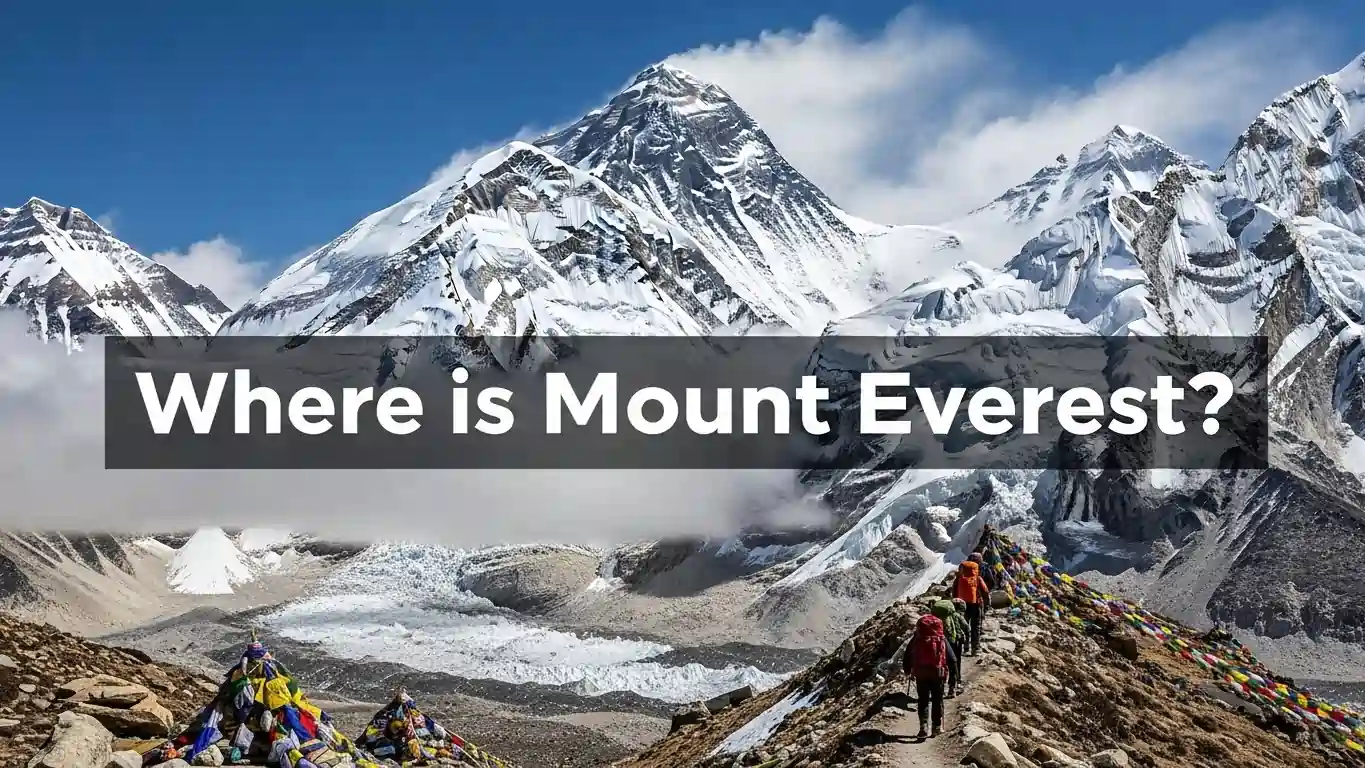
Most people know Everest as the highest mountain in the world, yet many cannot clearly say where it actually is. Some think it is only in Nepal, others believe it lies entirely in China, and many struggle to place it correctly on a world map. This confusion exists because Everest sits in a remote border region and is part of a massive mountain system that spans multiple countries.
In this blog, we clearly explain where is Mount Everest located, breaking down its exact geographic position, continental placement, and regional context. You will learn where Mount Everest is located in Asia, which countries share the mountain, how it appears on maps, and how its location connects to the Himalayas and surrounding regions. The goal is to give a precise, easy to understand answer to the question of where is Everest, supported by geographic and contextual details.
Where is Mount Everest Located?
Mount Everest is located on the border between Nepal and the Tibet Autonomous Region of China. Its summit lies at an elevation of 8,848.86 meters (29,031.7 feet) above sea level, making it the highest point on Earth. The mountain is part of the Himalayan range in Asia and attracts climbers and adventurers from around the world. Its unique location places it within both Nepal’s Sagarmatha Zone and Tibet’s Qomolangma region, highlighting its international significance. For those planning climbs, checking the top expeditions in Nepal is highly recommended.
Geographical Location of Mount Everest
Where exactly is Mount Everest in Asia?
Mount Everest is located in South Asia, specifically in the eastern section of the Himalayan range. It sits at approximately 27.9881° N latitude and 86.9250° E longitude, placing it between Nepal to the south and Tibet to the north. This region is part of the greater Himalayan belt formed by the collision of the Indian and Eurasian tectonic plates.
Where is Mount Everest found in Nepal and Tibet?
On the Nepal side, Mount Everest lies in Solukhumbu District of Koshi Province, within Sagarmatha National Park. In Nepal, it is known as Sagarmatha. On the Tibet side, Everest is called Chomolungma and is located in Tingri County of the Tibet Autonomous Region. Both sides serve as major access points through the South Base Camp in Nepal and the North Base Camp in Tibet.
Mount Everest in Relation to Surrounding Regions
How far is Mount Everest from major cities?
Mount Everest is approximately 160 km northeast of Kathmandu, the capital of Nepal. From Lhasa, the capital of Tibet, it is about 450 km southwest. There are no major cities nearby; the closest settlements are small mountain towns like Namche Bazaar, which serves as the main gateway for trekkers approaching from Nepal.
Where is Mount Everest situated relative to other Himalayan peaks?
Mount Everest is located among some of the world’s highest mountains, including Lhotse, Nuptse, and Makalu, all within the Mahalangur Himal subrange. It stands near the core of the Himalayas but is not the most centrally located peak. Compared to other Himalayan giants, Everest sits closer to the Nepal–Tibet border, while peaks like Kangchenjunga lie farther east and Annapurna farther west.
The Highest Mountain Peak in the World
Mount Everest is the tallest mountain on Earth, reaching an official height of 8,848.86 meters (29,031.7 feet) above sea level. Its extreme height and prominence make it a global symbol of mountaineering, scientific study, and adventure. The mountain continues to rise slowly due to the tectonic collision of the Indian and Eurasian plates, which formed the Himalayas millions of years ago.
Why is Mount Everest the Tallest?
Mount Everest is the tallest because its summit rises higher than all other peaks on Earth. This height is the result of millions of years of tectonic activity, where the Indian Plate pushes against the Eurasian Plate, lifting the Himalayan range. Compared to K2, Kangchenjunga, and Lhotse, Everest stands several hundred meters taller, giving it unmatched prominence.
How is Everest’s Height Measured?
Everest’s height has been determined using triangulation surveys, GPS technology, and satellite radar. Modern measurements combine ground observations with aerial and satellite data, also accounting for snow and ice thickness at the summit to determine the official elevation.
Comparing Everest to Other High Peaks
Everest exceeds K2 (8,611 m), Kangchenjunga (8,586 m), and Lhotse (8,516 m) in height. While Everest is the tallest, K2 is considered more technically difficult, and the surrounding peaks form part of the Mahalangur Himal subrange in the eastern Himalayas.
The Geological Story: How Everest Was Formed and Keeps Growing
Formation of the Himalayas
Mount Everest formed around 60 million years ago during the collision of the Indian Plate with the Eurasian Plate. This tectonic pressure lifted rocks to create the Himalayan range, and the mountain continues to grow at about 4 millimeters per year.
Why Everest’s Height is Globally Significant?
Everest’s height is globally significant because it represents the highest point on Earth, symbolizing human ambition and the limits of natural landscapes. Its extreme altitude provides valuable opportunities for scientific research in geology, climate, and high-altitude physiology. The mountain also inspires explorers and adventurers, making it a cultural and symbolic icon worldwide.
Symbolic Importance of Everest’s Height
Everest represents human ambition, endurance, and the pursuit of adventure, serving as the ultimate goal for climbers worldwide. Its towering presence has made it an icon of natural achievement.
Scientific and Exploratory Significance
Everest offers a natural laboratory for geology, climate research, and high-altitude physiology, helping scientists study glaciers, rock formations, and extreme environmental conditions.
Everest and the Spirit of Adventure
The mountain embodies the challenge of testing physical and mental limits, attracting thousands of climbers who aim to reach its summit each year.
The Journey to Measure Everest’s Height
Multiple expeditions and surveys over the centuries have attempted to measure Everest’s height, from 19th-century British triangulation to modern GPS and radar technology.
The Lasting Attraction of Everest’s Height
Everest continues to captivate due to its record-breaking height, majestic scenery, and symbolic value, making it a global icon of natural wonder and human aspiration.
Mount Everest: More Than Just a Mountain
Mount Everest is more than just the highest peak; it holds deep cultural, spiritual, and historical significance. For local communities, it symbolizes divine presence and sacred landscapes, while globally it inspires adventure, exploration, and human achievement. Beyond its physical height, Everest influences literature, films, and the mountaineering world, reflecting its lasting impact on culture and society.
Cultural and Spiritual Importance
Why is Mount Everest important in local culture and religion?
In Nepal, Mount Everest is called Sagarmatha, meaning “Forehead of the Sky,” and in Tibet, it is known as Chomolungma, meaning “Mother Goddess of the World.” Both names reflect its sacred status, and the mountain is revered in local Hindu and Buddhist traditions. Pilgrimages, rituals, and festivals often honor the peak, demonstrating the spiritual connection communities maintain with Everest.
Everest in Popular Culture and Media
Everest in Literature
Which books highlight Mount Everest adventures?
Everest has inspired numerous books detailing expeditions, survival, and mountaineering achievements. Notable works include “Into Thin Air” by Jon Krakauer, “The Climb” by Anatoli Boukreev, and historical accounts of early explorers like George Mallory. These books explore both the triumphs and tragedies of climbing Everest.
Everest in Films and Documentaries
Which movies and documentaries feature Mount Everest?
Films and documentaries such as “Everest” (2015), “Into Thin Air: Death on Everest”, and IMAX features like “Everest” (1998) showcase climbing challenges, natural beauty, and human endurance. They highlight real-life expeditions, dangerous conditions, and the personal stories of climbers.
Famous Climbers and Expeditions
Who are the most famous climbers of Mount Everest?
Renowned climbers include Sir Edmund Hillary, Tenzing Norgay, Reinhold Messner, Junko Tabei, and modern adventurers who have completed record-breaking ascents. Their expeditions have set milestones in mountaineering history and inspired generations of climbers worldwide.
Everest: A Symbol of Human Endurance
Mount Everest embodies human perseverance, ambition, and courage. Climbing it tests physical and mental limits, symbolizing the ultimate challenge for adventurers. Its enduring reputation motivates climbers, researchers, and travelers to confront extreme conditions and explore the heights of human potential.
Also Read: https://marveltreks.com/how-to-climb-mount-everest/
Interesting Facts About Mount Everest
Mount Everest is full of fascinating natural, historical, and climbing-related facts. Its towering height, extreme weather, and unique geology make it a remarkable subject for adventurers and scientists alike. The mountain hosts rare wildlife, dramatic glaciers, and an ecosystem that has adapted to extreme altitude conditions, reflecting the power and majesty of the Himalayas.
Mount Everest: The Highest Peak and Its Amazing Facts
Record-Breaking Achievements
What are some record-breaking feats on Mount Everest?
Mount Everest holds numerous records, including the first successful ascent by Sir Edmund Hillary and Tenzing Norgay in 1953. Modern achievements include youngest climbers, fastest ascents, winter summits, and even double summits without supplemental oxygen, showcasing human endurance and ambition.
Natural Wonders of Mount Everest
Glaciers
Which major glaciers are around Mount Everest?
The Everest region contains prominent glaciers such as the Khumbu Glacier on the south side and the Rongbuk Glacier on the north. These glaciers are critical for local water sources and serve as major routes for climbers ascending the peak.
Unique Plants and Animals
What wildlife and flora exist near Mount Everest?
Despite harsh conditions, Everest supports species like the snow leopard, Himalayan tahr, red panda, and yak. Alpine plants, mosses, and lichens survive at high altitudes, contributing to a fragile but unique ecosystem.
How Everest Was Formed?
How did geological processes create Mount Everest?
Mount Everest formed about 60 million years ago due to the collision of the Indian and Eurasian tectonic plates, which uplifted sedimentary rock layers. Ongoing tectonic movement continues to raise the mountain slightly each year.
Extreme Weather
What weather challenges do climbers face on Mount Everest?
Climbers contend with sub-zero temperatures, high winds, and sudden storms, especially in the Death Zone above 8,000 meters. Avalanches, blizzards, and rapid weather shifts make climbing hazardous and demand careful planning.
Everest’s Natural Wonders: A Tribute to Earth’s Power
Everest exemplifies nature’s extreme power and beauty, from towering peaks to shifting glaciers. Its combination of geological, climatic, and ecological features makes it a global symbol of the Earth’s majesty and a destination that continues to inspire explorers and scientists.
Conclusion: Mount Everest
Mount Everest is located on the border of Nepal and Tibet (China), forming part of the Himalayan range. Its towering height, extreme conditions, and unique geological formation make it a globally significant landmark and a benchmark for mountaineering and scientific study.The mountain’s significance extends beyond height; it symbolizes human ambition, endurance, and the spirit of exploration. Climbers, researchers, and adventurers are drawn to its challenges, pushing the limits of physical and mental resilience.
Respecting Everest is essential because of its unforgiving environment, unpredictable weather, and high-altitude risks. Proper preparation, caution, and awareness of local culture and ecology ensure both safety and the preservation of this iconic natural wonder.
Related Article: https://marveltreks.com/where-is-k2-mountain/
Where is Mount Everest located?
Mount Everest is located on the border between Nepal and China (Tibet). It is part of the Himalayan mountain range.
Where is Mount Everest in Asia?
Mount Everest sits in the Himalayas, which stretches across Nepal, China, Bhutan, and India, making it Asia’s tallest peak.
Where is Mount Everest found?
Everest is found in the Mahalangur Himal sub-range of the Himalayas, straddling Nepal’s Solukhumbu District and Tibet’s Qomolangma region.
Where is Mount Everest situated?
Mount Everest is situated at 27.9881° N latitude and 86.9250° E longitude, marking the highest point on Earth.
Where is Mount Everest on a map?
On maps, Everest appears on the Nepal-China border in the eastern Himalayas of Asia. The south side lies in Nepal, and the north side is in Tibet.
Where is Mount Everest Base Camp located?
The South Base Camp is in Nepal at 5,364 meters, while the North Base Camp is in Tibet at 5,150 meters. Both camps are starting points for climbers.
Where is the Mount Everest death zone?
The death zone is above 8,000 meters on Everest, where oxygen levels are critically low, and weather conditions are extreme.
Where exactly is Mount Everest?
Everest is precisely located at 27.9881° N latitude, 86.9250° E longitude, between Nepal and Tibet in the Himalayas.
Where is Mount Everest in Nepal?
Mount Everest lies in Nepal’s Sagarmatha National Park, in the Solukhumbu District of the eastern Himalayas.
Where is Mount Everest in the world?
Globally, Mount Everest is in Asia, on the Nepal-China border, and it represents the highest point on Earth at 8,848.86 meters.

Ready for your next Himalayan adventure?
Plan Your Next Big Adventure with Us
Explore Our AdventuresJoin our expert-guided journeys across Nepal and beyond, from classic trails to epic summits.